
Birch web-spinning sawfly
Pamphilius betulae
Description
How to identify
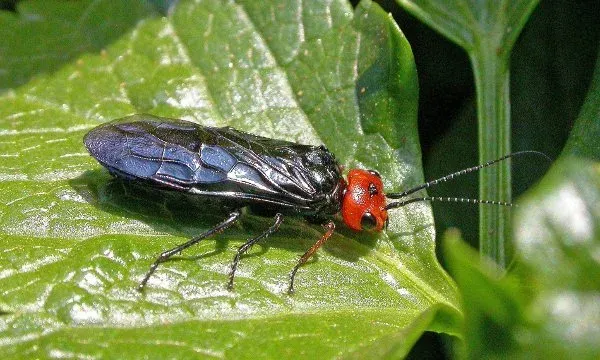
The birch web-spinning sawfly (Pamphilius betulae) belongs to the Pamphiliidae family within the order Hymenoptera. The adult insect reaches a length of up to 15 mm and has a black body with distinctive yellow markings on the head and abdomen.
The larvae are cylindrical, greenish-grey in color, and have a dark head. Unlike many other sawfly larvae, they lack thoracic legs for climbing and rely on their specialized ability to spin silk to create protective leaf shelters.
Adult females possess a strong ovipositor, which they use to slit the surface of the birch leaf to deposit eggs. The insect's life cycle is strictly tied to its host plant, where both development and shelter construction occur.
Adults emerge from the soil during late spring and early summer. They are typically found in sunny forest edges, parks, and tree nurseries where birch populations are stable and provide sufficient resources for their development.
Reproduction is sexual, and after mating, females lay eggs either singly or in small clusters on the underside of young, expanding leaves, ensuring that the larvae have immediate access to food upon hatching.
What it damages
The primary host for this pest is the European white birch (Betula pendula). In years of outbreak, the insect can cause significant damage to the foliage, impacting the overall aesthetics and health of the trees.
While birch is the preferred host, larvae may occasionally feed on related tree species in mixed woodlands. The damage is most acute in young tree plantations, where the loss of leaf area can severely stunt growth.
Economic damage is primarily seen in forestry and nursery settings. Persistent defoliation reduces the tree's photosynthetic efficiency, making it more susceptible to secondary environmental stressors and opportunistic pathogens.
In landscaping, the damage is mostly aesthetic. The presence of numerous rolled leaves and webs creates an untidy appearance, often necessitating intervention to maintain the value of the landscape and the health of the trees.
Infested trees may experience weakened vigor over time, especially if repeated defoliation occurs over several consecutive seasons, which can significantly reduce the tree's resistance to cold and drought.
When it appears
The development cycle of the birch web-spinning sawfly is closely synchronized with the phenological stage of birch trees. Adult flight usually commences in late May or early June, corresponding with the tree's leaf flush.
The larval feeding stage occurs primarily during the months of June and July. This is the period when damage becomes clearly visible as the larvae actively roll leaves into their characteristic protective tubes.
Once the larvae reach maturity, they descend to the soil to pupate. They remain in the soil as prepupae for the remainder of the summer, autumn, and winter, entering a state of diapause until the following spring.
This species is univoltine, meaning it produces only one generation per year. This predictable seasonal activity makes it easier for arborists and foresters to time their pest management interventions effectively.
Monitoring for adult flight and early larval activity in late spring is crucial. Targeted treatments during this window can prevent the escalation of an infestation into a larger, more damaging outbreak.
Signs of infestation
The most prominent sign of infestation is the presence of leaves rolled into tubes or packages, secured with silk threads. These structures serve as both the home and the primary food source for the growing larva.
When inspecting the birch canopy, look for clusters of leaves that appear distorted or withered. These "web-nests" are highly visible during mid-summer and are often found on the outer branches of the tree.
The feeding patterns of the larvae involve consuming the leaf blade from within the rolled structure. As the leaf tissue is eaten, the roll turns brown or yellow and may eventually detach from the branch.
The presence of fine, granular excrement (frass) accumulating on lower leaves or web structures is another reliable indicator of active larval feeding within the canopy of the birch tree.
If a suspected roll is carefully opened, the greenish-grey larva will be visible inside. Disturbance of the leaf roll usually triggers an immediate movement response from the larva, which may drop to the ground.
Control measures
Mechanical control is highly effective for small infestations. This involves manually removing and disposing of the rolled leaves before the larvae emerge, which helps to break the life cycle of the pest.
For larger infestations or high-value trees, systemic or contact insecticides are recommended. Applications should be timed to coincide with the period of larval hatching to ensure maximum mortality before leaf protection increases.
Utilizing products labeled for use against leaf-eating insects is essential. Always ensure thorough coverage of the foliage to effectively reach the larvae hidden within their silk-bound shelters.
Encouraging natural predators such as birds and parasitic wasps can help maintain the population of the sawfly at low levels. Integrated pest management (IPM) practices should prioritize these natural control agents.
Maintaining tree health through proper irrigation and soil management improves the tree's ability to recover from defoliation. A vigorous tree can better withstand the stress caused by sawfly feeding compared to a malnourished one.
Taxonomy
- Latin name
- Pamphilius betulae
- Order
- Hymenoptera
- Family
- Pamphiliidae
- EPPO code
- PAMPBE
Discussion
No discussions yet — be the first.