
Orthezia urticae
Orthezia urticae
Description
How to identify
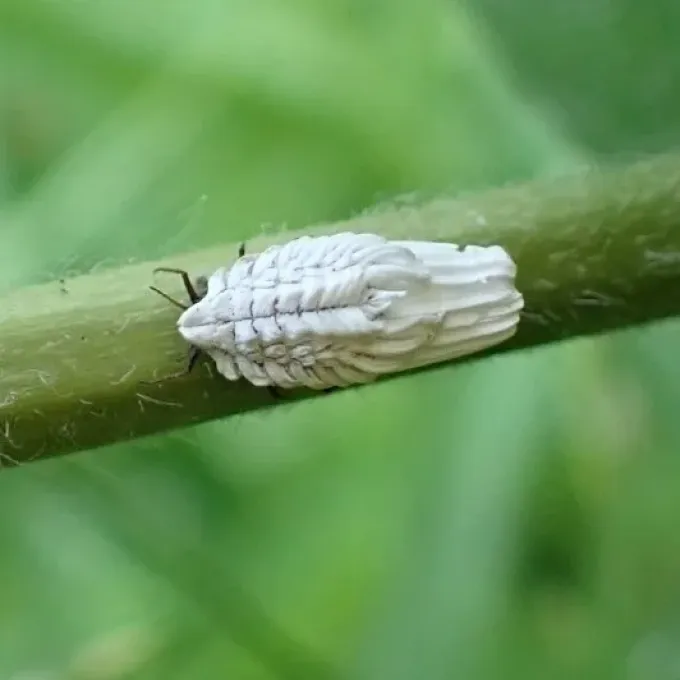
Orthezia urticae, commonly known as the nettle mealybug, belongs to the Ortheziidae family. This small insect is easily recognizable by the distinct white, wax-like egg sac attached to the rear of the adult female.
The adult female has a dark brown or black body covered in white waxy plates that form a noticeable fringe. Measuring about 2–3 mm, they are small but visible to the naked eye during a thorough inspection of the plant.
Males are extremely rare and rarely participate in the lifecycle, as the population consists primarily of females that reproduce parthenogenetically. This allows the colony to grow rapidly in favorable conditions.
The first-instar larvae, often called crawlers, are highly active. They move across stems and leaves, searching for suitable locations to settle and begin feeding on plant sap.
Because of their waxy appearance, they are sometimes mistaken for fungal infections like powdery mildew. However, close observation with a hand lens will reveal the insect form underneath the waxy secretions.
What it damages
This pest is a polyphagous insect, meaning it feeds on a wide range of plants, including nettles, mint, and various ornamental species. It causes damage by piercing the plant tissue and sucking out the vital cellular sap.
Insects typically congregate on the undersides of leaves and along the veins, where they can easily access the nutrient-rich sap. This activity leads to significant exhaustion of the host plant.
Besides direct physical damage, the insects excrete honeydew—a sugary substance that coats the leaves. This honeydew serves as a substrate for sooty mold, which manifests as a dark, dusty layer on the foliage.
The sooty mold blocks sunlight, severely hindering the plant's ability to perform photosynthesis. This results in yellowing leaves, stunted growth, and in severe cases, the premature death of the plant.
Heavy infestations can lead to massive leaf drop and loss of plant vigor, which is particularly destructive in nursery settings or private gardens where aesthetics are crucial.
When it appears
The activity of Orthezia urticae begins in early spring as temperatures rise. The insect completes multiple generations throughout the growing season, contributing to their rapid spread.
Population peaks usually occur in mid-summer when warm weather provides optimal conditions for larval development and colony expansion across the plant.
As autumn approaches, activity decreases, although adult females continue to feed until the onset of hard frost. The species survives the winter as fertilized females or in the egg stage in sheltered areas.
The waxy egg sac provides excellent protection for the offspring against environmental stressors, ensuring high survival rates even in fluctuating weather conditions.
In greenhouses, where temperatures remain relatively stable, the pest can continue its lifecycle year-round, posing a constant threat to seedlings and indoor crops.
Signs of infestation
The most prominent sign of an infestation is the presence of white, cotton-like masses on stems and leaves. These are the waxy protective sacs produced by the females.
Plants often display signs of general weakness: drooping leaves, stunted growth, and yellow spots at the sites where the insects have pierced the epidermis with their stylets.
A sticky, shiny residue on the leaves indicates the presence of honeydew. Finding this is a primary indicator that a mealybug colony is present and actively feeding.
The development of a black, powdery sooty mold is a secondary symptom, indicating that the infestation has persisted long enough for the mold to establish itself on the honeydew deposits.
The presence of ants around the plant is another indicator; ants frequently "farm" these mealybugs to collect the honeydew, and they often protect the colony from natural predators.
Control measures
Controlling Orthezia urticae requires overcoming the protection provided by its waxy coating. Systemic insecticides are generally the most effective as they are absorbed into the plant's vascular system.
Mechanical removal is a practical first step for light infestations. Using a soft brush or cotton swab dipped in soapy water or alcohol can effectively remove colonies from stems and leaf undersides.
For more severe cases, systemic insecticides containing neonicotinoids are recommended. These chemicals make the plant tissues toxic to the sap-sucking insects, ensuring deep-seated colonies are eliminated.
Cultural management involves removing weeds, especially nettles, which often serve as primary reservoirs and breeding grounds for the pest before it moves to garden crops.
- Regularly monitor the undersides of leaves and stems for early detection.
- Introduce biological controls like ladybirds or lacewings when possible.
- Prune and destroy heavily infested plant parts to reduce the total population.
- Maintain good plant spacing to improve airflow and reduce humidity around foliage.
Taxonomy
- Latin name
- Orthezia urticae
- Order
- Hemiptera (bugs, aphids, leafhoppers)
- Family
- Ortheziidae
- EPPO code
- ORTHUR
Discussion
No discussions yet — be the first.