
Orthezia
Orthezia
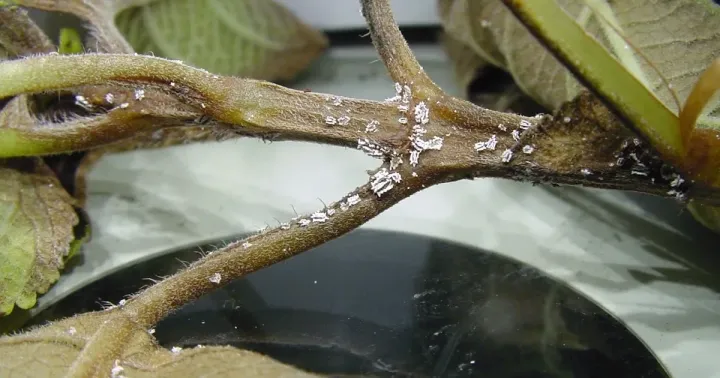
Description
How to identify
Orthezia is a genus of insects belonging to the family Ortheziidae. These small, sap-sucking insects are related to mealybugs and scale insects but are distinguished by their unique morphology and waxy structures.
Adult females are typically covered in a dense, white, waxy secretion that forms plates or a protective shield. A defining feature is the long, tubular egg sac attached to the female’s posterior, which can often be longer than the insect itself.
The insects generally measure between 2 and 5 millimeters in length. While the body beneath the wax is dark brown or black, the white waxy covering makes them appear as bright white, fuzzy spots on the plant foliage.
Male Orthezia are extremely rare, winged, and lack functional mouthparts, as they do not feed and exist solely to fertilize the females.
Unlike many other scale insects that become sedentary after early stages, Orthezia remains mobile throughout most of its life cycle, allowing them to relocate to more nutritious parts of the host plant as needed.
What it damages
Orthezia are polyphagous, meaning they attack a wide range of host plants. They are frequently found in greenhouses and nurseries, affecting ornamentals, citrus trees, ficus species, and various greenhouse crops.
Both larvae and adult females cause damage by inserting their stylets into plant tissues to feed on phloem sap. They typically congregate on the undersides of leaves, along the main veins, and in leaf axils.
During feeding, they excrete honeydew, a sugary waste product that coats the leaves. This honeydew serves as a substrate for sooty mold growth, which creates a black, unsightly film that blocks photosynthesis.
Severe infestations lead to chlorosis, leaf curling, and premature leaf drop. The plant loses its vigor, stops growing, and may eventually die if the infestation is not managed properly.
Furthermore, weakened plants become increasingly susceptible to secondary pests and various fungal or bacterial diseases, compounding the overall damage to the host.
When it appears
In greenhouses, conservatories, and indoor settings, Orthezia can reproduce year-round, as constant temperatures and lack of natural predators facilitate continuous breeding cycles.
The life cycle encompasses an egg stage, three larval stages (nymphs), and the adult stage. The female’s waxy egg sac provides an excellent environment for egg development, protecting them from environmental fluctuations.
Reproduction is most active in warm conditions, typically when temperatures remain above 20-22 degrees Celsius, which is common in indoor environments during the heating season.
The first-instar larvae, often called "crawlers," are highly mobile and can migrate between plants if they are kept in close proximity, leading to rapid spread within a plant collection.
Multiple generations can occur per year, which makes regular inspection of plant foliage essential for early detection and prevention of large-scale population growth.
Signs of infestation
The first visible sign of an Orthezia infestation is the appearance of white, cotton-like masses on leaves and stems that are difficult to dislodge without smearing them.
The development of sticky honeydew on the foliage, followed by the appearance of dark, sooty mold patches, is a clear indicator of a significant infestation of sap-sucking insects.
Plants may show signs of stunted growth, leaf yellowing, and a loss of natural luster, indicating that the plant is struggling due to the extraction of essential fluids.
Small white wax flakes or debris falling onto the soil surface or the plant tray is another telltale sign that these pests are present in the canopy.
Using a magnifying glass, one can observe the movement of these white insects, particularly in protected areas like the base of stems or the crevices where leaves attach to the main branch.
Control measures
The initial control measure is to quarantine the affected plant immediately. Separation is critical to preventing crawlers from spreading to healthy, non-infested plants nearby.
Mechanical removal: Use a cotton swab soaked in rubbing alcohol or a mild soap solution to wipe away visible insects. This helps reduce the population size significantly before chemical treatments.
Systemic insecticides are the most effective chemical intervention. By applying a systemic product, the toxin moves through the plant’s sap, ensuring that the pest is controlled even if they are in hard-to-reach areas.
Follow-up treatments are mandatory because the protective waxy layer of the adult Orthezia and the protected egg sacs often shield them from immediate contact with insecticides.
Cultural practices include ensuring good air circulation and maintaining proper plant hygiene. Avoid extreme dryness, as stressed plants are often more attractive to colonizing pests.
Taxonomy
- Latin name
- Orthezia
- Order
- Hemiptera (bugs, aphids, leafhoppers)
- Family
- Ortheziidae
- EPPO code
- ORTHSP
Discussion
No discussions yet — be the first.