
Twilight whirligig beetle
Orectochilus villosus
Description
How to identify
The Twilight whirligig beetle (Orectochilus villosus) belongs to the Gyrinidae family. Adults are oval-shaped, measuring about 6–7 mm in length, and are adapted for life on the water's surface.
The key identification feature is the dense, velvety hair (pubescence) along the margins of the elytra. This gives the beetle a matte appearance compared to the glossy look of other whirligig species.
Like all whirligigs, they possess divided compound eyes, with one pair optimized for air vision and the other for underwater navigation, allowing them to survey the entire environment simultaneously.
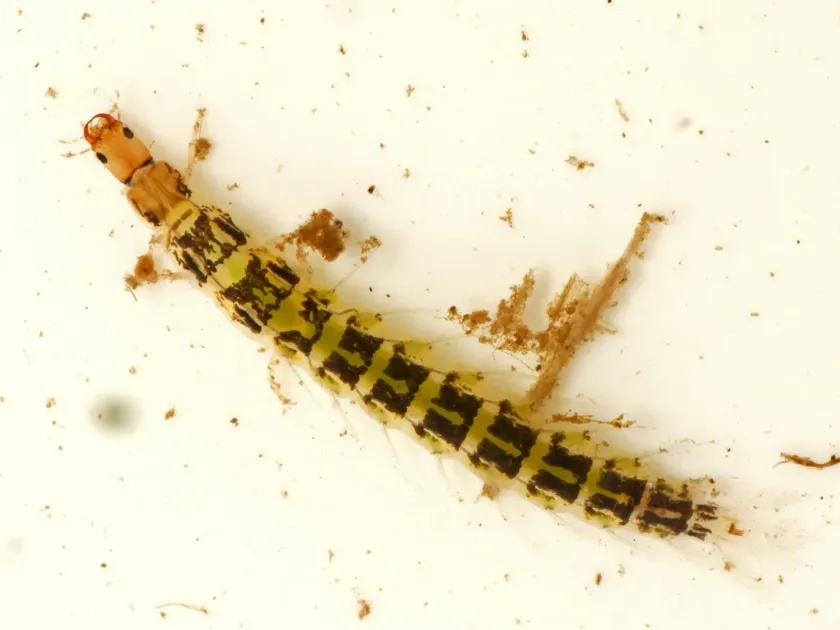
Larvae are elongated and resemble centipedes, living entirely submerged. They feature filamentous gills along the abdomen, which they use to breathe while hiding among underwater debris and vegetation.
These beetles are primarily nocturnal or crepuscular. During the day, they often gather in clusters on emergent rocks or plant roots along the shoreline to rest and conserve energy.
What it damages
While not a primary pest of terrestrial crops, Orectochilus villosus can impact aquaculture and water management systems. Larvae are voracious predators and can negatively affect controlled aquatic environments.
In fish hatcheries, large populations of whirligig larvae may prey on fish eggs or newly hatched fry. This predation can lead to economic losses and reduced survival rates for young fish stocks.
The presence of these beetles in irrigation reservoirs can lead to the contamination of water with waste products, potentially altering the water chemistry and promoting the growth of harmful bacteria.
In hydroponic systems, the larvae can clog filtration pipes and circulation components. This mechanical interference requires regular cleaning and maintenance of the irrigation infrastructure.
By consuming beneficial zooplankton, these beetles disrupt the natural food chain within artificial ponds. This reduces the water's self-purifying capacity and negatively impacts the overall aquatic health.
Signs of infestation
The most noticeable sign of a whirligig infestation is the rapid, circular swimming pattern on the surface of still water. These movements create ripples that are highly characteristic of the Gyrinidae family.
Under low-light conditions, shine a flashlight on the water's surface. The eyes of the beetles act as reflectors, creating a distinct shimmer that reveals their presence even in high density.
Larvae can be detected by sampling the bottom substrate and thick mats of algae. Their unique appearance with lateral gills makes them distinguishable from other aquatic insect larvae.
A sudden decline in the density of small daphnia or other aquatic crustaceans is a biological indicator. If the prey population drops significantly without other causes, it may be due to whirligig predation.
Accumulated cast-off skins (exuviae) near the shoreline indicate active molting and a stable, growing population within the water body.
Control measures
Effective management focuses on habitat modification. Since Orectochilus villosus prefers stagnant water, modifying the environment is the most sustainable approach to control.
Regularly clear submerged and emergent vegetation from the water's edge. This removes the essential habitat and breeding grounds required for the larvae to develop successfully.
Introduce aeration or flow-generating pumps into the water system. Whirligig beetles avoid turbulent water, and constant movement makes the environment unsuitable for their surface-dwelling lifestyle.
- Remove organic debris from the shoreline to eliminate hiding spots.
- Install fine mesh screens on water intakes to prevent insect migration.
- Encourage natural predation by maintaining healthy populations of insectivorous fish.
Avoid chemical pesticides as they are often toxic to non-target aquatic organisms. Integrated biological management remains the gold standard for controlling these beetles in sensitive aquatic environments.
Taxonomy
- Latin name
- Orectochilus villosus
- Order
- Coleoptera (beetles)
- Family
- Gyrinidae
- EPPO code
- ORECVI
Discussion
No discussions yet — be the first.