
Whirligig beetle
Gyrinus
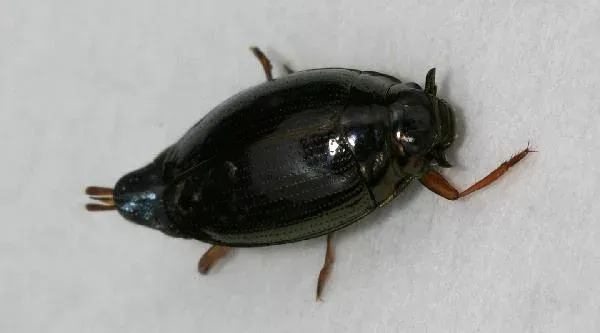
Description
How to identify
Whirligig beetles (family Gyrinidae) are aquatic insects characterized by their distinctive circular swimming patterns on the water surface. Adults typically have an oval, streamlined body with a metallic sheen, ranging from 3 to 7 mm in length.
A unique physiological feature is their eyes, which are split into two parts: the upper portion is adapted for vision above the water, while the lower portion tracks prey underwater.
Their middle and hind legs are shortened and flattened into paddle-like structures, which allow for rapid, erratic navigation on the water's surface.
Larvae are aquatic and possess slender bodies with filamentous gills along the abdomen, acting as voracious predators.
Taxonomically, they belong to the order Coleoptera and the family Gyrinidae.
What it damages
In terms of agronomy, whirligig beetles are not considered plant pests and do not damage crops or agricultural produce.
Their diet consists primarily of small terrestrial insects that fall onto the water surface or other small aquatic invertebrates.
Because their mouthparts are adapted for predatory behavior, they pose no threat to the tissues of rice or other shore-based agricultural crops.
Any perceived impact is generally restricted to fish farms, where they may compete for food with fry in limited volumes of water.
For most agricultural systems, they are viewed as beneficial organisms, helping to control mosquito larvae populations.
When it appears
Whirligig beetles are active during the warmer months, beginning in early spring as water temperatures rise.
Peak population numbers are typically observed in mid-summer, coinciding with the peak period of larval development in stagnant waters.
Adults overwinter in the mud at the bottom of ponds or by seeking shelter within submerged vegetation.
As spring approaches and water temperatures increase, adults emerge to resume feeding and mating cycles.
With the onset of autumn and cooling water temperatures, metabolic processes slow down, leading the insects to seek overwintering sites.
Signs of infestation
The primary sign of their presence is the rapid, erratic "whirling" motion of a group of beetles on the water's surface.
When disturbed, they instantly dive underwater, carrying a small air bubble that allows them to remain submerged.
A high density of these beetles in irrigation ditches or farm ponds indicates a healthy, active aquatic ecosystem.
Fine, circular ripples on the water surface are often the only visible indicator of their high-speed aquatic maneuvers.
During the breeding season, one may find small rows of eggs attached to the stems of submerged aquatic plants.
Control measures
No specific plant protection measures are required as whirligig beetles do not threaten crop health.
In aquaculture environments where population density needs reduction, mechanical removal of excessive vegetation is the recommended approach.
Chemical control is strongly discouraged as insecticides can have detrimental effects on non-target aquatic species and water quality.
Maintaining balanced nutrient levels in water bodies helps keep their populations within natural, non-disruptive limits.
These beetles are a vital part of the food web and contribute to the natural biological regulation of smaller aquatic organisms.
Taxonomy
- Latin name
- Gyrinus
- Order
- Coleoptera (beetles)
- Family
- Gyrinidae
- EPPO code
- GYRISP
Discussion
No discussions yet — be the first.