
Gyrinus natator
Gyrinus natator
Description
How to identify
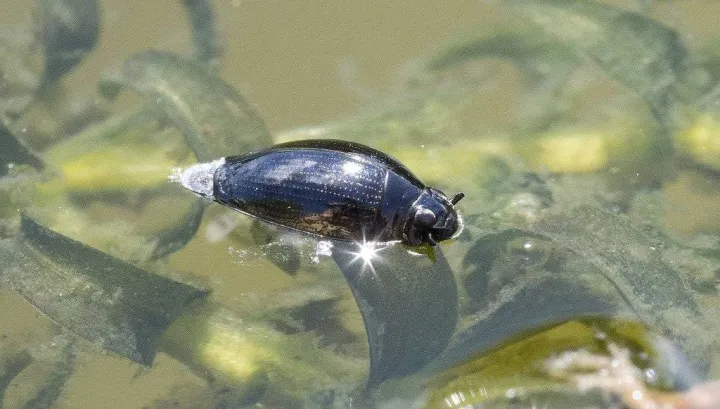
Gyrinus natator belongs to the order Coleoptera and the family Gyrinidae. This beetle has a characteristic oval, streamlined body about 5–7 mm long, colored in a shiny black with a metallic sheen.
A distinctive feature of the species is the eyes, which are divided into two pairs: the upper ones are designed for viewing above the water surface, and the lower ones for observing the underwater environment. The middle and hind legs are shortened, flattened, and adapted as effective swimming paddles.
Beetles often gather in groups and perform rapid, chaotic circular movements on the water surface, which gives them their common name. When threatened, they can instantly dive, taking an air bubble with them.
Larvae have an elongated body equipped with lateral gills, allowing them to lead an exclusively aquatic lifestyle. They are active predators equipped with sickle-shaped mandibles.
Adults also possess developed wings and are capable of flying from one body of water to another, which facilitates the rapid colonization of new habitats.
What it damages
It is important to understand that Gyrinus natator is a predatory insect rather than a classic phytophage. It does not cause direct damage to agricultural crops such as cereals or vegetables, as it does not feed on plant tissues.
The main damage caused by these beetles is recorded in aquaculture and fish farming. The larvae are aggressive predators and can prey on fish fry, eggs, and small invertebrates that form the food base for commercial fish species.
During mass outbreaks in fish breeding ponds, whirligig beetles become a serious biological nuisance. They compete for food resources with young fish, which reduces the overall productivity of the water body.
In ornamental gardening, these beetles may be undesirable in artificial ponds, as their presence disrupts the biological balance by consuming beneficial species such as daphnia and other feed organisms.
Although the beetles do not damage leaves, their presence in hydroponic systems or open water storage tanks can indirectly indicate water quality issues, contributing to the accumulation of organic waste and biological contamination.
When it appears
The active period for Gyrinus natator begins in early spring, immediately after the ice melts from water bodies, when the water temperature rises to comfortable levels.
The peak activity of adult beetles occurs in late spring and summer, when mating and egg-laying on underwater plant parts take place.
In autumn, with the onset of cold weather, the whirligig population gradually reduces its activity, preparing for the winter period. Adult beetles hide in bottom sediments or among coastal vegetation.
Insects hibernate mainly in the imago stage, burying themselves in the silt at the bottom of the pond, where the water temperature remains stable and above freezing point.
The life cycle includes complete metamorphosis: after hatching, the larvae actively hunt, pupate on land or on plant stems, after which a new generation of adult beetles emerges.
Control measures
Since Gyrinus natator is not a pest of agricultural crops, large-scale chemical treatment of fields is not required and is strongly discouraged.
In fish farming, management consists of regular cleaning of water bodies from excess aquatic vegetation, which serves as a substrate for egg-laying.
The use of biological control methods, such as stocking ponds with fish species that prey on larvae and adult beetles, is the most effective and environmentally friendly approach.
Maintaining water cleanliness and preventing the stagnation of organic waste reduces the attractiveness of the pond for this species.
Using mechanical nets or filtration systems in small ponds can limit the entry of adult beetles, but chemical pesticides should not be used due to the high risk of harming beneficial aquatic life.
Taxonomy
- Latin name
- Gyrinus natator
- Order
- Coleoptera (beetles)
- Family
- Gyrinidae
- EPPO code
- GYRINA
Discussion
No discussions yet — be the first.