
Gyrinus marinus
Gyrinus marinus
Description
How to identify
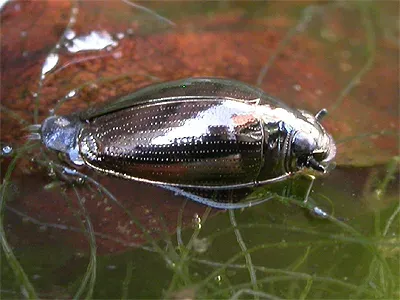
Gyrinus marinus, commonly known as the common whirligig, belongs to the family Gyrinidae. These small aquatic beetles are easily recognized by their shiny, oval-shaped black bodies, typically measuring 5-7 mm in length.
The most distinctive feature of these beetles is their specialized eyes, which are split horizontally. This allows the insect to see both above and below the water surface simultaneously while swimming.
They are famous for their erratic, circular swimming patterns on the surface of still water. Their mid and hind legs are shortened and flattened into paddle-like structures, enabling rapid movement.
The larvae of the whirligig beetle are aquatic predators. They have a slender, elongated body and are equipped with lateral gills, which are essential for their respiration throughout their aquatic life stages.
Adult beetles are capable of flight, which allows them to colonize new aquatic habitats, including agricultural irrigation ponds and slow-moving water channels, during the warmer seasons.
What it damages
Gyrinus marinus is not typically classified as a primary agricultural pest. However, in specific settings like aquaponics or nursery ponds, they can be considered a nuisance.
As predators, their diet consists primarily of small invertebrates. However, in closed or artificial aquatic systems, their presence can disrupt local ecosystems, potentially impacting the health of water-based crops.
High population densities in water reservoirs can lead to the deterioration of water quality due to excrement and competition for resources with other beneficial aquatic organisms.
While they do not directly consume plant tissues, their burrowing or hunting behavior in dense root mats of hydroponic crops might cause minor physical damage to delicate root systems.
In aquaculture environments, mass occurrences can interfere with the breeding success of fish, making management necessary to maintain balance in the aquatic environment.
When it appears
The activity cycle of Gyrinus marinus begins in early spring as water temperatures rise. Adults emerge from their hibernation sites to begin feeding and reproduction.
The peak activity period occurs during the summer months. During this time, larval development is at its fastest, leading to the highest number of insects observed on the water surface.
Their life cycle includes complete metamorphosis. Eggs are laid on underwater plants, followed by a larval phase, and finally pupation, which typically occurs on moist soil near the water's edge.
As autumn approaches and temperatures drop, adults seek refuge at the bottom of ponds, burying themselves in sediment or silt to overwinter until the next spring season.
Field monitoring should be prioritized between late spring and mid-summer to identify potential overpopulation in irrigation infrastructure.
Control measures
Direct chemical control for Gyrinus marinus is rarely recommended or necessary in most agricultural contexts due to their minimal impact on field crops.
Cultural management, such as the removal of excessive floating or submerged vegetation, is the most effective way to reduce available egg-laying sites and lower population numbers.
Maintaining good water flow and aeration in storage ponds makes the environment less attractive to whirligig beetles, as they prefer still water for their activities.
In managed aquaculture systems, biological control via the introduction of predator fish species is the preferred method to keep the beetle population within manageable limits.
If intervention is required, ensure any chosen method complies with environmental regulations, particularly when the water is intended for further use in crop irrigation or sensitive aquatic farming.
Taxonomy
- Latin name
- Gyrinus marinus
- Order
- Coleoptera (beetles)
- Family
- Gyrinidae
- EPPO code
- GYRIMA
Discussion
No discussions yet — be the first.