
Common whirligig beetle
Gyrinus substriatus
Description
How to identify
The common whirligig beetle (Gyrinus substriatus) is a member of the Gyrinidae family within the order Coleoptera. These insects are best known for their distinctive swimming patterns on the surface of freshwater bodies, moving in tight, rapid circles.
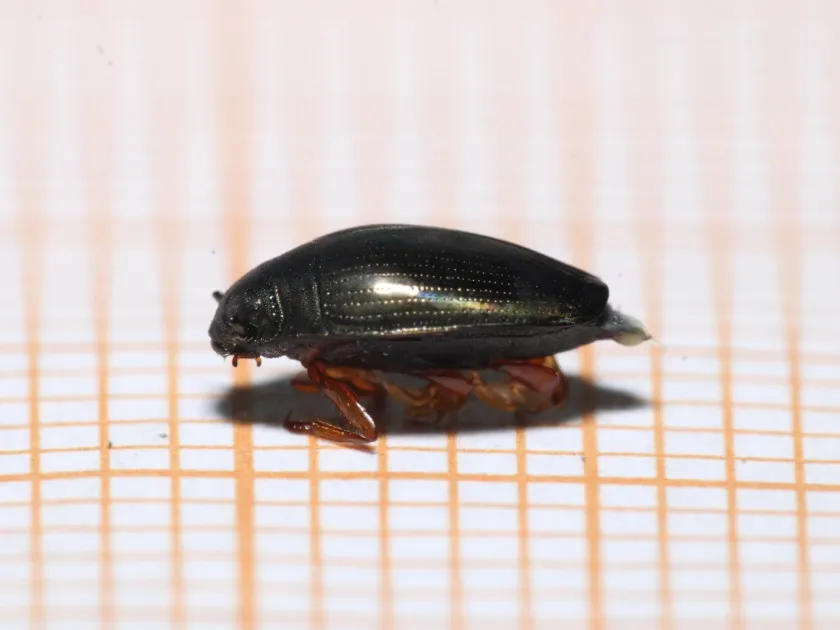
Adult beetles possess a streamlined, oval body that is typically 5–7 mm in length. They are characterized by their dark, metallic-colored chitinous exoskeleton and eyes split into two segments, allowing them to survey both air and water simultaneously.
The larvae are entirely aquatic and possess segmented bodies with feathery gills along their sides. They are predatory and live in the substrate of ponds, lakes, and slow-moving streams, feeding on other small aquatic invertebrates.
The life cycle involves egg-laying on submerged vegetation in the summer months. After hatching, the larvae develop through several instars before pupating on land or near the water's edge.
These beetles are well-adapted to the water surface, using their middle and hind legs, which are flattened into oar-like structures, to propel themselves at high speeds.
What it damages
The common whirligig beetle is not recognized as a plant pest in agricultural settings. As a predatory species, it feeds exclusively on small insects and microorganisms rather than agricultural crops or garden plants.
There is no evidence of these beetles causing direct damage to crops, fruit trees, or vegetable patches. Their impact on the ecosystem is generally neutral or even beneficial, as they act as predators of small aquatic nuisance insects.
In aquaculture environments, high densities of these beetles might theoretically cause minor disturbance to fish fry or eggs, but this is rarely documented as an economic concern in large-scale agriculture.
The presence of Gyrinus substriatus is often an indicator of water quality, as they avoid highly polluted aquatic environments. Their appearance should not be mistaken for an infestation that requires intervention.
Therefore, farmers do not need to implement any strategies for damage control regarding this species, as it does not pose a threat to plant health or yields.
Control measures
As Gyrinus substriatus is not an agricultural pest, no control measures or chemical treatments are recommended. Using insecticides near water bodies to eliminate these beetles can cause severe damage to the aquatic ecosystem and negatively affect non-target species.
If population control is needed for private ornamental ponds, the best approach is mechanical removal using a fine-mesh net or by maintaining high water flow to make the environment less suitable for breeding.
Promoting a balanced ecosystem by encouraging the presence of native fish species can naturally keep the population of whirligig beetles in check without the need for human intervention.
Avoiding the accumulation of decaying organic matter and excessive shoreline vegetation can reduce the attractiveness of a water body to these beetles, preventing mass colonization.
Integrated Pest Management principles suggest focusing exclusively on actual threats to crops. Consequently, the common whirligig beetle is excluded from management protocols in plant protection.
Taxonomy
- Latin name
- Gyrinus substriatus
- Order
- Coleoptera (beetles)
- Family
- Gyrinidae
- EPPO code
- GYRISU
Discussion
No discussions yet — be the first.