
Whirligig beetle
Gyrinus urinator
Description
How to identify
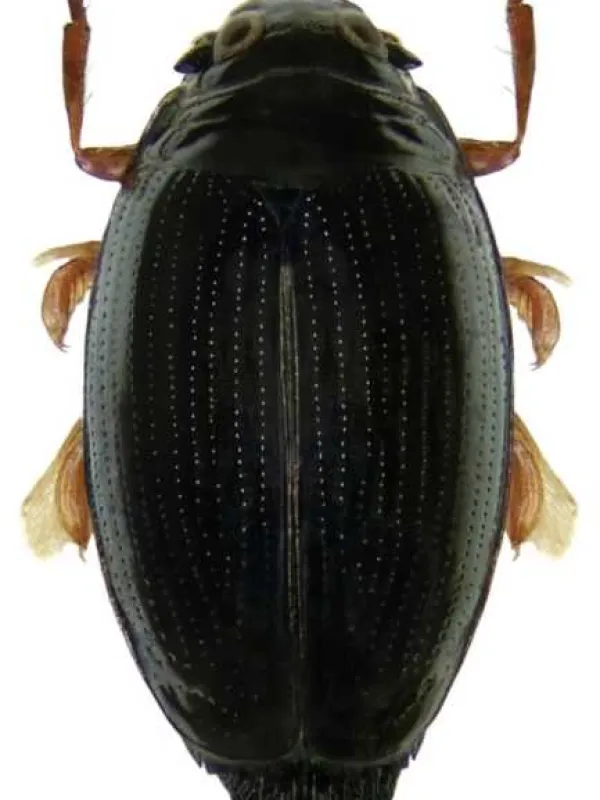
The whirligig beetle (Gyrinus urinator) is a member of the Gyrinidae family within the order Coleoptera. These insects are easily recognized by their streamlined, oval bodies, which are typically 5–7 mm long.
Their most remarkable feature is the compound eyes, which are split into two pairs: one for viewing above the water and one for viewing below, providing a constant 360-degree awareness.
The front legs are elongated for grasping prey, while the middle and hind legs are flattened into efficient oars, allowing for their characteristic rapid, erratic spinning movements.
Adults often congregate in large schools on the surface of calm water bodies, displaying synchronized circular swimming patterns.
The larvae are entirely aquatic, possessing a slender body with lateral filaments that function as gills, and they are predatory by nature.
What it damages
It is crucial to clarify that Gyrinus urinator is not a plant pest. It does not feed on crops, foliage, roots, or any agricultural vegetation.
As predators, both adults and larvae feed exclusively on small aquatic invertebrates, plankton, and terrestrial insects that fall onto the surface of the water.
They do not cause any form of economic damage to rice paddies, water gardens, or other agricultural aquatic systems.
In fact, they serve as a component of a healthy aquatic ecosystem, helping to regulate populations of other small insects and larvae.
Claims suggesting that these beetles damage plants are incorrect; their presence is entirely neutral in an agricultural context.
When it appears
Adult whirligig beetles become active in early spring as soon as the water temperature in ponds and streams begins to rise.
The reproductive phase takes place during the summer months, with eggs deposited on submerged plants or stones located near the water's edge.
Larval development proceeds through several instars throughout the warm season before the beetles pupate in cocoons located above the waterline.
The new generation of adults emerges in late summer or early autumn and remains active until cold weather triggers a transition to hibernation.
During the winter, they typically overwinter in the mud or organic detritus at the bottom of the water body to survive until the following spring.
Signs of infestation
The primary sign of the presence of Gyrinus urinator is the appearance of swirling ripples on the water surface caused by their high-speed swimming.
When approached, these insects demonstrate an instinctive avoidance reaction by diving rapidly beneath the surface to escape detection.
Observation of small, shiny, dark-colored beetles moving in chaotic, intertwined circular patterns on the surface is a definitive indicator of the species.
Because they are not herbivorous, there are no characteristic bite marks, wilting, or tissue destruction found on surrounding aquatic vegetation.
Their presence is purely biological and does not leave any lasting physical damage symptoms on the ecosystem.
Control measures
There are no control measures recommended for Gyrinus urinator as they do not constitute a pest problem for any crop or agricultural setting.
If their presence is undesirable in a small ornamental pond, simple maintenance, such as reducing surface debris and maintaining water clarity, can help reduce their population.
Active aeration of the water surface is generally effective at discouraging these beetles, as they prefer still or stagnant water environments.
Chemical control must be avoided at all costs, as the substances used would be highly toxic to the aquatic environment and beneficial water species.
The best management strategy is to maintain a natural balance, allowing predators like frogs and fish to regulate the beetle population naturally.
Taxonomy
- Latin name
- Gyrinus urinator
- Order
- Coleoptera (beetles)
- Family
- Gyrinidae
- EPPO code
- GYRIUR
Discussion
No discussions yet — be the first.