
Whirligig beetle
Orectochilus
Description
How to identify
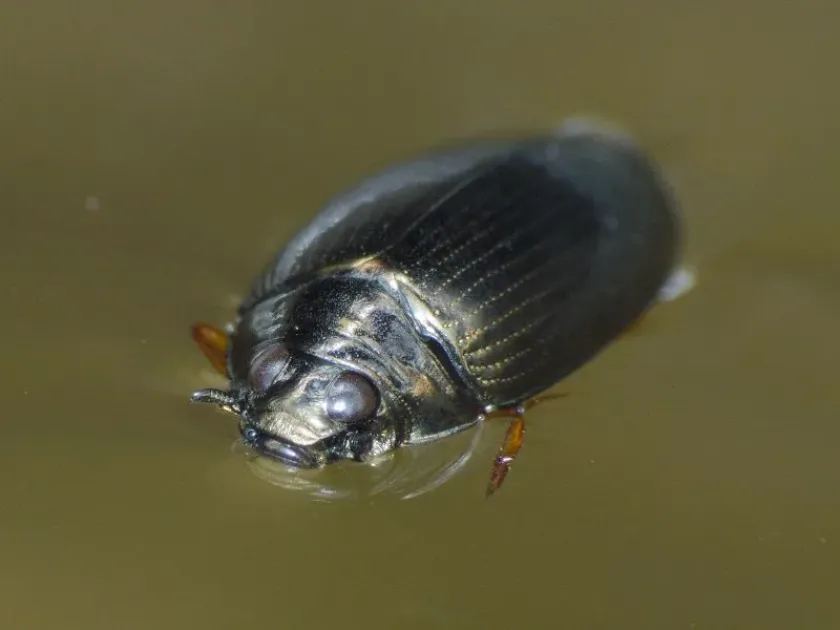
Whirligig beetles (Orectochilus) belong to the family Gyrinidae within the order Coleoptera, known for their distinct appearance.
The most remarkable feature of these insects is their divided eyes, which allow them to see simultaneously above and below the water surface.
They possess an elliptical, streamlined, and polished dark body that helps them move efficiently on the surface tension of water.
Their middle and hind legs are shortened and flattened, functioning like paddles that enable their signature circular, fast-paced swimming.
The larvae are entirely aquatic, featuring lateral gills that allow them to remain submerged while hunting for small prey in the water.
What it damages
Whirligig beetles are not considered agricultural pests because they do not feed on crops, vegetables, or any terrestrial plants.
They act as predators in aquatic environments, consuming small insects or organic particles found floating on the water surface.
Direct damage to agricultural fields is impossible, as these insects are limited to aquatic habitats and do not exhibit phytophagous behavior.
In irrigation systems, their presence is generally benign and often serves as an indicator of a balanced aquatic environment.
Rarely, they might compete for food sources in aquaculture ponds, but they are not viewed as a threat to primary crop production.
When it appears
Adult whirligig beetles become active in late spring, appearing on the water surface as soon as the water temperature begins to rise.
They are most active during the peak of summer, where they engage in mating and continuous surface hunting across calm waters.
Winter is spent in a state of hibernation, with the beetles remaining in the mud or plant debris at the bottom of the pond.
The larval stage lasts throughout the warmer months, culminating in pupation, which occurs on emergent vegetation near the waterline.
As the weather cools in autumn, their surface activity declines significantly as they prepare for the upcoming dormant season.
Signs of infestation
The presence of these beetles is easily spotted by the rapid, erratic, and circular swimming patterns on the surface of calm water bodies.
In sunny conditions, you can see the light reflecting off their dark, shiny exoskeletons as they scuttle across the pond surface.
When disturbed, they quickly dive underwater, carrying a bubble of air trapped against their bodies to assist with breathing while submerged.
The larvae can be found by examining the bottom substrates of ponds or checking floating debris near the edges of the water.
These insects often aggregate in groups, especially in areas with very little or no water flow, providing a very distinct visual signature.
Control measures
No agricultural control measures are required for whirligig beetles because they do not cause any harm to crops or farmland.
If management is necessary for technical ponds, simple mechanical removal of excessive floating weeds is usually sufficient.
Maintaining a healthy aquatic ecosystem is the best practice, as it encourages natural predators that keep beetle populations stable.
Application of insecticides is strictly discouraged, as it would cause unnecessary harm to the delicate balance of the aquatic habitat.
Biological control, such as introducing fish species that naturally feed on aquatic larvae, can help manage their numbers if needed.
Taxonomy
- Latin name
- Orectochilus
- Order
- Coleoptera (beetles)
- Family
- Gyrinidae
- EPPO code
- ORECSP
Discussion
No discussions yet — be the first.