
Grain ground beetle
Ophonus
Description
How to identify
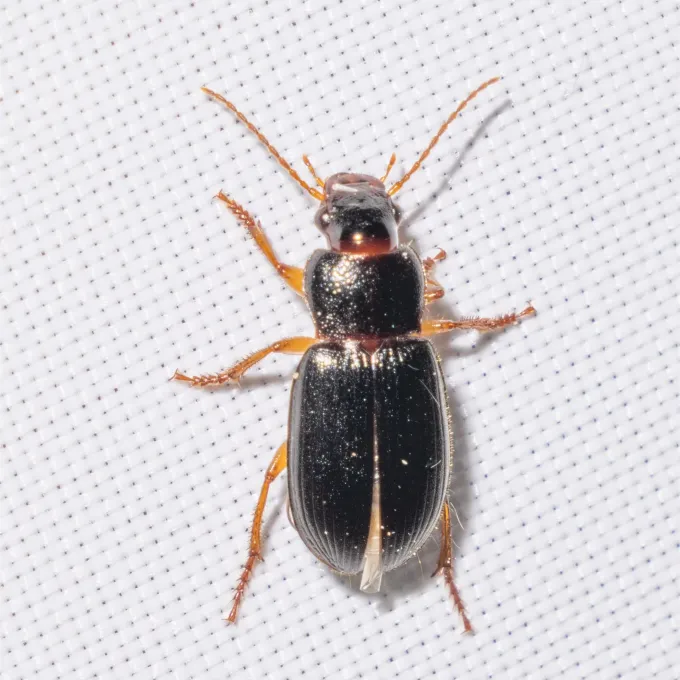
The grain ground beetle (genus Ophonus) belongs to the family Carabidae of the order Coleoptera. Adult beetles typically reach 12 to 16 mm in length and exhibit a black or brownish-black coloration with a metallic sheen.
The body is oval and convex, with the elytra showing distinct longitudinal striae. Larvae, which cause the most severe damage, grow up to 25 mm and are characterized by a dirty-white color and a dark, hardened head capsule.
This insect undergoes complete metamorphosis (egg, larva, pupa, adult). In most regions, it completes one generation per year, though climate variables can influence developmental rates.
They overwinter primarily as larvae in the soil or under crop residue. The adults are nocturnal, emerging to feed and mate during specific periods of the crop's development.
Females oviposit in the soil at depths of 10-15 cm, specifically targeting fields with high amounts of cereal stubble or volunteer plants.
What it damages
The primary hosts for the grain ground beetle are cereal crops, particularly winter wheat, rye, and barley. The larval stage is responsible for the most significant economic loss.
Larvae consume young shoots in the autumn, leading to poor stand establishment. In the spring, they continue feeding, often destroying the central leaves of young plants.
Adult beetles can also cause direct damage by feeding on the developing grains in the ear during the maturation phase, leading to shriveled kernels and yield reduction.
When infestation levels are high, larvae may cause complete defoliation of the crop at the seedling stage, resulting in large, bare patches across the field.
The damage creates an environment susceptible to secondary infections and moisture stress, significantly impacting the overall yield potential of the crop.
When it appears
Autumn feeding begins shortly after crop emergence, as larvae from the current year's eggs actively consume seedling tissues before the onset of winter.
Spring activity resumes immediately after the snow melts. Larval feeding is most intense during this period as the plant starts its rapid spring growth phase.
Adult emergence occurs in late spring or early summer. They migrate to grain fields to feed on ripening crops and to find mates for reproduction.
The life cycle is strictly regulated by environmental factors, particularly soil temperature and moisture, which dictate the duration of each developmental stage.
During the summer months, beetles often enter a period of aestivation, retreating into the soil to escape unfavorable high-temperature conditions.
Signs of infestation
The primary sign of infestation is the appearance of bare patches or "thinning" in fields, where seedlings have been consumed at the base by larvae.
Plants affected by larvae often exhibit shredded or twisted leaves, which resemble small braided structures in the center of the whorl.
Soil sampling in damaged areas will reveal the presence of larvae, which are typically found within the top few centimeters of the soil profile.
In mature crops, the presence of adult beetles is signaled by empty glumes and missing or half-eaten grains in the ear, indicating feeding by adults.
Irregular plant growth and a lack of uniformity in the field are common symptoms following an outbreak, reflecting the patchy distribution of the pest.
Control measures
Integrated Pest Management (IPM) for this beetle centers on crop rotation, avoiding the cultivation of cereals in fields where the pest was present in the previous season.
Good agricultural practices, such as stubble cultivation and deep plowing, are highly effective in exposing larvae to natural enemies and weather conditions.
- Seed treatment with systemic insecticides to provide early-stage protection.
- Foliar application of registered insecticides during peak larval activity if thresholds are exceeded.
- Efficient harvesting techniques to minimize grain loss and reduce food supply for the beetles.
Regular monitoring of fields in the autumn and spring is critical for determining the density of the larval population and planning timely interventions.
Conserving natural predators, such as birds and other ground beetles, plays a supporting role in maintaining the population below the economic threshold.
Taxonomy
- Latin name
- Ophonus
- Order
- Coleoptera (beetles)
- Family
- Carabidae
- EPPO code
- OHONSP
Discussion
No discussions yet — be the first.