
Onesia agilis
Onesia agilis
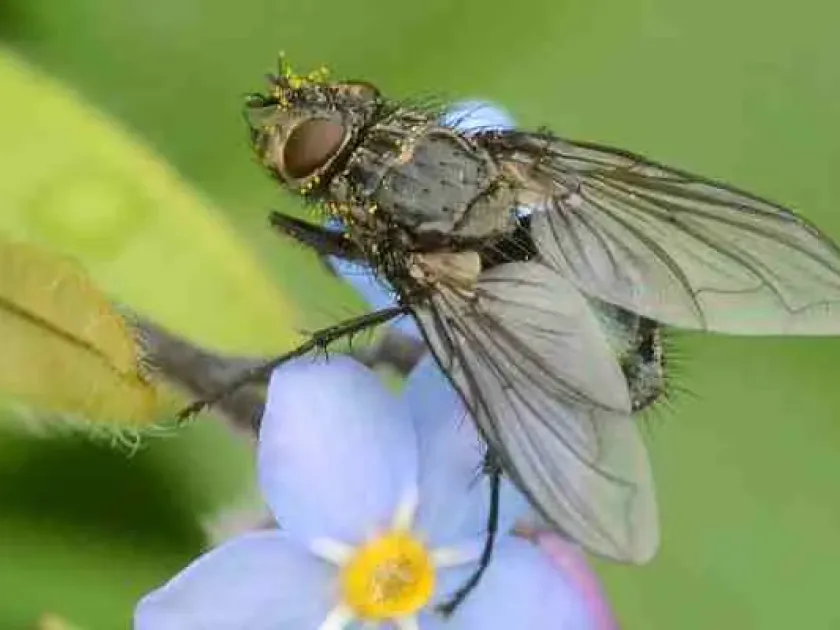
Description
How to identify
Onesia agilis is an insect from the order Diptera, belonging to the family Calliphoridae. Visually, this is a medium-sized fly, often displaying a metallic sheen on its body.
Adults possess a specialized proboscis adapted for lapping up liquids. Members of the Calliphoridae family are well-known for their larvae, which typically develop in organic substrates, playing a significant role in ecological processes.
Identification of the species is performed by entomologists through the examination of thoracic bristles and wing venation patterns. In field conditions, precise identification is difficult due to similarities with other blue blowflies.
The life cycle includes egg, three larval stages, puparium, and adult (imago). Metamorphosis is highly dependent on environmental conditions, particularly soil temperature and moisture levels.
This species exhibits high plasticity, allowing it to adapt successfully to various climatic conditions and expand its range across different regions.
What it damages
The primary damage is caused by the larval stage. While adult flies act as occasional pollinators, their offspring can damage plant tissues, especially if those tissues are already compromised by other injuries.
Crops under stress or those showing signs of necrotic tissue become prime targets for female flies to lay their eggs. This accelerates the decay and spoilage of fruits.
The pest poses the greatest danger to fruit and berry crops that have suffered from hail, diseases, or other insect attacks. Larvae penetrate deep into juicy fruits, causing rapid deterioration.
In warm and humid seasons, the level of damage increases significantly as the rate of larval development accelerates, promoting the spread of secondary microflora.
Indirect damage involves the transmission of pathogenic bacteria and fungi, which trigger the development of various rots on damaged plants.
When it appears
Adult activity is observed throughout the entire growing season, starting from early spring. Population peaks usually occur during summer months when temperature conditions are optimal for reproduction.
In autumn, flies seek places for overwintering, using plant debris, fallen leaves, or cracks in tree bark as shelter.
Climatic factors are critical for the survival of eggs and first-instar larvae. Excessive rainfall or drought can significantly influence population density.
The seasonality of appearance is closely correlated with the development stages of major crops, as flies are often attracted to them for nectar feeding.
Monitoring the pest is recommended during fruit ripening periods when the risk of infestation is highest.
Signs of infestation
The first sign of infestation is the appearance of soft, watery spots on fruits, which spread rapidly across the surface. Exudate is often observed on these affected areas.
Upon inspecting damaged plant parts, one can find clusters of white or yellowish larvae. These zones typically emit a foul odor due to bacterial activity.
A high concentration of adult flies around decaying or damaged fruits is also a serious signal indicating that protective measures must be implemented.
The interior of the fruit, once attacked by larvae, turns into a homogeneous mass that is unfit for consumption or storage.
In the final stages of infestation, tunnels made by larvae before pupation become visible on the surface of the fruit skin.
Control measures
The basis of protection is an agrotechnical method: regular collection of fallen fruit and disposal of infested produce. Eliminating the food source interrupts the pest's development cycle.
Controlling primary pests and diseases that cause mechanical damage or rot significantly reduces the attractiveness of the plantation to Onesia agilis.
Using traps with food attractants allows for the effective reduction of adult fly populations in orchards during the fruit ripening period.
Crop rotation and autumn soil tillage help destroy puparia that overwinter in the upper soil layers.
- Collection and destruction of damaged fruits.
- Use of insect netting in greenhouses.
- Maintaining field hygiene.
- Removal of weeds that attract adult flies.
Taxonomy
- Latin name
- Onesia agilis
- Order
- Diptera (flies)
- Family
- Calliphoridae
- EPPO code
- ONESAG
Discussion
No discussions yet — be the first.