
Four-spotted yellow moth
Oegoconia quadripuncta
Description
How to identify
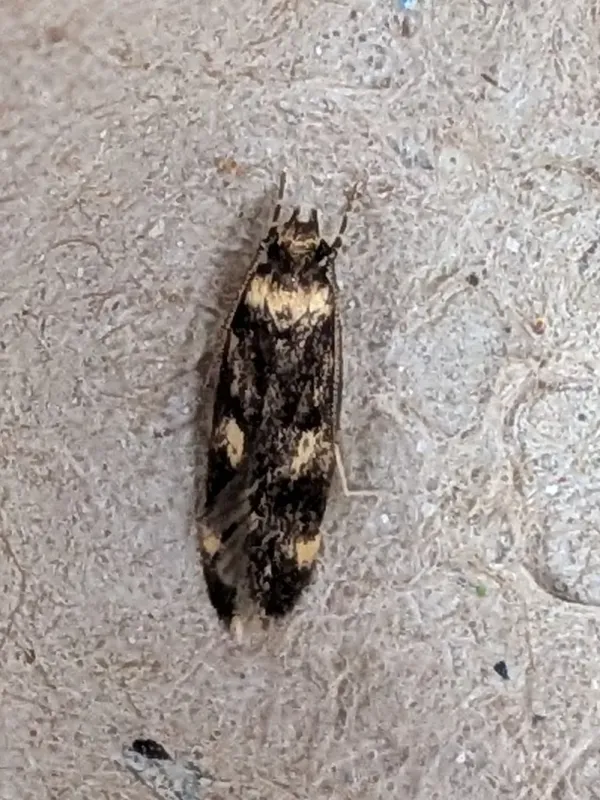
The four-spotted yellow moth, scientifically known as Oegoconia quadripuncta, belongs to the family Autostichidae. It is a small moth with a wingspan typically ranging from 12 to 15 mm.
The moth is characterized by its dark brownish-grey forewings, which feature four distinct light-colored spots that provide the species its common name.
As a member of the narrow-winged moths, it has a slender body structure. When at rest, the moth keeps its wings folded tightly against its body, making it difficult to spot against bark or debris.
The larvae are light-colored with darker heads. They are rarely seen as they reside in concealed habitats, such as organic soil matter or deep within rotting plant tissue.
Pupation takes place inside a tough, silk-lined cocoon, which is usually constructed in a protected area to ensure safety during the transformation process.
What it damages
Oegoconia quadripuncta is primarily a polyphagous detritivore. Its larvae feed mainly on decaying plant matter, leaf litter, and fungal growth found in moist environments.
In agricultural settings, the moth can become a secondary pest if it gains access to weakened plants or crops that are in contact with rotting organic debris.
Greenhouses and storage facilities are particularly vulnerable, especially when high humidity levels foster mold growth, which serves as an abundant food source for the larvae.
Although it rarely attacks healthy plant tissues, the presence of the larvae can weaken root systems and lower stems if the infestation density is high.
The damage caused is often compounded by the secondary infection of pathogens that thrive in the same moist, decaying conditions preferred by the larvae.
When it appears
The flight period of adult moths typically begins in late spring, around May, and continues through the summer months, with adults being most active at night.
The species can produce multiple generations per year, depending on environmental conditions and the availability of decaying organic matter to support larval development.
Larval activity peaks during periods of high humidity and moderate temperatures, which are ideal for the decomposition processes they rely on for food.
Overwintering usually occurs in the larval stage or as pupae, hidden deep within debris, soil crevices, or protected structural elements of greenhouses.
A second generation of adults usually emerges in late summer or early autumn, making this a critical time for monitoring and implementing control measures before winter sets in.
Signs of infestation
One of the primary indicators of an infestation is the presence of thin, silken trails or webbing across organic debris or the base of plants.
Small, dark granular frass left on the soil surface or plant bases is a clear sign that larvae are active and feeding in the immediate vicinity.
Damage to the epidermis of lower stems or roots, accompanied by visible decay, points to potential larval feeding, especially if sanitation in the area is poor.
The observation of adult moths fluttering near artificial lights at night provides reliable evidence of a local population and potential egg-laying activity.
Finding white, silk cocoons tucked away in the corners of storage bins or greenhouse construction joints is a strong indicator of successful reproduction cycles.
Control measures
Sanitation is the most effective control strategy. Regularly remove decaying plant matter, leaf litter, and other organic debris from fields, greenhouses, and storage sheds.
Improve ventilation in controlled environments to lower humidity levels, thereby preventing the mold growth that is essential for larval survival.
Use light traps to monitor population levels and capture adults, which can significantly reduce the number of eggs laid in a given area.
Biological control options, such as using Bacillus thuringiensis-based products, are effective at targeting larvae when infestations are detected early.
Chemical intervention should be considered a last resort, ensuring that any insecticide used is approved for the specific crop and applied according to safety guidelines.
Taxonomy
- Latin name
- Oegoconia quadripuncta
- Order
- Lepidoptera (butterflies)
- Family
- Autostichidae
- EPPO code
- OEGOQU
Discussion
No discussions yet — be the first.