
Swallow bug
Oeciacus vicarius
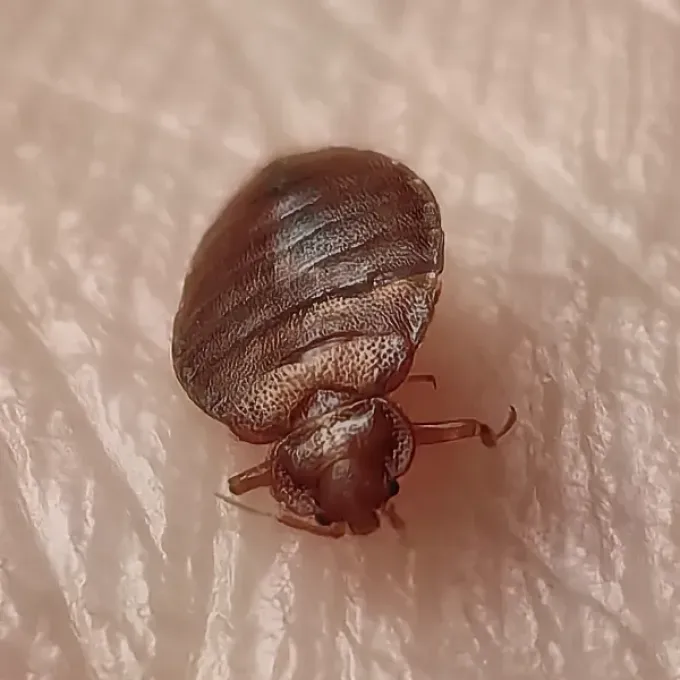
Description
How to identify
The swallow bug (Oeciacus vicarius) is an ectoparasite belonging to the Cimicidae family, closely related to the common bed bug. These insects are small, measuring between 3 to 5 mm, and possess a flattened, reddish-brown body designed for hiding in narrow crevices.
Their bodies are covered in fine, dense hairs, which are evolutionary adaptations for clinging to the feathers of host birds and navigating through the complex structure of a bird's nest. They have well-developed eyes to help them locate warm-blooded hosts in various light conditions.
Nymphs resemble adults but are generally lighter in color and smaller in size. Their entire life cycle is strictly tied to the nesting habits of cliff swallows and barn swallows, which construct nests under building eaves or bridges.
Being obligate blood-feeders, they possess specialized piercing-sucking mouthparts. They do not consume plant sap or other organic debris, making them purely parasitic insects that rely solely on birds for survival.
While they are not agricultural pests in the sense of damaging crops, their presence around barns and livestock facilities can be problematic, often requiring specialized pest management interventions to ensure the hygiene of the surrounding structures.
What it damages
The primary damage caused by swallow bugs is the weakening of host birds, particularly nestlings. Heavy infestations lead to significant blood loss, which can result in severe anemia, reduced growth rates, and increased mortality among young birds.
From a farm management perspective, these bugs are considered a nuisance that impacts the overall health of nesting colonies. If bird nests are built on commercial buildings, the bugs may pose a sanitary issue for the facilities themselves.
When the host birds leave the nest after the breeding season, swallow bugs are known to migrate into nearby buildings. This can result in human discomfort if they infiltrate living areas, as they are capable of biting humans, leading to skin irritation.
The economic damage is primarily linked to the labor and costs associated with cleaning and disinfecting buildings infested with these parasites. Maintaining a parasite-free environment is essential for structures where birds frequently nest.
While they do not directly attack vegetation, their role as vectors for certain avian pathogens highlights the importance of managing their population densities in areas where bird nesting is dense and persistent across seasons.
When it appears
The activity of the swallow bug is perfectly synchronized with the migration of its host birds. In the spring, as birds return to their nesting sites, the bugs emerge from diapause and begin their search for a blood meal.
Summer is the peak reproductive period. As long as nestlings are present in the nests, the bug population grows exponentially, with thousands of individuals completing multiple generations within a single nesting season.
As autumn approaches and birds depart, the bugs enter a state of diapause. They retreat deep into cracks, crevices, or the remnants of the nesting material, where they can survive the winter months without any nutritional intake.
Population density reaches its maximum in mid-summer. Observers may notice insects moving along exterior walls during this time as they seek new nesting sites or shelter after the initial nest becomes overcrowded.
During the winter, the bugs are completely inactive. This dormancy makes them highly resilient to extreme weather, allowing the population to persist year after year in the same nesting locations unless deliberate control measures are taken.
Control measures
The most effective strategy for managing swallow bugs is the removal of old, abandoned nests after the birds have migrated for the season. This eliminates the primary habitat and overwintering reservoir for the population.
In cases where infestations are heavy, the use of registered insecticides is recommended. Treatment should focus on the areas surrounding the nest attachment sites, ensuring that all crevices where bugs hide are properly covered.
- Mechanical removal of old nests during the non-breeding season.
- Sealing cracks and crevices in eaves and wall structures to deny shelter.
- Application of approved insecticides to building surfaces during the off-season.
- Regular monitoring of nesting sites to assess and manage parasite pressure.
Control measures must be carried out with caution to avoid harming the birds. It is essential to perform all cleaning and chemical applications only when the nests are confirmed to be empty of birds.
Using smooth finishes on building exteriors can also discourage the attachment of nests and provide fewer hiding spots for the bugs, offering a long-term architectural solution to potential infestation issues.
Taxonomy
- Latin name
- Oeciacus vicarius
- Order
- Hemiptera (bugs, aphids, leafhoppers)
- Family
- Cimicidae
- EPPO code
- OECIVI
Discussion
No discussions yet — be the first.