
Odacantha melanura
Odacantha melanura
Description
How to identify
Odacantha melanura is a species of beetle belonging to the ground beetle family (Carabidae) within the order Coleoptera.
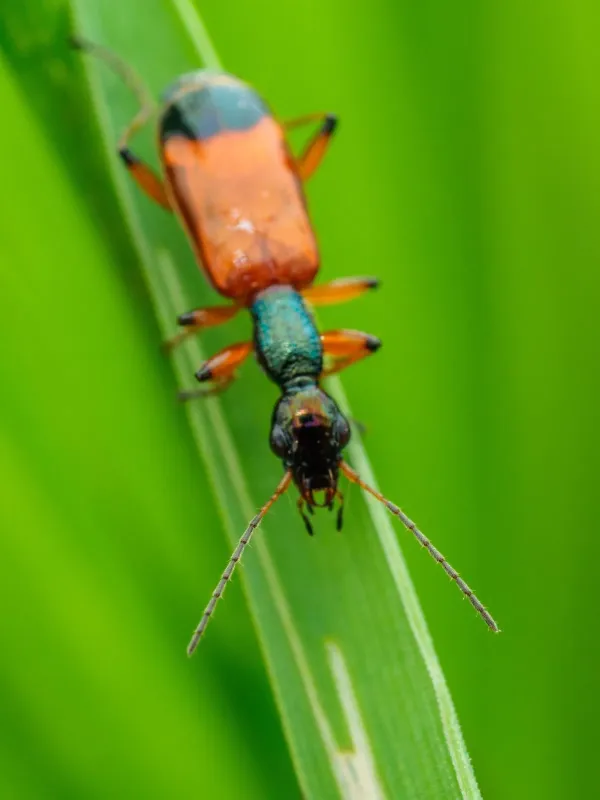
The adult beetle is relatively small, measuring between 6 and 8 millimeters in length, with a distinct elongated body shape.
Its most identifiable feature is the coloration: the elytra are yellowish-brown with a prominent black tip, which is the source of its name.
The head and pronotum are typically darker with a metallic luster, contrasting with the lighter wing covers of the insect.
As part of the ground beetle family, it prefers damp habitats, particularly those associated with reeds and other semiaquatic vegetation.
What it damages
This beetle primarily affects common reeds and various wetland grasses by boring into the stems during its larval stage.
Adult beetles may also cause damage by feeding on foliage, though the larval tunneling within the stem is the most destructive phase.
Tunneling disrupts the plant's vascular system, leading to weakened stems and reduced ability to transport nutrients and water.
Infested plants become more vulnerable to secondary fungal infections and structural failure due to the weakened stem integrity.
In agricultural settings where reeds are grown for biomass, Odacantha melanura can lead to measurable losses in overall yield and fiber quality.
When it appears
Adult beetles are most active during the spring and summer months when weather conditions are optimal for breeding and feeding.
After emerging from hibernation in the spring, the beetles actively search for suitable host plants to deposit their eggs.
Larval development occurs inside the plant stems throughout the summer, depending heavily on the temperature and moisture levels of the area.
Adults overwinter in protected locations such as plant debris, leaf litter, or near the base of vegetation to survive winter temperatures.
The lifecycle is generally completed within one year, with population peaks coinciding with the rapid growth stages of host grasses.
Signs of infestation
The presence of the pest is often signaled by small, round entry holes found along the surface of the reed stems.
Visible wilting or yellowing of the upper leaves of a reed stalk is a clear indicator that the stem has been compromised internally.
Splitting an infested stem reveals internal galleries or tunnels filled with frass, which are characteristic of larval feeding activity.
The presence of adult beetles near the base of reeds during dusk hours is a strong indicator of an active local infestation.
Increased stem lodging or buckling under light wind pressure often occurs in areas where larval populations have hollowed out the plant structure.
Control measures
Cultural control is the most effective strategy, involving the removal and destruction of infested plant debris after the growing season.
Maintaining proper water levels in reed-growing areas helps to create less favorable conditions for the beetle's life cycle.
Chemical control, using selective insecticides, should be reserved for high-threshold infestations and applied during peak activity periods.
Biological control methods include fostering habitats for natural predators such as birds and other beneficial insects that prey on ground beetles.
Regular monitoring of stem health throughout the spring helps in determining the necessity and timing of any required intervention.
Taxonomy
- Latin name
- Odacantha melanura
- Order
- Coleoptera (beetles)
- Family
- Carabidae
- EPPO code
- ODACME
Discussion
No discussions yet — be the first.