
Ground beetle Ocys harpaloides
Ocys harpaloides
Description
How to identify
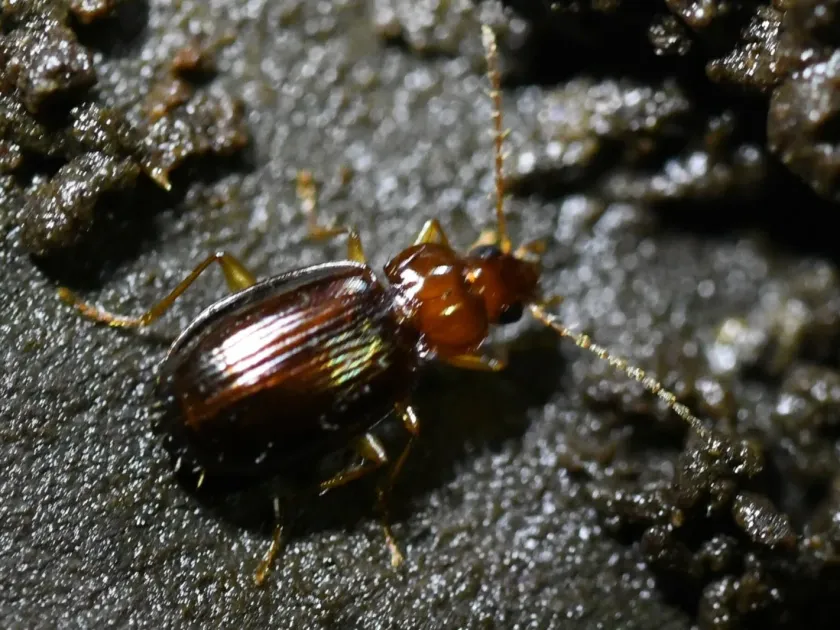
The ground beetle Ocys harpaloides is a small insect belonging to the family Carabidae, order Coleoptera. Adult beetles are typically 4 to 5 mm long, with a distinct elongated body shape and dark brown coloration.
These insects exhibit morphological traits typical of the subfamily Trechinae. They possess powerful mandibles and robust legs, which enable them to move rapidly across the soil surface in search of food or shelter.
The eyes of the beetle are well-developed, aiding in orientation and predation within dense vegetation or soil surface layers. The elytra are marked with longitudinal striations, which serves as a key identification feature for field diagnostics.
Ocys harpaloides is highly mobile and often favors humid habitats. It is commonly found in areas with high soil moisture, near water bodies, or in fields with abundant organic litter, which provides a suitable microclimate.
Being nocturnal or crepuscular, they often spend daylight hours concealed, making them elusive to spot unless population densities are high enough to cause noticeable disturbance in the field.
What it damages
While many ground beetles are considered beneficial natural predators, Ocys harpaloides can occasionally act as an opportunistic phytophage, causing damage to agricultural crops when prey is scarce.
The primary damage occurs during the seedling stage. Adult beetles may chew on young stems and shoots, leading to plant thinning or the complete loss of seedlings in localized areas of the field.
Damage to the tissues of young plants can also facilitate secondary infections, making crops more susceptible to pathogens and compromising their early physiological development.
The economic impact is most pronounced in areas with high soil moisture or where crop residue management practices allow for large beetle populations to persist throughout the season.
If left unchecked, significant damage to emerging crops can lead to reduced plant stands, necessitating expensive replanting or intensive chemical intervention to save the harvest.
When it appears
The life cycle of Ocys harpaloides is closely tied to seasonal temperature fluctuations and moisture levels. They are active from early spring until late autumn, whenever conditions are favorable.
The period of peak activity usually occurs in the spring, as temperatures rise and adults emerge from their overwintering sites to begin feeding and reproduction.
Overwintering takes place in the adult stage, typically within the upper soil profile, under debris, or in soil cracks, which provide protection from freezing winter temperatures.
Larvae develop within the soil, feeding on organic matter and small invertebrates. Their development is influenced by soil humidity, with moist soil environments promoting higher survival rates.
By late summer and early autumn, the new generation of adults reaches maturity. They feed intensely to build up fat reserves, ensuring their survival through the upcoming winter months.
Control measures
Managing Ocys harpaloides requires an integrated approach that focuses on habitat modification and strategic chemical control when population thresholds are exceeded.
Cultural practices, such as deep autumn plowing, are highly effective as they disrupt the beetle's overwintering sites and expose them to unfavorable conditions and natural predators.
Effective weed management is crucial, as weeds provide both refuge and supplemental food sources that support the survival and proliferation of the beetle population.
- Use of insecticide seed treatments to protect crops during the vulnerable germination phase.
- Application of contact insecticides based on strict economic threshold monitoring.
- Regular field scouting to identify infestation hotspots before the damage becomes widespread.
Integrated pest management (IPM) is essential to ensure that control measures do not unnecessarily harm beneficial insects, maintaining a balance that naturally suppresses the population of the pest.
Taxonomy
- Latin name
- Ocys harpaloides
- Order
- Coleoptera (beetles)
- Family
- Carabidae
- EPPO code
- OCYSHA
Discussion
No discussions yet — be the first.