
Ocys ground beetles
Ocys
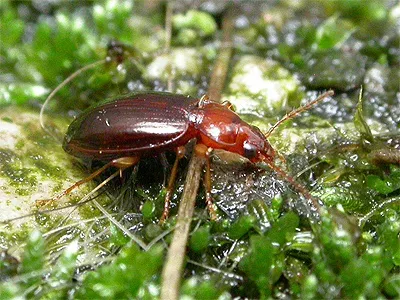
Description
How to identify
Ground beetles of the genus Ocys belong to the family Carabidae within the order Coleoptera. These are typically small, predatory beetles that thrive in moist environments, near water bodies, and in soils rich in organic matter.
The morphology of these beetles includes an elongated body, often with a metallic or dark coloration, and powerful mandibles adapted for capturing prey within their habitat.
Their wings are well-developed, enabling adults to actively disperse across large agricultural fields in search of suitable breeding and feeding conditions.
The larvae, which also lead a cryptic lifestyle, reside primarily in the upper soil layers, where they are protected from environmental stressors and predators.
Systematically, the genus comprises several species, and while they share similar ecological niches, minor variations in behavior can be observed depending on the local climate and agricultural ecosystem.
What it damages
Although many carabid species are considered beneficial entomophages, members of the genus Ocys can become pests when their populations reach high densities, particularly if their natural prey is scarce.
The primary damage occurs during the early growth stages of agricultural crops, as the soft, emerging seedlings are highly susceptible to mechanical feeding.
Cereal crops, vegetables, and sugar beets are the most frequent targets, especially during drought periods when the beetles seek moisture and nutrition from plant tissues.
Signs of infestation include consumed seeds, gnawed roots, or severed stems, all of which contribute to patchy stands and decreased overall yields.
In intensive farming, these beetles can also target the root collars of young horticultural crops, weakening the plant's structural integrity and overall vigor.
When it appears
The activity of Ocys ground beetles begins in early spring as soon as soil temperatures permit, following the winter dormant period.
Population peaks are typically observed during the first half of the summer, aligning with the rapid development phase of most cultivated crops.
Their life cycle involves complete metamorphosis, including egg, larva, pupa, and adult stages, each being carefully adapted to the specific soil moisture conditions.
Overwintering occurs either as adults or larvae within the soil profile or beneath plant debris, ensuring a swift emergence during the following spring season.
The genus typically completes one generation per year, although favorable climatic conditions can sometimes support partial development of subsequent generations in a single season.
Signs of infestation
A primary indicator of their presence is the appearance of characteristic gnaw marks on the cotyledons or stems of young seedlings, often appearing as irregular edges.
One can identify their presence by observing small burrows or entry holes on the soil surface, especially in fields with high organic matter or mulch coverage.
Nocturnal monitoring of the crop canopy or soil surface using a flashlight often reveals the presence of these beetles, as they are mostly active during the night.
High levels of crop residue often correlate with larger beetle populations, as these residues provide the necessary refuge and moisture-rich microhabitats.
Severe infestations often result in visible gaps within rows, where young plants have died due to critical root system damage or destruction of the growing point.
Control measures
Managing Ocys ground beetles requires an integrated approach that combines robust agronomic practices with targeted chemical interventions when necessary.
Thorough soil cultivation, such as deep plowing, remains the most effective mechanical method to disturb their habitats and significantly reduce larval population density.
Implementing effective crop rotation strategies helps to disrupt the beetles' life cycles, making the field environment less stable for their long-term colonization.
Chemical control should only be applied after monitoring confirms that the economic injury level has been exceeded, using approved contact or systemic insecticides.
Sanitation practices, including the removal of dense weed cover, are recommended as they reduce the favorable microclimates that promote beetle reproduction and survival.
Taxonomy
- Latin name
- Ocys
- Order
- Coleoptera (beetles)
- Family
- Carabidae
- EPPO code
- OCYSSP
Discussion
No discussions yet — be the first.