
Common Lutestring
Ochropacha duplaris
Description
How to identify
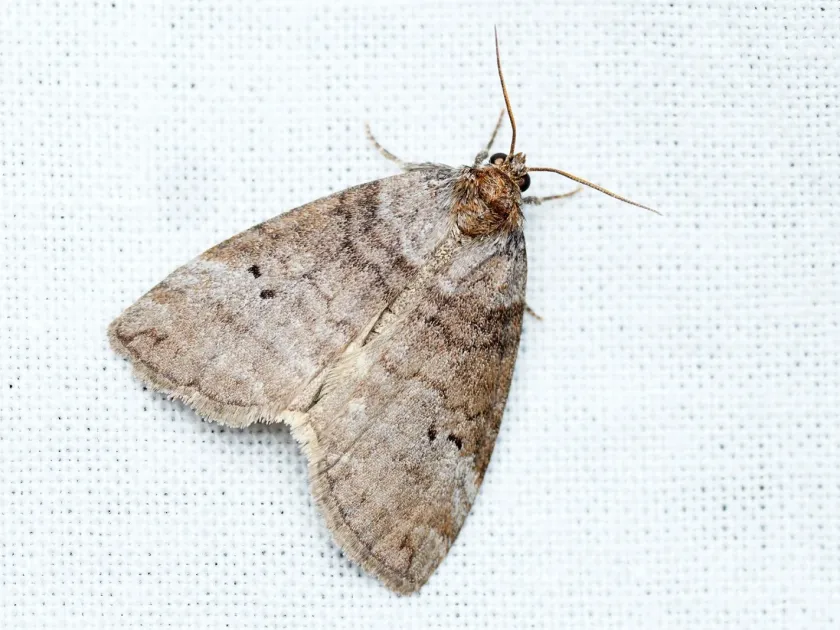
The Common Lutestring (Ochropacha duplaris) is a moth of the family Drepanidae. Its wingspan typically ranges from 25 mm to 30 mm.
The moth is recognized by its greyish-brown forewings, which feature intricate transverse wavy lines and two distinct pale spots near the center.
The larvae (caterpillars) are slender and have a green hue with darker dorsal markings, providing excellent camouflage against leaves.
Pupation occurs within a tough, silk-bound cocoon, often spun between leaves or in crevices of the tree bark, which serves as a protective winter shelter.
Adult moths are nocturnal and are frequently attracted to light sources, which allows researchers to monitor population levels in different areas.
What it damages
The Common Lutestring primarily affects deciduous trees, with a strong preference for species such as birch (Betula), alder (Alnus), and aspen (Populus).
Caterpillars feed on the leaf tissue, causing irregular holes and skeletonization, which significantly reduces the leaf surface area available for photosynthesis.
While mature trees can usually withstand light infestations, young trees or those in nurseries may suffer stunted development due to severe defoliation.
The damage often leaves the foliage looking ragged, which is particularly concerning for ornamental plantings in gardens and public parks.
Cumulative stress from heavy feeding can predispose trees to secondary infections by fungi or opportunistic wood-boring insects.
When it appears
The life cycle of the Common Lutestring is synchronized with the budburst and growth stages of its host plants.
Adults emerge primarily during the late spring and early summer months, typically between May and June.
Larval activity is most intense during the summer period, specifically from July through August when the foliage is fully developed.
The species typically overwinters in the pupal stage, emerging as adults the following spring to restart the cycle.
Understanding these phenological windows is crucial for timing any necessary control actions to maximize efficacy and minimize ecological impact.
Signs of infestation
Early identification of the pest involves checking for small holes and irregular feeding edges on the leaves of host trees like birch or alder.
The presence of frass (small dark excrement pellets) on the leaves or the forest floor below indicates active feeding by larvae in the canopy.
Some larvae are known to web leaves together or create protective rolls, which are visible upon close inspection of the foliage.
Finding the characteristic pupal cocoons tucked into leaf folds during late autumn can help assess the potential population for the following year.
- Ragged leaf edges.
- Visible dark frass pellets.
- Webbed or rolled leaf structures.
- Skeletal leaf patches.
Control measures
Mechanical control, such as pruning and destroying infested leaf clusters, is effective for managing small populations in garden settings.
Biological control using Bacillus thuringiensis (Bt) sprays can selectively target caterpillars without harming beneficial pollinators or insects.
If chemical intervention is deemed necessary, contact or systemic insecticides should be applied during the early larval stages for best results.
Encouraging natural predators, including parasitic wasps and birds, helps maintain the population of Common Lutestring below economic injury levels.
Regular monitoring of tree health and early detection of defoliation are the most effective strategies for preventing long-term damage to host plants.
Taxonomy
- Latin name
- Ochropacha duplaris
- Order
- Lepidoptera (butterflies)
- Family
- Thyatiridae
- EPPO code
- OHRPDU
Discussion
No discussions yet — be the first.