
Notiophilus palustris
Notiophilus palustris
Description
How to identify
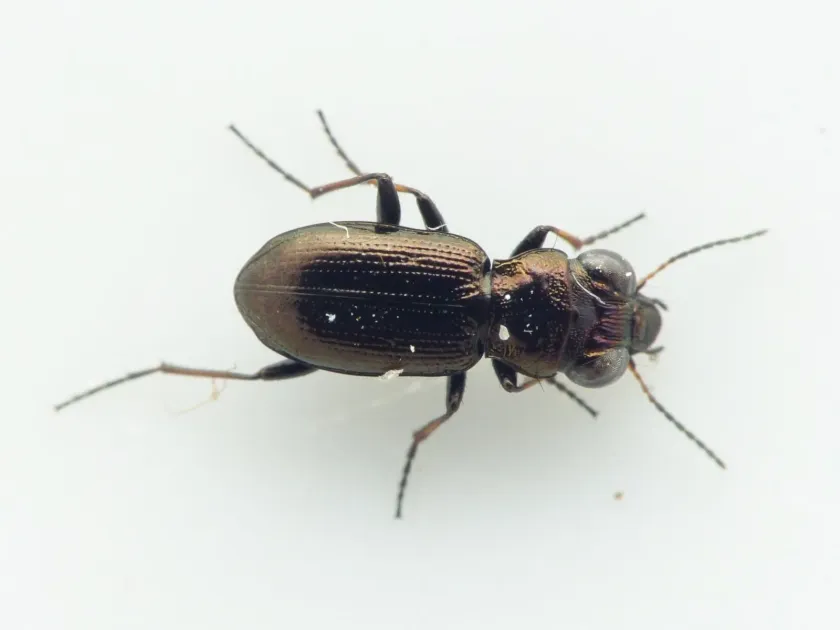
Notiophilus palustris is a small ground beetle belonging to the Carabidae family, characterized by a distinct appearance common to this genus.
The adult beetle typically measures between 5 and 6 millimeters in length and exhibits a brilliant bronze, copper, or green metallic sheen on its elytra.
The most prominent feature is its disproportionately large, protruding eyes, which allow the insect to detect minute movements of its prey effectively.
The elytra have deep longitudinal striae, which are a characteristic feature for visual identification in the field by trained agronomists.
The larvae are active, predatory, and possess long legs and strong mandibles, typical of members of the ground beetle family that hunt on the soil surface.
What it damages
It is crucial to clarify that Notiophilus palustris is not an agricultural pest and does not cause damage to crops, roots, or foliage.
The species acts as a specialized predator that feeds primarily on micro-arthropods, such as springtails (Collembola), living in the soil surface layer.
By preying on these organisms, the beetle contributes to the regulation of soil micro-fauna and does not pose any threat to agricultural production.
There is no economic threshold for this species, as it serves as a beneficial inhabitant of agricultural fields rather than a damaging agent.
Therefore, farmers should not target this beetle, as its presence is an indicator of ecological stability and a healthy soil environment.
When it appears
The activity period for Notiophilus palustris begins in early spring when soil temperatures allow for the metabolic processes of the beetles.
These beetles are moisture-loving insects and are typically found in damp habitats, meadows, or the shaded areas of agricultural fields near irrigation sources.
The life cycle involves complete metamorphosis, with the species usually overwintering in the adult stage in protected soil niches or organic debris.
Reproduction occurs throughout the warmer months, with females laying eggs in moist soil where the emerging larvae immediately begin hunting for prey.
Environmental humidity is the primary factor limiting its seasonal distribution and population density within the cropping landscape.
Control measures
Since Notiophilus palustris is a beneficial predator, no control measures are necessary, and they should be encouraged rather than eradicated.
The use of broad-spectrum synthetic insecticides should be minimized to prevent the unintended killing of these helpful beetle populations.
Promoting a diversified field landscape with buffer strips helps maintain stable populations of these beetles, providing long-term biological control.
Integrated Pest Management (IPM) strategies emphasize the conservation of predatory Carabidae as part of the natural regulation of soil-dwelling pests.
Agronomists are advised to identify this beetle as an ally in the ecosystem and incorporate its preservation into sustainable farming practices.
Taxonomy
- Latin name
- Notiophilus palustris
- Order
- Coleoptera (beetles)
- Family
- Carabidae
- EPPO code
- NOTIPA
Discussion
No discussions yet — be the first.