
Notiophilus aquaticus
Notiophilus aquaticus
Description
How to identify
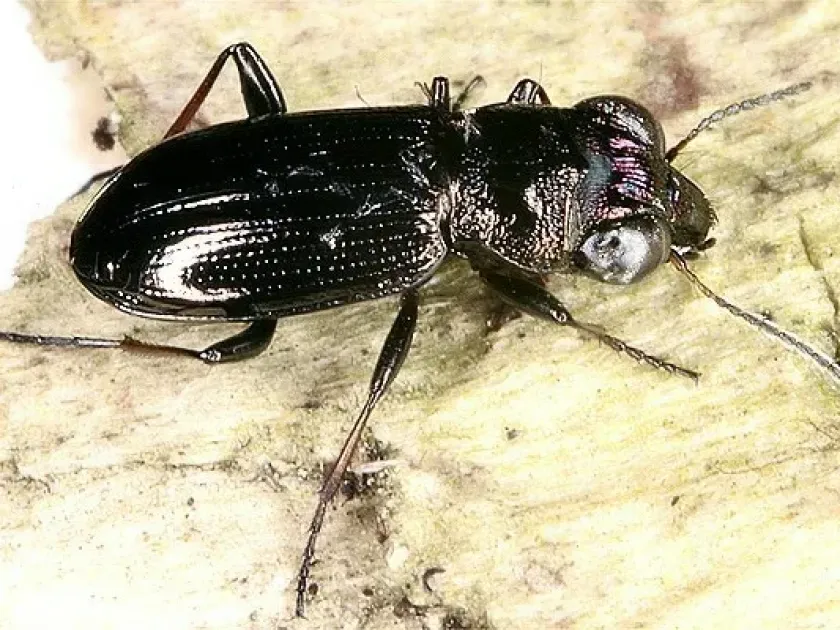
Notiophilus aquaticus is a species of ground beetle belonging to the family Carabidae, order Coleoptera. These beetles are relatively small, typically measuring between 4 and 6 millimeters in length.
The most prominent feature of this species is its disproportionately large head, equipped with massive eyes that allow it to be a highly efficient visual hunter during daylight hours.
The body displays a distinctive metallic luster, often ranging from bronze to green, with longitudinal grooves on the elytra that are easily recognizable under light magnification.
Despite its name aquaticus, this beetle is not aquatic but resides in damp, temperate environments, frequently found in cultivated fields and margins with high soil moisture.
The larvae possess a typical campodeiform shape with elongated bodies and functional legs, enabling them to move rapidly through the topsoil layer to forage for food.
What it damages
While Notiophilus aquaticus primarily functions as a predator of small invertebrates, it can act as a facultative pest under specific agricultural conditions, particularly when primary prey is scarce.
The primary damage occurs during the seedling stage of various cereal and vegetable crops. Adult beetles may feed on tender cotyledons and shoots, causing structural damage to young plants.
This feeding behavior leads to plant thinning and gaps in crop stands, which forces farmers to undertake costly re-seeding operations.
Plants at the very early growth stages, known as the "spike" phase, are particularly vulnerable because the loss of the growing point often results in complete plant death.
The economic damage is most pronounced in fields where suboptimal weather slows down crop growth, keeping the plants in the vulnerable "spike" stage for a prolonged period.
When it appears
The life cycle begins early in the spring as soon as the soil temperatures rise above 10-12 degrees Celsius, allowing the beetles to emerge from their overwintering sites.
Adults are most active on the soil surface during the spring planting season, which coincides with the germination and emergence of many major agricultural crops.
Summer activity typically decreases as soil surface temperatures rise and moisture levels drop, causing the beetles to seek refuge in deeper soil layers or dense vegetation.
A secondary, often minor, peak of activity may occur in the autumn, primarily associated with the beetles seeking suitable overwintering sites near fields.
The winter is spent in a state of diapause, with adults burrowing into the soil or hiding under protective surface litter to survive harsh winter conditions.
Signs of infestation
Identification of the pest involves looking for mechanical injury patterns on young seedlings, such as irregular gnawing or scalloped edges on the leaves and stems.
During sunny mornings, observant field scouts can often spot the metallic-colored beetles darting across the soil surface before they retreat into soil crevices.
Damage is typically patchy and is often found in localized areas where soil moisture is higher or where crop emergence has been slow due to soil compaction.
The presence of these beetles is often correlated with an environment rich in organic matter, which supports populations of small soil invertebrates.
Monitoring can be effectively conducted using pitfall traps placed throughout the field margins during the initial germination phase of the crop.
Control measures
Controlling Notiophilus aquaticus requires a multifaceted strategy focusing on rapid crop establishment and minimizing the window of plant vulnerability.
The most effective chemical control measure is the use of insecticidal seed treatments, which provide a protective zone around the germinating seed.
Agricultural practices should prioritize creating a seedbed that promotes uniform germination and vigorous seedling growth, as strong plants can outgrow minor beetle damage.
- Maintaining optimal planting depths for quick emergence.
- Managing field borders to reduce overwintering sites for the beetles.
- Ensuring high germination rates through quality seed selection.
- Monitoring fields during the critical 14-day post-emergence window.
In cases of severe infestation, targeted foliar applications of insecticides may be considered, although this is rarely necessary if preventative seed treatments are used correctly.
Taxonomy
- Latin name
- Notiophilus aquaticus
- Order
- Coleoptera (beetles)
- Family
- Carabidae
- EPPO code
- NOTIAQ
Discussion
No discussions yet — be the first.