
Pollen beetle
Nitidula
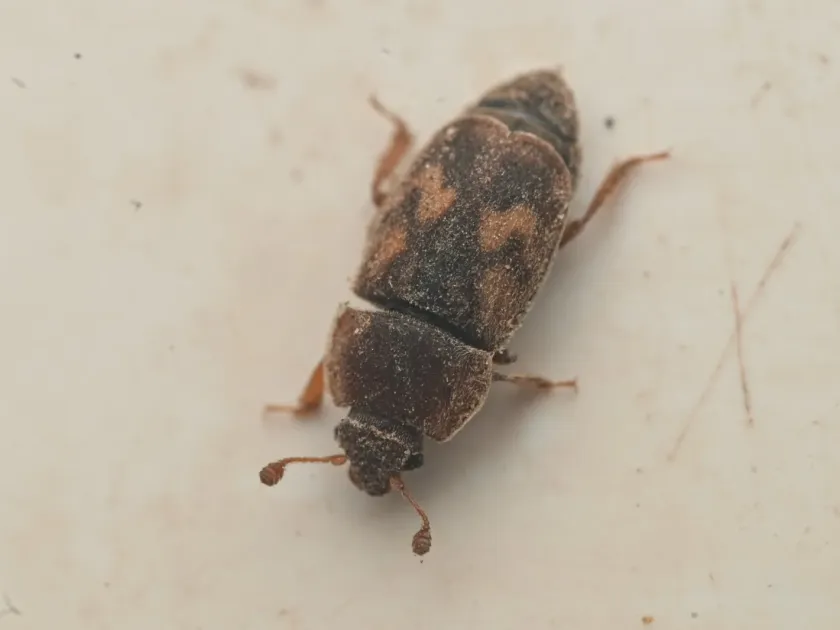
Description
How to identify
Pollen beetles (Nitidulidae) are a family of small beetles characterized by their compact, oval-shaped bodies typically measuring 2 to 6 mm in length. Their coloration ranges from dark brown to black, often featuring a distinct metallic sheen.
A key diagnostic feature is the structure of their antennae, which terminate in a three-segmented club. The elytra (wing covers) are slightly shortened, leaving the final segments of the abdomen exposed, which helps distinguish them from other similar small beetles.
Larvae are elongated, slightly flattened, and covered with sparse hairs. They possess functional legs and well-developed mouthparts, enabling them to navigate through flower buds and actively consume plant tissues.
These insects undergo complete metamorphosis, passing through egg, larva, pupa, and adult stages. Adults are often found in moist, sheltered areas, particularly where there is dense vegetation that provides protection from intense sunlight.
Identifying the specific species within the Nitidulidae family is essential, as some are serious agricultural pests while others are beneficial scavengers or predators of other small arthropods.
What it damages
The primary damage occurs during the flowering stage, when adults migrate to crops to feed on pollen. They chew through flower buds to reach the nutritious pollen inside, causing the buds to wither and fall prematurely.
Cruciferous crops, such as oilseed rape, are particularly vulnerable. In severe infestations, the beetles can cause significant yield losses by destroying the reproductive organs of the plants before fertilization can occur.
Larvae contribute to the damage by feeding inside the buds. This internal feeding often causes the bud to become deformed, leading to poor pod formation or the total failure of the flower to develop into a seed-bearing pod.
The feeding sites created by the beetles serve as entry points for secondary pathogens, including various fungal and bacterial infections. This increases the total damage, often leading to necrosis and decay of the plant tissues.
Reduced plant vigor and stunted growth are common side effects of heavy infestations, especially if the crop is already stressed by environmental factors like drought or nutrient deficiencies.
When it appears
Adult beetles overwinter in the soil or under leaf litter and crop residues. They emerge in early spring as soon as temperatures consistently exceed 10°C, seeking out the first available flowering plants to feed upon.
Initial feeding often takes place on wild cruciferous plants before the beetles migrate to commercial agricultural fields. This migration period is a critical window for monitoring population levels before the crop enters its vulnerable budding stage.
The main breeding and egg-laying phase coincides with the formation of flower buds in the spring. During this period, the population of the pest often peaks, requiring close attention from farmers and agronomists.
The life cycle is usually completed by mid-summer. After finishing their development, the new generation of adults may disperse, enter a summer diapause, or shift to late-season crops depending on the local environmental conditions.
As autumn approaches, adult beetles gradually seek out overwintering sites. They move into sheltered areas to enter a state of dormancy, effectively ending the active growing season for the pest.
Signs of infestation
The most prominent sign of infestation is the presence of beetles inside the flower buds. If you gently shake the flower racemes over a light-colored surface, the beetles will quickly drop off, confirming their presence.
Damaged buds often appear yellow or shriveled and fail to open. If you notice a high rate of bud drop or bare areas on the flower stalks, it is a clear indicator that the pollen beetle population is exceeding the economic threshold.
In oilseed rape, look for "hollow" or "empty" racemes where the lower buds have been destroyed. This creates a distinct visual pattern of loss that contrasts with the healthy growth in the upper parts of the plant.
The presence of frass or fecal pellets on leaves beneath the flower stalks is another indicator. It confirms active feeding by the beetles and can help distinguish their presence from environmental or disease-related flower drop.
Wilting of entire flower clusters, especially in hot weather, may also suggest extensive tissue damage, as the plant's vascular integrity is compromised by the mechanical feeding of the insects.
Control measures
Effective management relies on an integrated approach. Crop rotation is essential to prevent the buildup of beetle populations in the soil and disrupts the life cycle of the pest across multiple seasons.
Maintaining clean field margins by removing wild cruciferous weeds helps reduce the primary food sources for beetles before they invade the main crop. Deep tillage after harvest can also help destroy pupae in the soil.
Chemical control should be applied strictly based on economic thresholds and field monitoring. When spraying is necessary, it must be performed during non-foraging hours to avoid killing pollinators such as bees.
The use of systemic insecticides can provide longer-lasting protection for the sensitive buds, but rotating different chemical groups is vital to prevent the development of insecticide resistance within the population.
- Monitoring with yellow sticky traps to track flight activity.
- Planting early-maturing varieties to escape the peak infestation window.
- Using biopesticides or natural antagonists where applicable.
Taxonomy
- Latin name
- Nitidula
- Order
- Coleoptera (beetles)
- Family
- Nitidulidae
- EPPO code
- NITISP
Discussion
No discussions yet — be the first.