
Cherry slug sawfly
Neurotoma nemoralis
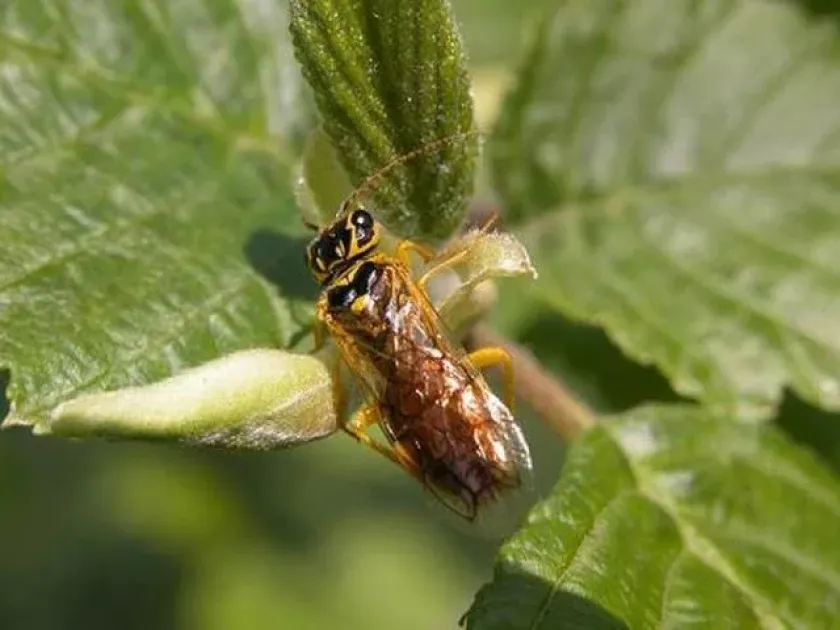
Description
How to identify
The cherry slug sawfly (Caliroa limacina) is a member of the Hymenoptera order, specifically the Tenthredinidae family. Adults are small, shiny black insects about 5 mm in length.
The larvae are distinct in their appearance, resembling tiny slugs or leeches. They are olive-green or blackish, covered with a shiny, slimy secretion that protects them from drying out.
The lifecycle begins when adults emerge in late spring or early summer. Females use their ovipositors to insert eggs into the leaf tissue, leaving small bumps on the leaf surface.
Under optimal temperature conditions, the pest can complete two generations in a single growing season, leading to potential population explosions.
Winter is spent as mature larvae inside cocoons buried in the soil, usually at a depth of 10 to 15 centimeters beneath the host trees.
What it damages
The primary hosts of this pest include stone fruit trees such as cherries, sweet cherries, plums, and apricots. These trees often suffer the most severe damage.
Other tree species, including pears, quinces, and sometimes hawthorn or rowan, can also be infested. The feeding pattern remains consistent across all host plants.
Damage is restricted to the foliage. Larvae feed on the upper surface of the leaves, consuming the green tissue and leaving only the veins and the lower epidermis intact.
Severe infestations cause a total loss of leaf surface area, severely limiting the tree's ability to photosynthesize and store carbohydrates for the following year.
In young trees, repeated annual damage significantly stunts growth and can eventually lead to tree mortality if left unmanaged over several seasons.
Signs of infestation
The most recognizable sign is the skeletonized appearance of the leaves. As the green matter disappears, the leaves turn brown, look burned, and eventually curl up.
Initially, you may notice small, translucent "windows" on the foliage where the larva has begun its feeding, which eventually expand into large, dead patches.
The presence of the slimy, slug-like larvae on the undersides of leaves is a definitive diagnostic feature of an active infestation.
Large outbreaks often lead to premature defoliation, where trees lose their leaves as early as mid-summer, causing the tree to appear dormant prematurely.
- Shiny, slimy black-green larvae on leaf undersides.
- Skeletonized leaves with translucent patches.
- Early-season browning and defoliation of the canopy.
Control measures
Cultural control is highly effective; cultivating or turning the soil under the tree canopy in late autumn helps expose the overwintering cocoons to predators and frost.
For chemical control, contact or systemic insecticides are applied when the larvae are actively feeding. It is crucial to target the undersides of the leaves during application.
Bio-rational products or organic sprays can be effective if applied early in the infestation cycle, before the larvae grow too large and resilient.
In small backyard gardens, physically washing the trees with a strong jet of water can dislodge larvae, providing some relief from the pest pressure.
Always verify the chemical safety guidelines and pre-harvest intervals for the specific insecticides used on edible fruit crops to ensure food safety.
Taxonomy
- Latin name
- Neurotoma nemoralis
- Order
- Hymenoptera
- Family
- Pamphiliidae
- EPPO code
- NEURNE
Discussion
No discussions yet — be the first.