
Cherry web-spinning sawfly
Neurotoma iridescens
Description
How to identify
The cherry web-spinning sawfly (Latin: Neurotoma iridescens) is a member of the Pamphiliidae family within the Hymenoptera order. Adult insects have a stocky body measuring 10–12 mm, featuring a dark, metallic sheen.
The wings of the adult are translucent with distinct venation. Both the head and thorax are sparsely covered in hair, and the abdomen often exhibits lighter markings on the segments, which helps in identifying the species.
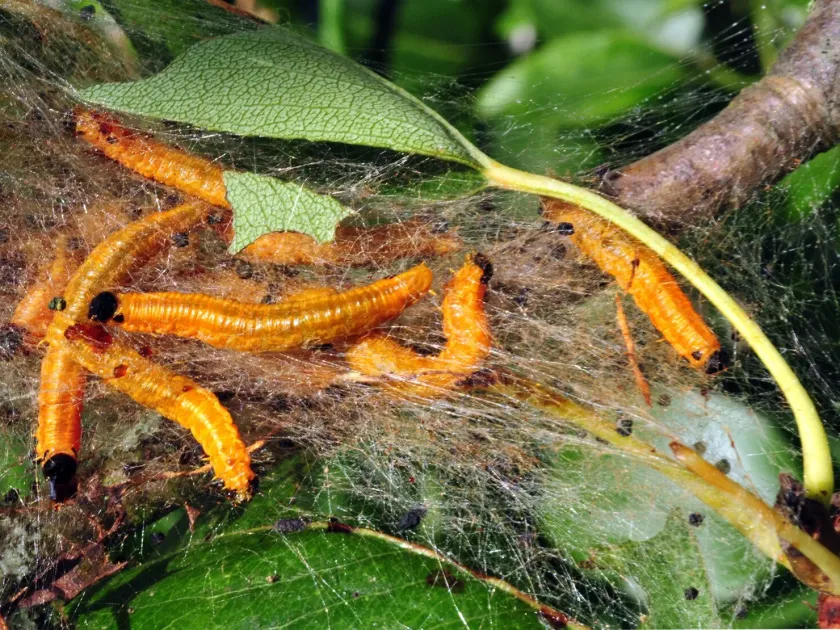
The larvae (false caterpillars) are pale green or yellowish in color, possess a black head, and lack abdominal prolegs. They can grow up to 20 mm in length during their developmental stages.
The life cycle includes a complete metamorphosis: egg, larva, pupa, and adult. They overwinter as larvae in the soil, constructing dense earthen cells at a depth of 10–15 cm.
The mass emergence of adults typically coincides with the flowering stage of stone fruit trees, providing a critical window for monitoring and early detection.
What it damages
The primary host for this pest is the cherry tree, though it frequently attacks sweet cherries, plums, and other stone fruit species within the Prunus genus.
The larvae are specialized feeders that prefer young leaves in the upper canopy, where they construct characteristic nests made of silk webbing.
Damage occurs when larvae skeletonize the foliage and eventually consume the entire leaf blade, leaving only the primary veins, which significantly hampers the tree's photosynthesis.
In cases of high population density, the pest can cause significant defoliation, which reduces the tree's cold hardiness and negatively impacts fruit quality in the following season.
Young nursery stock is especially vulnerable, as the loss of foliage during early growth stages stunts the development and structural formation of the tree.
When it appears
Adults emerge in spring during the bud break and flowering phase, synchronizing their arrival with the availability of fresh foliage required for oviposition.
Females deposit eggs in groups on the underside of leaves, covering them with a glandular secretion that hardens to protect the eggs from environmental stress.
Larvae hatch after 7–12 days and immediately begin constructing web nests, within which they live in colonies, feeding actively throughout the spring and early summer.
The larval feeding phase lasts for 3 to 5 weeks, after which they drop to the ground and burrow into the soil to enter diapause, where they remain until the following spring.
There is typically one generation per year, making the seasonal management of this pest relatively straightforward if the timing of the emergence is tracked correctly.
Signs of infestation
The most prominent sign of infestation is the appearance of silk web nests on branch tips, within which clusters of larvae can be seen actively consuming the foliage.
Leaves damaged by the sawfly quickly curl, wither, and turn brown, creating a characteristic burnt or scorched appearance on affected branches.
Inspection beneath the webbing reveals numerous dark granular frass (excrement) pellets, which serve as a definitive indicator of an active larval colony.
When a branch is shaken, the nests may partially collapse, and the larvae often display a defensive reaction, arching their bodies to deter potential threats.
Significant defoliation in mid-summer, in the absence of other obvious pests, is a strong indication that the sawfly colonies have completed their development and retreated into the soil.
Control measures
Effective management of the cherry web-spinning sawfly relies on a combination of cultural practices and targeted chemical interventions.
The most important cultural practice is deep cultivation of the soil beneath the canopy in autumn and early spring, which destroys the overwintering chambers and kills the larvae.
Manual removal and destruction of the web nests is a highly effective control measure for home orchards and young trees, helping to avoid the need for broad-spectrum pesticides.
Chemical control is most effective when applied early in the larval stage, before the webbing becomes too thick and dense for insecticides to penetrate effectively.
- Use of systemic insecticides during critical larval development phases.
- Application of biological pesticides containing entomopathogenic bacteria.
- Maintaining optimal tree health through proper fertilization and pruning to improve resilience.
Taxonomy
- Latin name
- Neurotoma iridescens
- Order
- Hymenoptera
- Family
- Pamphiliidae
- EPPO code
- NEURIR
Discussion
No discussions yet — be the first.