
Pear web-spinning sawfly
Neurotoma flaviventris
Description
How to identify
The Pear web-spinning sawfly (Neurotoma flaviventris) is a member of the Pamphiliidae family within the Hymenoptera order. The adult insect is characterized by a shiny black body with an orange-yellow abdomen, reaching approximately 12 mm in length.
Adults possess clear, transparent wings with a distinct dark venation pattern. The antennae are thread-like, serving as a key diagnostic feature for professionals identifying the species in the field.
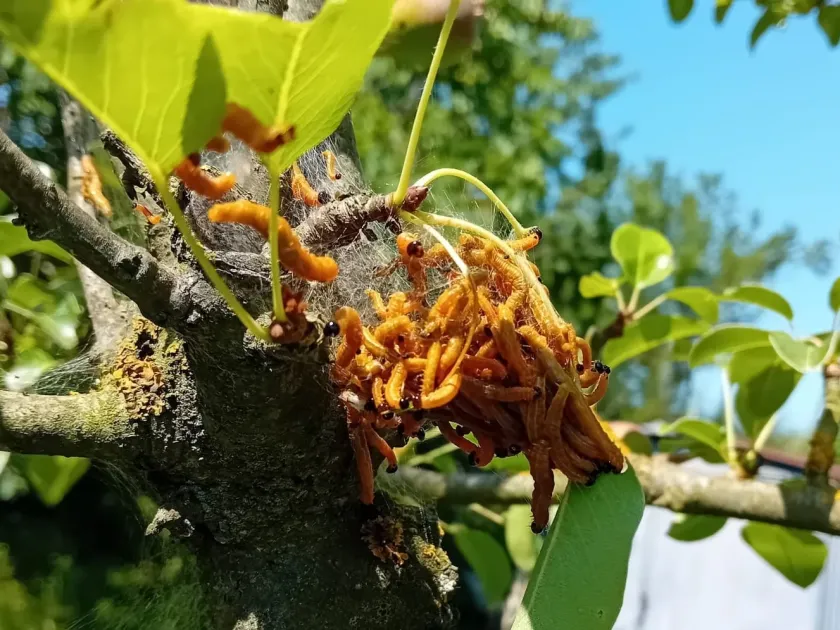
The larvae are cylindrical, reaching up to 20 mm, and typically display a yellowish-green to ochre coloration. Their heads are dark, smooth, and highly sclerotized with powerful mouthparts.
A defining biological trait of this species is the construction of communal silk nests on twigs, which house the larvae and protect them from environmental stressors and predators.
This species is univoltine, meaning it produces one generation per year. Larvae overwinter in the soil in specialized earthen cells, where they pupate during the following spring.
What it damages
The primary host for this pest is the pear tree, although it may occasionally infest apple trees, quince, and other members of the Rosaceae family when pear trees are not present.
Larvae consume foliage aggressively, starting by skeletonizing leaves and eventually consuming entire leaf blades, leaving only the primary veins behind.
Severe infestations reduce the tree's photosynthetic capacity, which leads to decreased vigor, poorer fruit development, and lower yields throughout the growing season.
Premature defoliation caused by heavy feeding weakens the tree's overall structure, negatively affecting its ability to store nutrients for winter survival and next year's growth.
Young trees are particularly vulnerable, as the loss of a significant portion of their leaf area can drastically stunt branch development and overall structural growth.
When it appears
Adult emergence typically coincides with the flowering period of pear trees or shortly thereafter, which is a critical time for monitoring potential infestations.
Females deposit eggs in small clusters on the underside of young leaves, usually concentrating near the central midrib to facilitate the future construction of the web nest.
Larvae hatch in late spring or early summer and immediately begin spinning their silk webs, which expand progressively to encompass more foliage as the colony grows.
The larval feeding period lasts approximately 30 to 40 days, after which the larvae descend to the soil to enter a state of diapause until the next spring.
During the peak of summer, observers will typically see only empty, tattered silk nests left behind on the branches, indicating that the larvae have already retreated underground.
Signs of infestation
The most reliable sign of an infestation is the presence of silk web nests that pull several leaves together into a visible, tightly bound cluster on the twigs.
Accumulations of frass (larval excrement) trapped within the silk webs are highly visible and often appear as dark, granular debris tangled throughout the nest structure.
Affected leaves begin to wither and dry out, giving the branch a scorched appearance that often stands out against the healthy foliage of the rest of the tree.
Close inspection of the leaves around the nest will reveal significant tissue loss, with irregular holes appearing as the larvae grow larger and consume more leaf surface.
In cases of severe infestation, the white or gray silk webs are easily spotted from a distance, making early detection possible if the orchard is regularly scouted.
Control measures
Mechanical control is effective in small orchards, involving the removal and destruction of visible nests before the larvae finish their development and descend to the soil.
Autumn cultivation of the soil under the tree canopy helps disrupt the overwintering chambers, exposing the larvae to frost and natural predators during the winter months.
Chemical control should be timed correctly, targeting the early larval stages before the nests become thick and dense, which provides the larvae with a natural shield.
Systemic insecticides may be utilized if populations reach economic damage thresholds, ensuring that the active ingredients penetrate the leaf tissue consumed by the larvae.
- Monitor the canopy regularly during May and June.
- Prune and burn infested twigs early in the season.
- Support natural enemies like parasitic wasps and predatory birds.
- Use pheromone traps for monitoring adult sawfly populations.
Taxonomy
- Latin name
- Neurotoma flaviventris
- Order
- Hymenoptera
- Family
- Pamphiliidae
- EPPO code
- NEURSA
Discussion
No discussions yet — be the first.