
American mink
Neovison vison
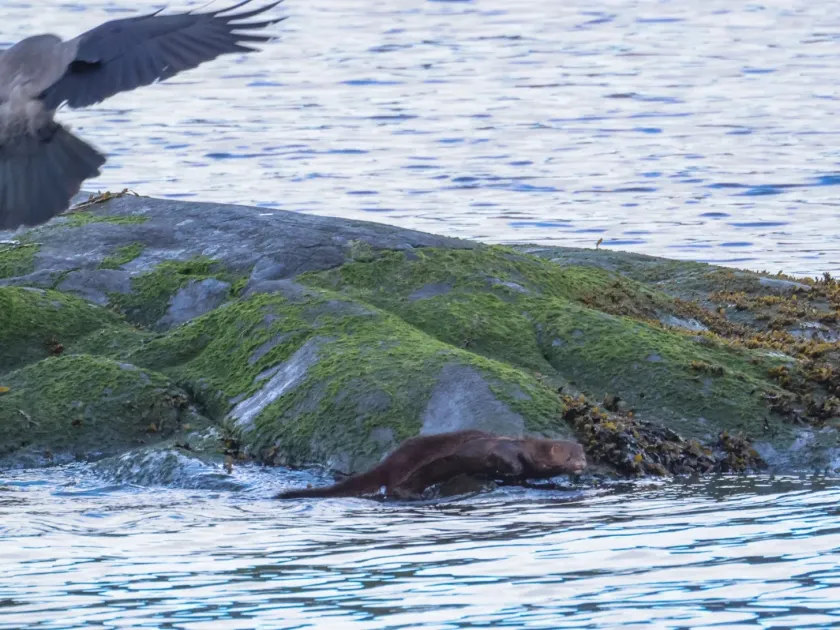
Description
How to identify
The American mink (Neovison vison) is a semi-aquatic carnivorous mammal belonging to the Mustelidae family. Originally native to North America, it has become an invasive species in many parts of the world.
This species is characterized by its slender, elongated body and thick, lustrous fur that is highly water-repellent. The coat color ranges from dark brown to black, usually featuring a distinctive white patch on the chin.
Adult American minks typically measure between 30 and 50 centimeters in length, excluding the tail. They are excellent swimmers, possessing partially webbed feet that aid in their aquatic mobility.
They are primarily nocturnal or crepuscular, meaning they are most active during dawn, dusk, and nighttime hours, which helps them avoid detection by humans.
Due to their high level of adaptability, they thrive in diverse habitats, including wetlands, riverbanks, and suburban areas located in close proximity to farms.
What it damages
The American mink is a significant threat to poultry farming, as it is known to breach enclosures and kill birds in excess of its food requirements, often slaughtering entire flocks.
Rabbit farming operations also face substantial risks, as minks can easily squeeze through small gaps in wire fencing or gnaw through wood to reach their prey.
In aquaculture, these predators frequently raid fish ponds, consuming juvenile fish and damaging netting, which leads to direct economic losses for the farmer.
Minks are capable of digging under foundations and chewing through various materials, causing physical damage to infrastructure, including insulation and perimeter fencing.
In addition to direct destruction of livestock, the presence of minks causes significant stress to the remaining animals, which may lead to reduced growth rates or decreased egg production.
When it appears
The American mink is active throughout the entire year, as it does not hibernate and continues its hunting activities even during the coldest winter months.
The spring season, particularly during the breeding and rearing period from April to July, is marked by increased food demand, making attacks on farms more frequent.
Late summer and autumn coincide with the dispersal of juveniles, who are actively seeking new territories and often encounter farm facilities during their search.
During the winter, when natural water bodies may freeze over, minks often shift their foraging focus towards human-made structures where food sources are more accessible.
Consequently, the risk of predatory attacks remains persistent across all seasons, necessitating continuous vigilance and maintenance of farm perimeter defenses.
Signs of infestation
Identifying mink presence involves looking for footprints, which are typically five-toed and visible on soft mud or damp soil near water sources and enclosure entries.
Finding dead livestock with no signs of partial consumption, but featuring clear bite marks around the neck or head, is a strong indicator of a mink raid.
The existence of "latrines," or piles of scat found on rocks or stumps near the farm perimeter, confirms that a mink has established a territory nearby.
Evidence of forced entry, such as broken wire mesh, dug tunnels beneath poultry house foundations, or chewed-through wood, clearly signals the predator's attempts to enter.
A persistent, strong musky odor in the vicinity of livestock buildings often indicates that a mink has been marking its presence in the area.
Control measures
The most effective strategy is the total physical exclusion of the predator by securing all buildings with high-quality, fine-gauge hardware cloth or metal mesh.
All ventilation gaps and doors must be properly sealed, and it is recommended to bury fencing at least 30 cm deep into the ground to prevent the animal from tunneling underneath.
Live-trapping is a highly recommended method for removal; using appropriate baited traps placed along known routes can effectively capture the predator without harming domestic pets.
Maintain a clean farmyard by removing brush, tall grass, and piles of debris, which otherwise provide the necessary cover for minks to approach structures undetected.
Implementing sensor-activated lighting or acoustic deterrents can serve as a supplementary defense mechanism to startle the animal and discourage it from approaching the site.
Taxonomy
- Latin name
- Neovison vison
- Family
- Mustelidae
- EPPO code
- NEVSVI
Discussion
No discussions yet — be the first.