
Stilt bug
Neoneides muticus
Description
How to identify
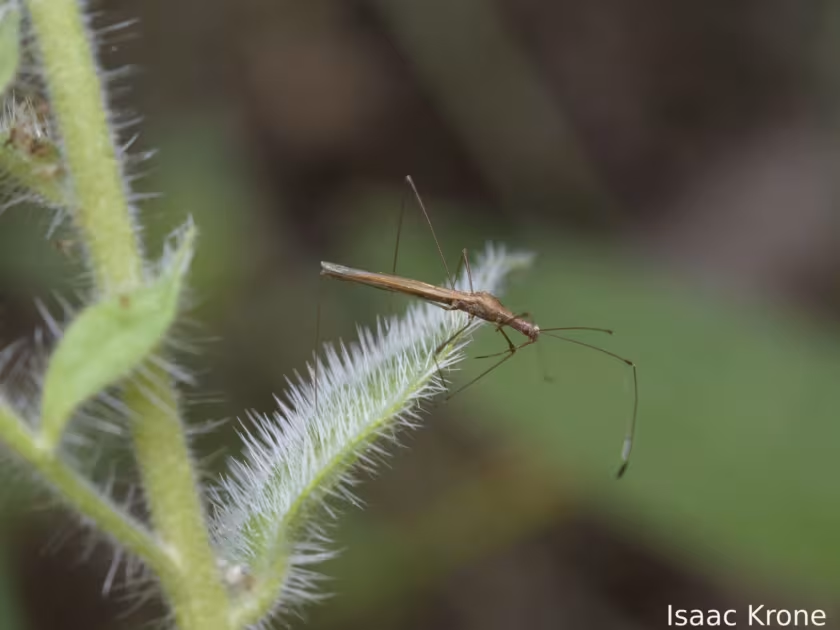
The stilt bug (Neoneides muticus) belongs to the Berytidae family within the Hemiptera order. These insects are easily recognized by their extremely slender, elongated bodies, which often mimic plant stems to avoid detection.
Their most prominent features are their exceptionally long and thin legs, often equipped with small, club-like swellings on the tibiae. The coloration is usually light brown or yellowish, perfectly adapted to camouflage on cereal stalks.
The head is equipped with a specialized piercing-sucking proboscis, designed for feeding on plant sap. Their antennae are notably long and filiform, featuring distinct segments that serve as critical sensory organs.
Adults are capable of flight, which allows them to migrate between fields, although they are frequently observed moving slowly over the host plants. Nymphs are smaller versions of the adults but lack wings and developed reproductive organs.
This species is widely distributed in open habitats and agricultural landscapes, typically favoring dry areas where wild and cultivated grasses are abundant.
What it damages
The stilt bug primarily feeds on a variety of wild and cultivated grasses, including major cereal crops like wheat, barley, and rye. Both adults and nymphs contribute to the feeding damage.
By piercing the stems and leaves, the bugs extract essential cell sap, which disrupts the plant's metabolic functions and water regulation. This process can significantly weaken the plant during its critical growth stages.
Heavy infestations can lead to stunted growth, reduced tillering, and an overall loss of vigor in the crop. While individual bugs do little damage, cumulative feeding by large populations can be detrimental.
The feeding sites can also serve as entry points for various secondary plant pathogens, which may lead to infections and further complicate the recovery of the crop.
In addition to physiological damage, the presence of these insects can affect the quality of the harvested produce, especially in high-density populations where the entire plant structure is compromised.
When it appears
The life cycle of Neoneides muticus begins in the spring when adults emerge from their overwintering sites as temperatures rise above 15°C. Their activity is closely aligned with the growth cycle of cereal crops.
During the summer months, multiple generations can develop, depending on regional temperature and moisture levels. Warm and dry weather usually accelerates their reproductive cycles.
The winter is passed in the adult stage, with insects hiding in crop residues, leaf litter, or crevices in the soil. These sites must provide adequate protection from frost and moisture.
Population peaks typically occur during the mid-summer period when the cereals are in their vegetative growth or grain-filling stages. This is when the impact on the plants is most noticeable.
As autumn temperatures drop, the insects cease feeding and migrate to more stable overwintering habitats to enter a state of dormancy until the following year.
Signs of infestation
Early symptoms of infestation include the appearance of small, pale or chlorotic spots on leaves. These marks are the direct result of the bug's proboscis penetrating the plant tissue.
As the feeding continues, leaves may start to yellow at the tips and eventually curl. The overall appearance of the infested field can look patchy or sickly compared to healthy sections.
Because of their thin body shape and camouflaged color, the bugs themselves are often difficult to spot unless one inspects the stalks and grain heads very closely.
General plant weakness and stunted development are common indicators. Farmers may notice that the crop fails to respond normally to irrigation or fertilizer applications in localized areas.
- Pale spots on leaf blades
- Yellowing and curling of leaf tips
- General stunting of plant growth
- Presence of slender insects on stalks
Control measures
Good agricultural practices are the first line of defense. Ensuring the proper incorporation of post-harvest crop residues and controlling weeds around field edges can significantly reduce overwintering populations.
Crop rotation is an effective strategy to break the life cycle of the stilt bug, as it removes the continuous availability of preferred host plants for successive generations.
Chemical control should be employed only when monitoring reveals that population levels exceed the economic threshold. Contact and systemic insecticides effective against Hemiptera are usually recommended.
Regular scouting using an insect sweep net is essential to detect the arrival of the pest from adjacent weedy areas. Monitoring should focus on field margins where the initial infestation usually occurs.
Encouraging natural predators, such as spiders, ground beetles, and various parasitic wasps, can help suppress stilt bug populations naturally without the need for intensive chemical use.
Taxonomy
- Latin name
- Neoneides muticus
- Order
- Hemiptera (bugs, aphids, leafhoppers)
- Family
- Berytidae
- EPPO code
- NENEMU
Discussion
No discussions yet — be the first.