
Lesser stilt bug
Berytinus minor
Description
How to identify
The Lesser stilt bug (Berytinus minor) belongs to the family Berytidae, commonly known as stilt bugs, within the order Hemiptera.
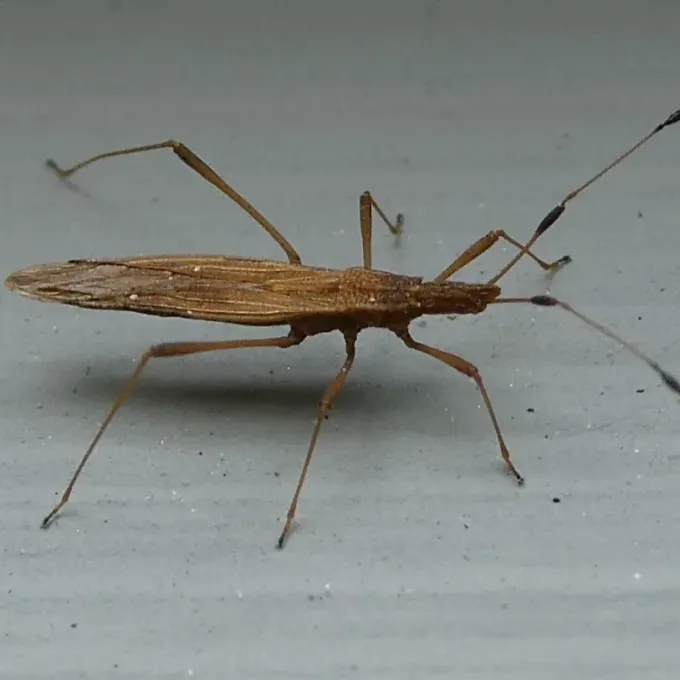
These insects are characterized by their extremely slender, elongated bodies, which usually measure between 6 and 9 millimeters in length.
They are easily recognizable by their disproportionately long, thread-like legs and antennae that feature distinct clubbed tips.
The coloration of Berytinus minor is typically pale brown or tan, providing excellent camouflage against stems and dry vegetation.
As true bugs, they possess specialized mouthparts, known as a rostrum, designed for piercing and sucking fluids from host plants.
What it damages
This species is primarily known as a pest of various legumes, including clover, alfalfa, peas, and vetch, causing significant agricultural concern.
Both adults and nymphs feed by piercing the plant tissues and extracting sap, which deprives the plant of essential nutrients and moisture.
Continuous feeding causes local necrosis and chlorosis, manifesting as yellow or white spots on the leaves and stems of the host plant.
Severe infestations can lead to stunted growth, reduced photosynthetic efficiency, and overall weakening of the crop's vigor.
Furthermore, the physical damage created by the bugs can serve as entry points for various phytopathogens, potentially leading to plant diseases.
When it appears
Adults overwinter in protected areas, such as leaf litter, hedgerows, or soil cracks, emerging once temperatures rise in the spring.
The spring emergence is typically followed by a period of feeding on early-season host plants before they migrate to agricultural fields.
The insect undergoes several nymphal stages during the summer months, with development speed being highly dependent on ambient temperature.
Peak activity often correlates with the vegetative growth stages of legume crops, posing the highest risk to young, developing plants.
As the weather cools in autumn, the final generation of adults seeks shelter to enter a state of dormancy until the next growing season.
Signs of infestation
Early warning signs include the appearance of tiny, discolored spots on the foliage, which are direct results of the bug's probing and feeding.
Leaves may show signs of curling or wilting, particularly when populations reach levels that compromise the plant's vascular integrity.
Infected crops often exhibit delayed flowering and poor pod development, which directly impacts the yield of seed-producing legumes.
Observation of the insects themselves is possible, as they tend to congregate on the lower stems or the undersides of the leaves.
- Yellowed or mottled leaf patterns.
- Evidence of stunted terminal growth.
- Presence of slender, long-legged bugs on plants.
Control measures
Effective management begins with strict weed control in field margins to eliminate secondary hosts for the Lesser stilt bug.
Cultural practices, such as deep autumn tillage, are crucial for disrupting the overwintering sites of the pest and reducing population density.
Farmers should implement scouting programs to monitor population levels and apply intervention only when economic thresholds are met.
Biological control agents, such as predatory insects and parasitic wasps, can help manage populations within a balanced ecosystem.
If chemical control is necessary, the application of systemic insecticides during the early growth stages is generally most effective.
Taxonomy
- Latin name
- Berytinus minor
- Order
- Hemiptera (bugs, aphids, leafhoppers)
- Family
- Berytidae
- EPPO code
- BERYMI
Discussion
No discussions yet — be the first.