
Jalysus wickhami
Jalysus wickhami
Description
How to identify
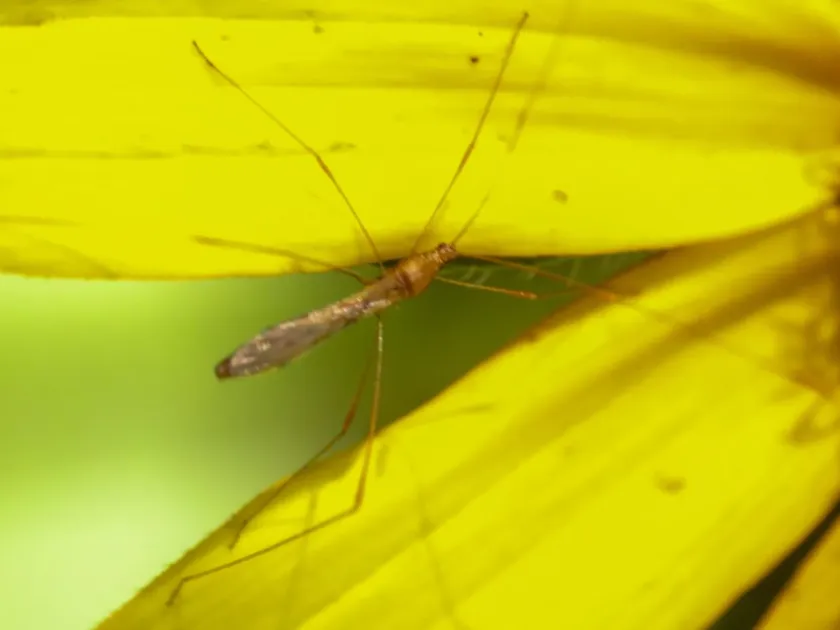
Jalysus wickhami belongs to the Berytidae family, commonly known as stilt bugs. These insects are characterized by their extremely thin and elongated legs, which resemble stilts, giving them a visual similarity to crane flies.
Adult individuals have a slender body, colored in yellowish-brown or brown tones, providing excellent camouflage against plant stems. The head is equipped with prominent eyes and long antennae that are in constant motion.
Nymphs are physically very similar to adults but lack wings and are smaller in size. They undergo several developmental stages, gradually increasing in volume and acquiring the coloration of mature specimens.
Systematically, this species is included in the order Hemiptera. Understanding the morphology of this pest is critical for early diagnosis, as their small size and specific body shape often cause them to go unnoticed by farmers.
A distinctive feature is their ability to move quickly across the plant, shifting between parts at the slightest sign of a threat. Populations frequently concentrate in leaf axils and on the underside of leaf blades.
What it damages
The primary crops susceptible to this pest include members of the Solanaceae family, specifically tomatoes, tobacco, and potatoes. The pest can also be found on various wild weeds, which complicates control measures.
Adult bugs and nymphs feed on plant sap by piercing the epidermis of stems, leaves, and flower stalks. During feeding, they inject saliva into plant tissues, containing enzymes that disrupt normal cell metabolism.
Tissue damage leads to localized necrosis, deformation of young shoots, and a decrease in the plant's overall turgor pressure. Damage during active flowering and fruit set is particularly dangerous, often resulting in flower drop.
Under conditions of high pest density, a significant reduction in crop growth rates and fruit quality is observed. Damaged areas become entry points for secondary bacterial and fungal infections transmitted by the bug itself.
Additional harm involves the indirect impact on photosynthesis: because of mass punctures, the area of healthy leaf surface is reduced, which negatively affects the yield of the entire agroecosystem.
When it appears
The activity of Jalysus wickhami directly correlates with the temperature regime of the growing season. The first individuals appear in fields in late spring or early summer, when air temperatures remain stable above 15–18 degrees Celsius.
The insect's life cycle during the warm season proceeds quite rapidly, allowing the species to produce several generations per summer. Peak mass reproduction usually occurs in mid-summer when weather conditions are most favorable.
Adults overwinter in plant debris, under fallen leaves, or in the topsoil layer. With the onset of the first autumn cold, the bugs' activity drops sharply, and they enter diapause until the following season.
Monitoring for the appearance of the pest should begin at the time of transplanting or seedling emergence. Regular field inspections allow for the detection of insect migration from surrounding weeds onto crops.
Regional climatic features can shift the timing of pest emergence; therefore, agronomists are advised to use pheromone or sticky traps to monitor population dynamics.
Signs of infestation
The first visual sign of infestation is small, light-colored puncture marks on the leaves, which may turn brownish over time. In cases of severe infestation, yellowing and premature wilting of terminal buds are observed.
Curling of young leaves and deformation of flower clusters are also important indicators of Jalysus wickhami presence. Plants look stunted, and their development lags noticeably behind healthy control samples.
The presence of excrement in the form of small dark spots on the underside of leaves often indicates the prolonged residence of a bug colony on a particular plant.
Upon careful inspection during the morning hours, one can notice the bugs themselves, which act extremely cautiously. Using a magnifying glass allows for the detection of nymphs in hard-to-reach places like axils and stems.
A reduction in the number of ovaries and the appearance of "empty" flowers can also be a consequence of these pests feeding on flower stalks, which disrupts the proper pollination and fruit-setting process.
Control measures
Agrotechnical control methods include thorough cleaning of fields from plant residues and the eradication of weeds that serve as reservoirs for the pest during the off-season.
The application of systemic and contact insecticides effectively reduces bug populations. The choice of chemical must be based on pre-harvest intervals and environmental regulations regarding pesticide use.
- Timely weeding of rows.
- Crop rotation to break the developmental cycle.
- Application of biological preparations during early infestation stages.
- Monitoring of field borders.
Biological control involves the use of entomophages that can feed on bug nymphs, suppressing their numbers naturally. It is important to preserve natural biodiversity in the field area.
On an industrial scale, a combined approach is recommended, which integrates monitoring using yellow sticky traps with precise application of pesticides once the economic injury threshold is exceeded.
Taxonomy
- Latin name
- Jalysus wickhami
- Order
- Hemiptera (bugs, aphids, leafhoppers)
- Family
- Berytidae
- EPPO code
- JALYWI
Discussion
No discussions yet — be the first.