
Ash plant bug
Neoborus amoenus
Description
How to identify
The Ash plant bug (Neoborus amoenus) is a small insect belonging to the family Miridae, commonly known as plant bugs. These insects are known for their soft bodies and specialized feeding habits on trees.
Adults typically measure between 4 and 6 mm in length. Their coloration ranges from yellowish-brown to nearly black, which provides excellent camouflage against the bark and leaves of ash trees.
The insects possess well-developed wings, allowing them to disperse effectively within the canopy, while their mouthparts are adapted for piercing and sucking plant tissues.
Nymphs look similar to adults but are smaller and lack fully developed wings. They often exhibit a lighter, greenish-yellow color, making them difficult to spot on the foliage.
These bugs are hemimetabolous, meaning they undergo incomplete metamorphosis, with nymphs resembling adults and occupying the same habitat throughout their life cycle.
What it damages
The Ash plant bug is highly host-specific, feeding almost exclusively on ash trees (Fraxinus spp.). They extract cell contents, causing significant localized damage to leaf tissues.
By piercing the leaf epidermis, they disrupt the plant's photosynthetic process, leading to the formation of chlorotic spots and tissue necrosis at the feeding sites.
Heavy infestations can lead to severe crown deterioration, causing premature leaf drop, which weakens the tree's health and vitality over time.
Young ash trees in nurseries and young plantations are particularly susceptible, as repeated feeding can stunt their growth and lead to deformed branch development.
The damage caused by these insects often leaves the host tree more vulnerable to secondary infections by opportunistic fungi or pests seeking weakened tissue.
When it appears
The life cycle begins in spring when overwintered eggs, laid within the bark or near buds, hatch into nymphs coincide with the bud break of the ash tree.
Peak activity and feeding intensity occur during the spring months, specifically when the tree is producing new, succulent leaves that are easy for the bugs to penetrate.
Depending on the climatic zone, the species may produce one or two generations per year, with activity persisting until late summer or early autumn.
As the season progresses, adults mate and females deposit eggs into the plant tissues, where they remain in a dormant state through the winter until the following spring.
Weather patterns significantly influence the timing of emergence, with warmer springs often leading to earlier appearances of the insect population.
Signs of infestation
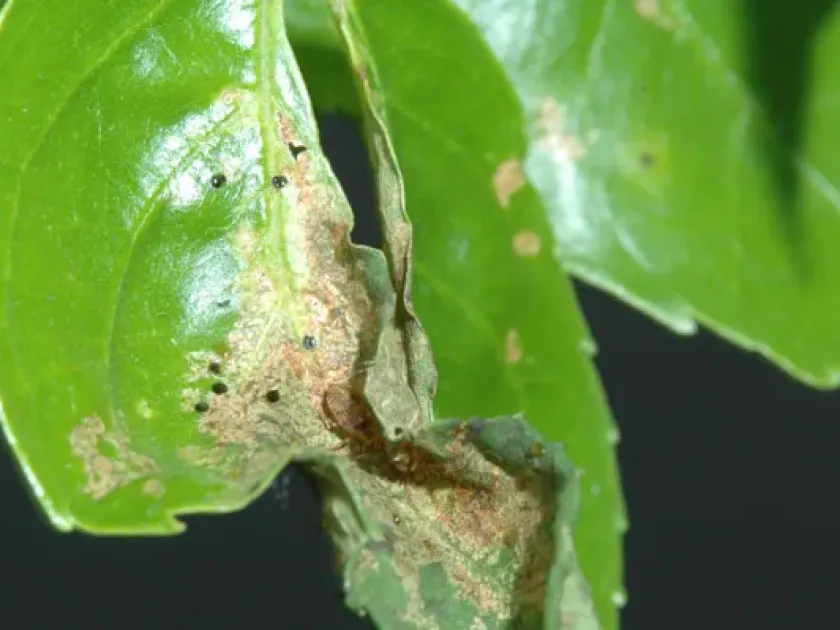
The most prominent sign of an infestation is the appearance of small, pale or yellowish stippling on the leaves, caused by the bugs extracting chlorophyll.
Over time, these individual stippled spots merge, causing entire sections of the leaf to become discolored and look sickly or chlorotic.
Close inspection of the leaf undersides often reveals the presence of nymphs or their dark, spotted excrement, which serves as a telltale sign of their activity.
Distorted, curling leaves and stunted growth of young shoots are common symptoms associated with established or severe populations of the pest.
Premature leaf senescence and early autumn coloration are additional indicators that the tree has suffered significant damage from the feeding population.
Control measures
Management focuses on early detection through monitoring, particularly in spring, to determine if the population density warrants a chemical intervention.
Systemic insecticides are generally the most effective method, as they are absorbed by the tree and provide protection during the critical period of nymph development.
Promoting a healthy environment for natural predators such as lady beetles, lacewings, and predaceous bugs can help keep the population in check naturally.
Providing proper tree care, including regular watering and nutrient management, helps ensure that trees can recover more efficiently from pest-related damage.
- Apply systemic insecticides during initial leaf development
- Monitor tree crowns with sticky traps to track population spikes
- Remove severely damaged shoots to reduce local populations
- Support natural predators in the landscape
- Use biopesticides where environmentally friendly options are required
Taxonomy
- Latin name
- Neoborus amoenus
- Order
- Hemiptera (bugs, aphids, leafhoppers)
- Family
- Miridae
- EPPO code
- NEOBAM
Discussion
No discussions yet — be the first.