
Stilt bug
Neides tipularius
Description
How to identify
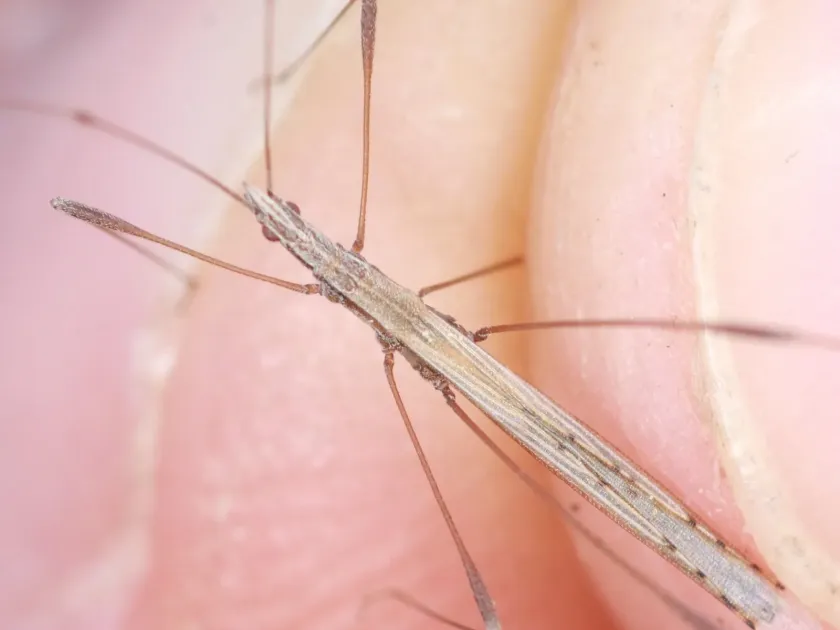
The stilt bug, scientifically known as Neides tipularius, belongs to the family Berytidae within the order Hemiptera. These insects are characterized by a very slender and elongated body structure, typically reaching 8 to 11 mm in length.
Their appearance often resembles a mosquito, featuring extremely thin and long legs that allow them to move gracefully over plant surfaces. The coloration is generally pale brown or straw-like, providing excellent camouflage.
The antennae are notably long and end in a distinct club-like thickening. The head features prominent compound eyes, and the pronotum is slender, contributing to their overall fragile aesthetic.
Their wings are transparent and rest flush against the body when not in use. Despite their delicate appearance, they are well-adapted to the environments in which they live, effectively navigating complex plant architectures.
Nymphs are smaller versions of the adults, though they lack fully developed wings and have a slightly different body proportion during their early developmental stages.
##damage##Stilt bugs primarily feed on various wild and cultivated plants, particularly those in the Caryophyllaceae family, as well as several types of cereal crops.
They are piercing-sucking insects that insert their stylets into plant tissues to extract sap, which can significantly stress the host plant over time.
Frequent feeding leads to the formation of necrotic spots, chlorosis of the leaves, and stunted growth of the stems and developing shoots.
In cases of high infestation, cereal crops may suffer from reduced yields, as the bugs feed on the developing grains, draining the nutrients that should otherwise support the crop's maturation.
Furthermore, these insects may act as vectors for various plant pathogens, potentially leading to more severe systemic issues within the affected crop fields.
When it appears
Stilt bugs overwinter as adults, finding refuge in sheltered areas such as leaf litter, dried grass, or other dense vegetation remnants near agricultural fields.
Activity resumes in the early spring once temperatures consistently rise above the threshold of 10 to 12 degrees Celsius, allowing the insects to emerge and feed.
The mating and oviposition period typically occurs throughout late spring and early summer, with eggs being laid directly on the stems or leaves of host plants.
Nymphal development takes place during the summer months, with the duration depending heavily on the prevailing weather conditions in the specific geographic area.
By late autumn, the bugs prepare for the winter months, moving toward their overwintering sites where they enter a state of diapause until the following spring.
Signs of infestation
Early identification of an infestation often starts with noticing minute, pale, or necrotic spots on the foliage where the bugs have used their mouthparts to feed.
Careful inspection of the plants, particularly during the cooler hours of the day, often reveals the presence of adult bugs resting on the underside of leaves or along the stems.
Severe infestations often present as premature yellowing of leaves or the twisting of new shoots, which can sometimes be mistaken for nutrient deficiency.
- Presence of small chlorotic patches on leaf surfaces.
- Wilted appearance of terminal shoots during warm spells.
- Evidence of shed nymphal skins (exuviae) left on plant parts.
If consistent monitoring indicates a high density of these insects, it serves as a critical indicator that intervention is necessary to prevent significant yield losses.
Control measures
Integrated Pest Management (IPM) for the stilt bug focuses largely on cultural practices, such as the systematic removal of weeds that serve as alternative hosts.
Deep fall tillage is an effective mechanical control measure, as it disrupts the overwintering sites and significantly reduces the adult population for the subsequent spring.
Crop rotation remains a fundamental strategy, preventing the buildup of the population by regularly changing the host environment and breaking the insect's lifecycle.
When economic thresholds are reached, targeted insecticide application may be required, focusing on the nymphal stages to prevent further damage and population expansion.
Encouraging natural predators, including various beneficial insects, can play a key role in suppressing populations, making chemical intervention a last resort in a healthy ecosystem.
Taxonomy
- Latin name
- Neides tipularius
- Order
- Hemiptera (bugs, aphids, leafhoppers)
- Family
- Berytidae
- EPPO code
- NEIDTI
Discussion
No discussions yet — be the first.