
Nebria livida
Nebria livida
Description
How to identify
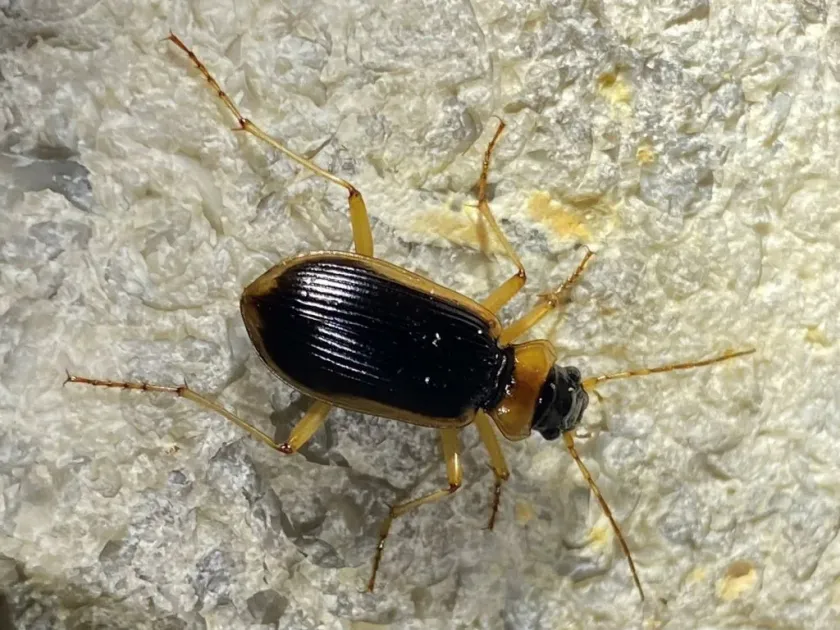
Nebria livida is a species of ground beetle belonging to the family Carabidae within the order Coleoptera. It is a predatory insect typically found in moist environments.
The adult beetle measures approximately 10–12 mm in length, featuring an elongated body that is structurally adapted for rapid movement across the soil surface.
Its coloration ranges from yellowish-brown to reddish-brown, which provides effective camouflage against soil and organic debris in its natural habitat.
The head possesses well-developed mandibles, highlighting its predatory nature, though it may occasionally feed on young plant tissues when preferred prey is scarce.
The larvae are characterized by an elongated body shape, three pairs of legs, and high agility, allowing them to navigate efficiently through the upper soil layers.
What it damages
The pest status of Nebria livida arises when adults or larvae consume tender plant shoots, leaves, or roots, particularly during the early stages of crop development.
Field and vegetable crops are most vulnerable during germination and seedling emergence, as mechanical damage can severely impede plant vigor.
As these beetles are nocturnal, signs of feeding are typically observed in the morning, manifesting as ragged, irregular edges on seedling leaves.
Root damage caused by larvae can weaken the plant's structural integrity, leading to wilting, stunted growth, or increased susceptibility to soil-borne pathogens.
High population densities in fields with significant organic debris can result in localized patches of crop failure, necessitating careful field monitoring.
When it appears
Activity generally commences in the spring when soil temperatures rise, prompting the beetles to emerge from their overwintering sites.
The peak population density usually occurs in mid-summer, coinciding with the active growth phases of many agricultural crops in the region.
Adults engage in active foraging and mating throughout the summer months, subsequently laying eggs in moist soil substrates rich in organic matter.
As autumn approaches, activity levels decline as the insects seek out protected shelters in the soil or beneath debris to survive the winter period.
The life cycle is generally univoltine, although fluctuating weather conditions can influence the timing of emergence and the duration of each developmental stage.
Signs of infestation
A primary indicator of infestation is the presence of uneven leaf damage on young seedlings, visible primarily during early morning inspections.
Checking the rhizosphere of affected plants often reveals the presence of beetles hiding under soil clods or larvae within the upper root zone.
Sudden wilting or yellowing of seedlings without apparent disease symptoms may indicate root feeding by beetle larvae in the soil.
The presence of large amounts of crop residue on the soil surface is a key factor that often correlates with higher local populations of this species.
Using pitfall traps in the evening can help confirm the presence and relative abundance of Nebria livida within a specific agricultural field.
Control measures
Effective management relies heavily on cultural practices, such as rigorous crop rotation to break the beetle's life cycle and reduce population buildup.
Deep autumn tillage is a recommended strategy to disrupt overwintering sites, effectively reducing the number of larvae and adults surviving until spring.
Maintaining field hygiene by clearing weeds and excess crop residue limits the availability of refuges and secondary food sources for the beetles.
Chemical control should only be utilized when pest thresholds are exceeded, choosing products that minimize impact on beneficial predatory insects.
- Implementation of early sowing to allow plants to pass the vulnerable stage.
- Management of soil moisture to discourage excessive beetle activity.
- Use of biological controls like entomopathogenic fungi.
- Regular field scouting to monitor pest density.
Taxonomy
- Latin name
- Nebria livida
- Order
- Coleoptera (beetles)
- Family
- Carabidae
- EPPO code
- NEBRLI
Discussion
No discussions yet — be the first.