
Nebria brevicollis
Nebria brevicollis
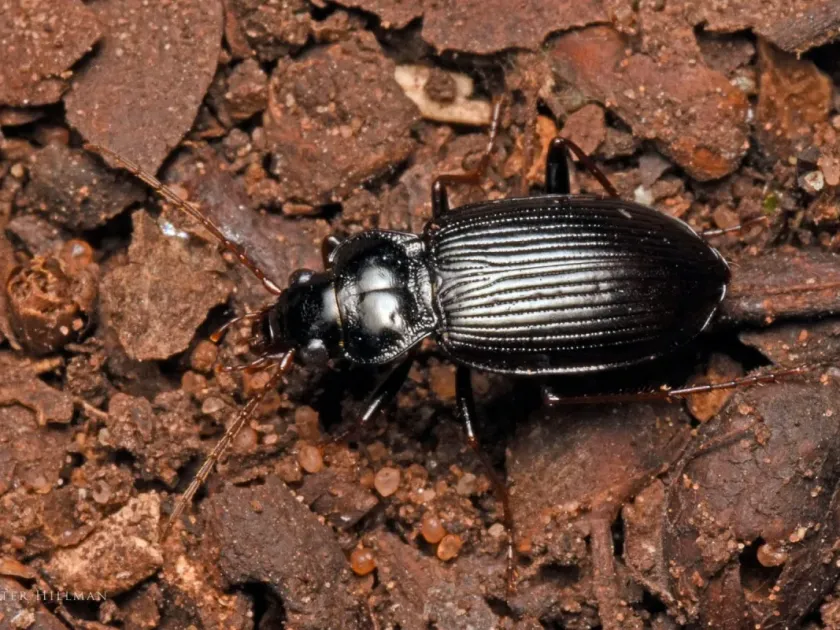
Description
How to identify
Nebria brevicollis, commonly known as a ground beetle, is a species belonging to the family Carabidae within the order Coleoptera. Adult beetles are typically 10–13 mm long, featuring a dark brown or black shiny body.
The key identification feature is the pronounced narrowing of the pronotum near the base, combined with distinct longitudinal striations on the elytra. The legs and antennae are generally lighter, exhibiting a reddish-brown coloration.
Larvae are elongated and somewhat flattened, covered in chitinous plates. They are highly mobile and possess robust, biting mouthparts designed for active hunting in the soil and leaf litter layer.
This beetle is primarily nocturnal. During daylight hours, it remains hidden under stones, plant debris, or within soil crevices, emerging only after sunset to search for prey, which is its primary behavior.
Systematically, this species belongs to the genus Nebria, which is widely distributed across temperate regions. While often considered beneficial due to their predatory habits, they can become problematic in specific agricultural conditions.
What it damages
Although adults and larvae are fundamentally predators that consume smaller invertebrates, they can turn to phytophagy when prey density is low or when their natural food sources are unavailable.
The primary damage occurs on seeds and young seedlings of cereals, sugar beets, and various vegetable crops. Adults can bite through the stems of young plants near the soil surface, causing them to collapse.
Larvae contribute to the damage by gnawing on the root systems of seedlings. Such damage disrupts nutrient uptake and makes the plants susceptible to secondary fungal or bacterial infections that occur at the damage sites.
These damages are most significant in fields with high moisture content and thick layers of organic debris. In such environments, the beetles thrive and their populations can reach levels that impact overall crop density.
In most agro-ecosystems, the economic impact is negligible, but in intensified agricultural production, Nebria brevicollis should be monitored as a potential risk factor during the early establishment phase of crops.
When it appears
The life cycle of Nebria brevicollis is closely linked to seasonal temperature variations. Adult activity typically peaks during the spring and autumn months, favoring mild, moist conditions for reproduction and movement.
Reproduction occurs in the autumn, with females laying eggs directly into the soil. Larvae overwinter in the soil and remain active as long as the ground does not freeze, allowing them to continue development in milder regions.
Pupation generally occurs during the spring. In the heat of summer, adult activity significantly decreases as beetles enter a state of aestivation, retreating into deeper soil layers to avoid desiccation and high heat.
A new generation of beetles typically emerges at the end of the summer or early autumn. This timing coincides with the planting season for winter cereals, increasing the risk of seedling damage during emergence.
Agronomic monitoring should focus on the early spring (sowing time) and the autumn (emergence of winter crops), as these are the periods when crop density is most vulnerable to potential feeding.
Signs of infestation
The main sign of damage is the appearance of irregular patches of thinned crops, where seedlings appear to have been severed at the base of the stem without signs of decay or pathogen infestation.
Detailed examination of the rhizosphere will often reveal characteristic chew marks on the root systems of seedlings. The presence of larvae can be confirmed by looking for small boreholes in the soil or in the root collar area.
The presence of adults is easily verified through the use of pitfall traps, which are standard tools for monitoring epigeic insect populations. Beetles are frequently caught in these traps during their nocturnal roaming.
High population densities often correlate with fields adjacent to woodland or uncultivated margins, which serve as refugia. Observations should be concentrated in these border zones when assessing potential risks.
Plants affected by larval feeding often show stunted growth or discoloration, as the damage to the roots prevents efficient water and nutrient intake, leading to an overall reduction in crop vigor compared to healthy areas.
Control measures
Cultural control is the most effective approach for managing Nebria brevicollis. Deep autumn plowing is highly effective at destroying larvae habitats and exposing them to natural predators like birds.
Maintaining a proper crop rotation and practicing good weed management is essential, as high weed density provides refuge and alternative food sources for the beetles throughout the growing season.
Chemical control is rarely necessary but can be implemented as a seed treatment with systemic insecticides if there is a documented history of severe infestation in a specific area, ensuring protection at germination.
Optimizing growing conditions, such as ensuring high-quality seedbed preparation and adequate fertilization, helps crops grow rapidly through the vulnerable seedling stage, significantly reducing the window for potential damage.
- Use pitfall traps for population monitoring during peak periods.
- Remove excess plant debris from the field surface before sowing.
- Consider insecticide seed treatments in high-risk areas with previous damage history.
Taxonomy
- Latin name
- Nebria brevicollis
- Order
- Coleoptera (beetles)
- Family
- Carabidae
- EPPO code
- NEBRBR
Discussion
No discussions yet — be the first.