
Square-nosed fungus beetle
Nausibius clavicornis
Description
How to identify
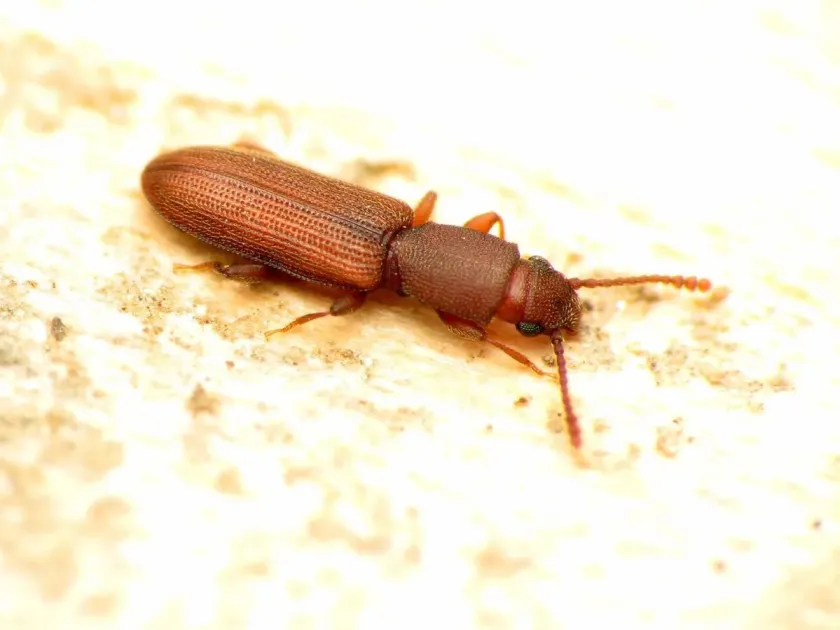
The Square-nosed fungus beetle (Nausibius clavicornis) is a member of the Silvanidae family within the order Coleoptera. It is a small insect, typically measuring 2.5–3 mm in length, known for its flat, reddish-brown body.
The name reflects the distinct shape of its antennae, which terminate in a noticeable club. Its flattened appearance and serrated edges on the pronotum are key features used by entomologists to distinguish this species from other stored-grain beetles.
The larvae are yellowish-white and elusive, as they typically develop inside the food substrate, making them difficult to detect during the early stages of an infestation without professional grain inspection tools.
Adult beetles are highly mobile and thrive in warehouse environments, particularly in crevices and areas where dust and food particles accumulate. They prefer warm, humid conditions for optimal reproduction.
Identification often requires careful examination under a microscope, focusing on the morphological structures of the head and thoracic segments, which are characteristic of this specific beetle species.
What it damages
As a significant stored-product pest, the Square-nosed fungus beetle infests a wide range of agricultural commodities. It is commonly found in grain silos, flour mills, and processed food storage facilities.
Primary targets include cereal grains such as wheat, barley, and oats. Furthermore, the beetle is notorious for infesting flour, bran, breakfast cereals, and various starch-based food products.
The pest is also known to feed on dried fruits, nuts, and oilseeds, especially if the commodities have been exposed to high humidity or have already been compromised by other insect pests or mold.
The beetles burrow into the grain, consuming the endosperm. This feeding behavior causes significant weight loss in stored grain and reduces the overall quality of the product, rendering it unsuitable for human or animal consumption.
Infested commodities become contaminated with larval skins, feces, and webbing, which ruins the commercial value of the stock and necessitates costly remediation or disposal measures.
When it appears
The activity and lifecycle of the Square-nosed fungus beetle are heavily dictated by environmental factors within the storage facility. They do not have a strict seasonal cycle if the warehouse is climate-controlled.
In temperate climates, population growth slows down significantly during the winter months. However, in heated warehouses, the life cycle continues year-round, posing a constant threat to stored goods.
High moisture levels in the grain mass are the most critical factor for rapid population expansion. Moisture allows the beetle to thrive and reach maturity much faster, leading to exponential growth in infestation rates.
Mass migration or spread of the beetle often occurs during the transport of infested grain between silos or through contaminated machinery that has not undergone proper cleaning protocols.
Monitoring for the presence of the beetle should be a continuous process, utilizing pheromone traps and periodic grain sampling to detect infestations before they escalate into significant economic losses.
Signs of infestation
The presence of adult beetles in grain samples is the primary indicator of infestation. Sifting grain samples through laboratory sieves is a common technique for identifying the pest in bulk storage.
A distinctive sweet or musty odor, often accompanying the presence of mold, serves as an alert that the beetle population has reached a level that interferes with the grain's natural ventilation and moisture balance.
Visible clumping of grain or flour indicates that the larvae are active. These clumps are held together by excrement and organic debris, which often promote the growth of secondary fungal infections.
Examination of the grain often reveals hollowed-out seeds or grains with small entry holes, which are typical signs of internal feeding by the larval stages of the beetle.
- Reduced grain weight and density.
- Unusual odors emanating from storage bins.
- Presence of grain dust and debris on surfaces.
- Localized heating (hot spots) within the grain mass.
Control measures
Sanitation is the cornerstone of control. Cleaning storage facilities, removing all grain dust, and sealing crevices where insects might hide are essential preventative measures before introducing new stock.
Maintaining low moisture content in the stored grain is crucial. Keeping the grain dry (below 14% moisture) creates an environment that is largely inhospitable to the Square-nosed fungus beetle.
When an infestation is detected, fumigation with phosphine-based products is the standard procedure. This method is highly effective at reaching hidden pests inside the grain kernels and within structural gaps.
Applying residual contact insecticides to the surfaces of empty storage bins and machinery can prevent re-infestation and provide a chemical barrier against migrating beetle populations.
Active aeration and cooling of the grain mass are effective management strategies to keep the grain temperature below the threshold required for the beetle's rapid reproduction and development.
Taxonomy
- Latin name
- Nausibius clavicornis
- Order
- Coleoptera (beetles)
- Family
- Cucujidae
- EPPO code
- NAUSCL
Discussion
No discussions yet — be the first.