

Description
How to identify
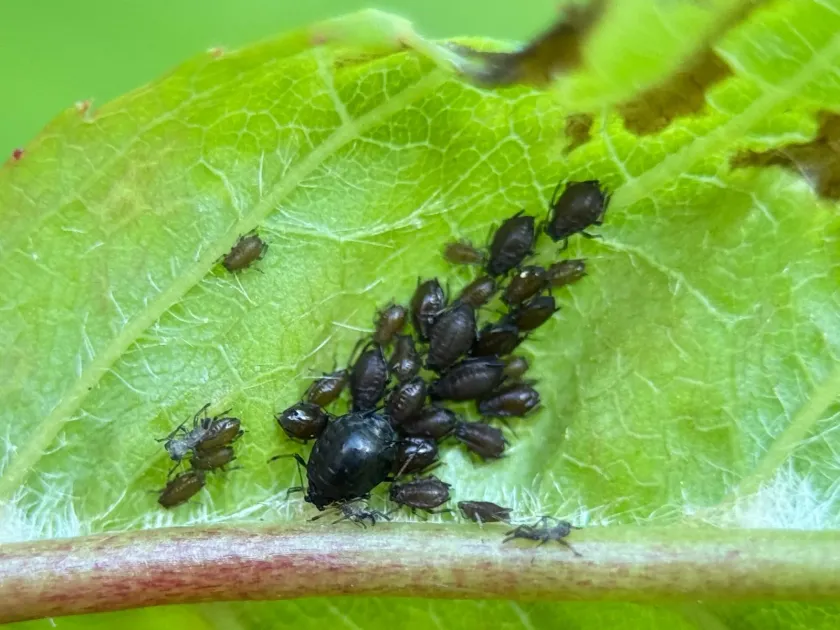
The black cherry aphid (Myzus cerasi) is a member of the Aphididae family, known for its distinct shiny black appearance and its tendency to cluster on host plants.
Adult aphids measure about 2 to 2.5 mm in length. The population consists of wingless forms that remain on the host and winged forms that facilitate dispersal to new trees.
These insects are characterized by their sucking mouthparts, which allow them to extract vital sap from the young, tender tissues of cherry and sweet cherry trees.
The life cycle is complex, involving overwintering as eggs on the bark near buds, followed by the hatching of stem mothers in early spring when the tree starts to bud.
They are colonial insects, meaning they aggregate in large numbers on the undersides of leaves, making them difficult to detect until the damage becomes visible.
What it damages
Black cherry aphids primarily target stone fruit species, with cherries being their most preferred host. They settle on the tips of new growth and developing leaves.
Feeding causes leaves to curl inward and become distorted. This curling serves as a protective habitat for the aphid colony, shielding them from environmental factors and predators.
The secretion of honeydew is a significant problem, as it promotes the growth of sooty mold, which blocks sunlight and interferes with the leaf's ability to photosynthesize.
Severe infestations lead to stunted growth of terminal shoots, which can significantly reduce the tree's vigor and negatively impact fruit development and yield.
In young trees, repeated attacks over several seasons can cause branch dieback and significantly weaken the overall health of the orchard.
When it appears
Activity begins in early spring, synchronized with the bud-burst stage of the host tree, as the first nymphs emerge from overwintered eggs.
During late spring and early summer, populations reach their peak, fueled by rapid reproduction cycles that generate successive generations of aphids.
As summer temperatures rise, some winged adults migrate to secondary host plants, such as bedstraw or speedwell, where they remain until the season turns.
In late summer and autumn, a return migration occurs, where mating takes place and fertilized females lay overwintering eggs on the cherry trees.
The timing of these seasonal events is heavily influenced by local climate conditions, with warmer springs leading to faster and more aggressive colony colonization.
Signs of infestation
The most diagnostic sign is the presence of tightly curled, blackened, or stunted leaves at the tips of shoots, which often appear unsightly and deformed.
Sticky honeydew covering the leaves and branches is a clear indicator of aphid presence, often accompanied by the development of a black, soot-like substance.
Increased ant activity on the tree is a strong indicator of aphid presence, as ants feed on the honeydew and actively protect the aphids from natural predators.
Close observation of the underside of affected leaves reveals masses of shiny black insects, often surrounded by white cast-off skins from their molting process.
Stunted shoot growth and premature leaf drop in the upper canopy are common late-stage indicators of a significant aphid infestation within the tree.
Control measures
- Apply dormant oil sprays in late winter or early spring to destroy overwintering eggs before they hatch.
- Manage weed populations and remove root suckers near the tree base to eliminate summer refuge sites for the aphids.
- Encourage beneficial predatory insects like ladybugs, lacewings, and hoverflies by avoiding broad-spectrum insecticides.
- Use physical barriers like sticky bands on the trunks to deter ants and prevent them from protecting the aphid colonies.
- Apply systemic or contact insecticides during the active growing season if the infestation exceeds the economic threshold for tree health.
Content graph
Connections · Black cherry aphid
Most often together:
Marketplace
Products · 2

Biology
Taxonomy
- Latin name
- Myzus cerasi
- Order
- Hemiptera (bugs, aphids, leafhoppers)
- Family
- Aphididae
- EPPO code
- MYZUCE
Community
Discussion
No discussions yet — be the first.