
Least weasel
Mustela nivalis
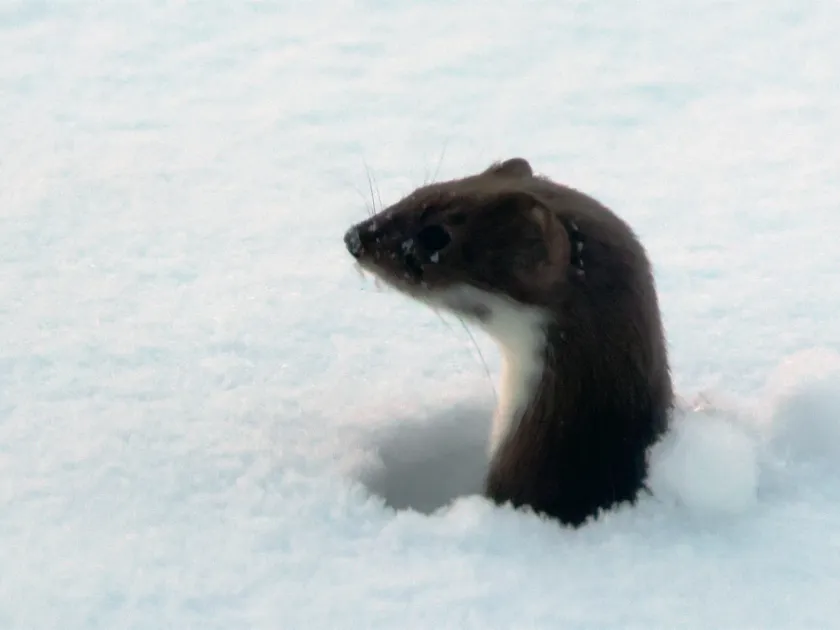
Description
How to identify
The least weasel (Mustela nivalis) is the smallest member of the order Carnivora and the family Mustelidae. An adult has a slender, flexible body ranging from 11 to 26 cm, enabling it to navigate deep into rodent burrows with ease.
The coat color varies by season; it is brown with a white belly in summer and turns pure white in winter in colder climates. It is characterized by swift, darting movements and a habit of standing upright to survey its surroundings.
Weasels are primarily nocturnal but can be active during the day. They do not dig their own burrows but occupy abandoned rodent tunnels or crevices under logs, stones, and tree roots.
These animals have a high metabolic rate, requiring them to hunt frequently and aggressively. Despite their small size, they are fearless predators capable of tackling prey larger than themselves.
The population density of Mustela nivalis in agricultural areas is directly proportional to the availability of its primary food source: voles, mice, and other small rodents.
What it damages
From an agricultural standpoint, the least weasel is a complex species: while it acts as a natural control agent for rodent pests, it poses a severe threat to small-scale poultry farming.
The primary damage occurs in chicken coops and sheds. Due to their small stature, weasels can penetrate tiny gaps or vents, leading to significant losses of chicks and adult birds during nocturnal raids.
They often exhibit surplus killing behavior, attacking more birds than they can consume, which can devastate a backyard flock in a single night.
The constant presence of a predator causes significant stress to livestock and domestic animals, which can lead to reduced health and lower productivity in the farmyard.
Physical damage can also occur to structural components of outbuildings, as the weasel may gnaw or dig around foundations to secure better access or safe nesting sites.
Control measures
The most effective strategy for protection is the structural fortification of poultry houses. All gaps, cracks, and vents should be covered with heavy-duty, small-mesh hardware cloth.
Good sanitation practices are essential; keep the perimeter of buildings clear of tall grass, wood piles, and construction debris to remove potential hiding spots for the predator.
Ultrasonic deterrent devices may offer temporary relief, although wild predators often adapt to these frequencies if they find reliable food sources nearby.
Live trapping is a humane and recommended approach. Traps should be placed along natural travel paths using appropriate bait to catch and relocate the animal far from your property.
Chemical control is strongly discouraged as it is inhumane, ineffective for small carnivores, and poses a significant risk to domestic pets and the local ecosystem.
Taxonomy
- Latin name
- Mustela nivalis
- Family
- Mustelidae
- EPPO code
- MUSTNI
Discussion
No discussions yet — be the first.