
Broad-winged katydid
Microcentrum rhombifolium
Description
How to identify
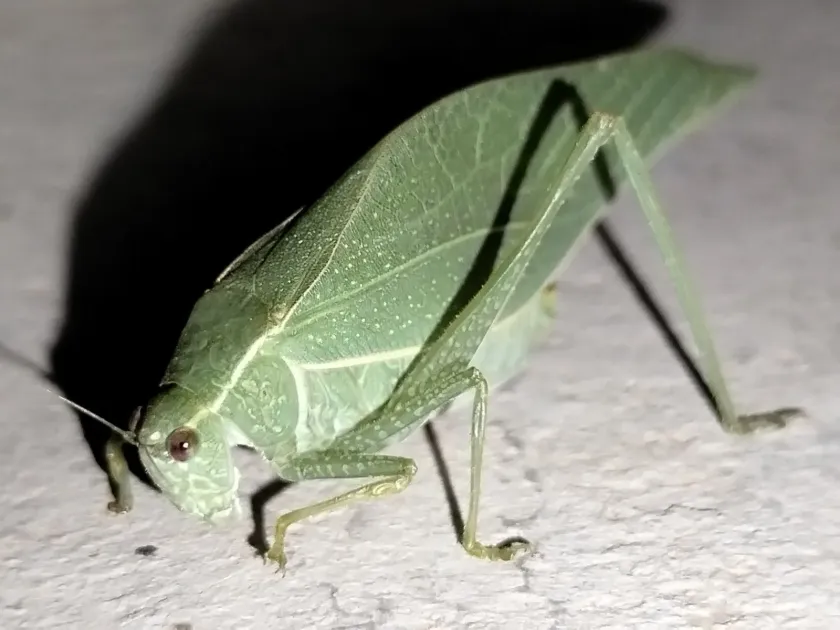
The Broad-winged katydid (Microcentrum rhombifolium) is a member of the Tettigoniidae family within the order Orthoptera. This insect is famous for its exceptional camouflage, as its body shape and green coloration mimic the leaves of the trees it inhabits.
Adult insects typically reach 50–60 mm in length. Their wings are notably wider than their bodies, which is the defining physical characteristic of this species. They possess powerful hind legs designed for jumping between branches.
Females are equipped with a sharp, sickle-shaped ovipositor, which they use to insert eggs into the edges of leaves or under the bark of twigs. This makes their eggs difficult to locate during routine garden inspections.
Nymphs, or immature katydids, undergo a series of molts, progressively increasing in size. Even in their early stages, they retain the leaf-like appearance and agile nature of the adults.
These insects are primarily arboreal, preferring the higher canopy of trees and shrubs, which often allows them to remain hidden from gardeners until significant damage is already done.
What it damages
Broad-winged katydids feed primarily on the foliage of a wide range of woody plants. Fruit trees such as apples, pears, and various citrus species are frequent targets, along with many common ornamental shrubs.
Both adults and nymphs cause damage by chewing large, irregular sections out of leaves. This feeding pattern reduces the tree's overall photosynthetic capacity, which can hinder growth and fruit development.
Mechanical damage caused by females during oviposition is another significant issue. By slitting the plant tissues to lay eggs, they create entry points for secondary bacterial or fungal pathogens.
In cases of high population density, these katydids can cause substantial defoliation. This weakens the tree, making it more susceptible to winter injury and reducing its structural integrity over time.
Ornamental plants lose their aesthetic value quickly when infested, as the combination of ragged leaf margins and potential twig dieback ruins their appearance for landscapes and nurseries.
When it appears
The life cycle of the Broad-winged katydid consists of one generation per year. They overwinter in the egg stage, which remains protected inside the plant tissue until the return of warmer spring weather.
Nymphs typically emerge in the spring, coinciding with the flush of new growth on host trees. This is the period when they begin their primary feeding stage, targeting young, nutrient-rich leaves.
Adult katydids are most active during the summer months. During this time, they mature, mate, and continue to feed actively, which makes them highly visible during the peak of the growing season.
As autumn approaches, activity wanes as the insects complete their cycle. Females focus on finding suitable sites for oviposition to ensure the survival of the next generation through the winter.
Monitoring should be conducted during the evening hours. Their characteristic chirping, or "stridulation," often serves as the most reliable indicator that an infestation is present in your garden.
Signs of infestation
The most common sign of an infestation is the appearance of shredded or ragged leaf edges. Unlike caterpillars that may skeletonize leaves, katydids tend to consume larger, irregular chunks from the leaf perimeter.
Close inspection of twigs and leaf edges may reveal rows of flat, scale-like eggs. These eggs are often tightly pressed against the surface and can be mistaken for natural plant features.
The audible presence of males chirping at dusk is a clear sign that adults are present. This sound often carries well across a garden and indicates a established population.
The presence of exuviae—the discarded outer skins left behind by nymphs during their molting process—on branches or trunks provides proof of successful population growth and development.
Severe infestations may result in visible stress symptoms on the plant, including stunted new growth, premature yellowing of leaves, and an overall lack of vigor in the foliage.
Control measures
Effective management begins with cultural controls. Pruning and destroying branches containing egg clusters can significantly reduce the number of nymphs that hatch in the following spring.
In smaller garden settings, hand-picking nymphs and adults is a highly effective, non-toxic control strategy. This is best accomplished in the early morning when the insects are less active and slower to escape.
Biological controls, including the use of entomopathogenic fungi or nematodes, can be targeted toward nymphs to reduce population growth without negatively impacting beneficial pollinators.
Chemical intervention should be reserved for severe outbreaks. Always use insecticides labeled for use on the specific crop and strictly adhere to pre-harvest intervals to ensure safety and compliance.
Promoting a healthy garden ecosystem by encouraging birds and other natural predators is an essential long-term strategy for keeping katydid populations below the economic threshold.
Taxonomy
- Latin name
- Microcentrum rhombifolium
- Order
- Orthoptera (locusts)
- Family
- Tettigoniidae
- EPPO code
- MCCERH
Discussion
No discussions yet — be the first.