
Roesel's bush-cricket
Metrioptera roeselii
Description
How to identify
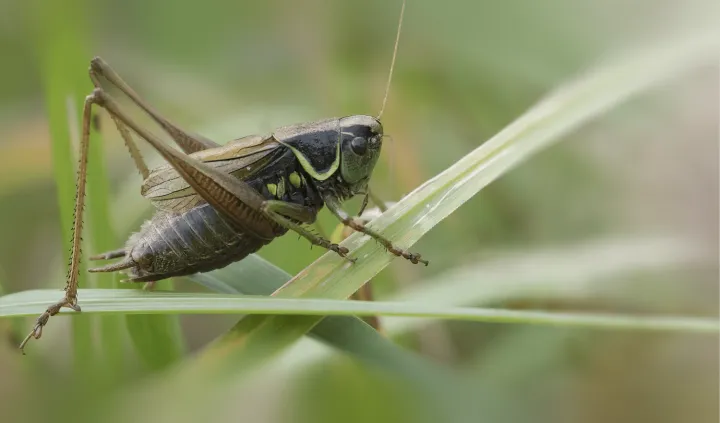
Roesel's bush-cricket (Metrioptera roeselii) is a member of the Tettigoniidae family, commonly found in meadows and agricultural fields across Europe.
The adult insect typically measures between 13 and 20 millimeters in length and is generally green or brownish with distinctive yellowish or tan highlights.
A key identification feature is the pale, usually yellow or whitish line along the rear margin of the pronotum, which distinguishes it from related species.
These crickets display wing dimorphism, with both short-winged and long-winged forms, the latter of which are capable of flight for migration purposes.
Females possess a characteristic sabre-like ovipositor, which they use to deposit eggs into soft plant tissues or directly into the soil surface.
What it damages
This species is a polyphagous feeder, meaning it consumes a wide variety of plant materials, including wild grasses and essential agricultural crops.
It causes significant damage to cereal crops such as wheat, rye, and barley, particularly during the critical stages of ear formation and grain filling.
When present in high populations, it also affects forage legumes like clover and alfalfa, reducing both the quality and biomass yield for livestock feed.
General vegetable crops and certain technical crops may also suffer from defoliation or mechanical damage to stems caused by the feeding activity of the crickets.
Feeding damage reduces the photosynthetic area of the plants and can introduce pathogens through the wounds, leading to further yield loss or plant decay.
When it appears
The life cycle of Roesel's bush-cricket is annual, with the species surviving the winter months exclusively in the egg stage hidden within the substrate.
Nymphs emerge in the spring, typically in May, and undergo several molts through different nymphal instars before reaching sexual maturity.
The adult phase is most prevalent during the summer months of July and August, during which time mating and egg-laying activities take place.
Activity levels are highly dependent on weather conditions, as warm and moist seasons often trigger significant population surges in suitable habitats.
Adults die off as temperatures drop in late autumn, ensuring that only the next generation, protected in the egg stage, remains to continue the cycle.
Signs of infestation
Evidence of infestation is usually found through visible gnawing on leaf margins, which appear as irregular, ragged holes in the plant foliage.
On cereals, the presence of empty glumes or partially consumed grains indicates that bush-crickets have been actively feeding in the field.
The distinct and continuous buzzing song produced by males is a primary indicator of their presence and can be heard throughout the day and evening.
Bush-crickets can often be spotted on the upper parts of plants or along field margins when vegetation is dense and provides sufficient cover.
Mechanical injuries to plant stems often become necrotic, showing yellowing or drying of the tissue as a response to the physical damage caused by the insects.
Control measures
Effective control measures rely heavily on cultural practices, such as deep autumn plowing, to bury and destroy the overwintering egg clusters in the soil.
Maintaining clean field edges by mowing weeds helps reduce the primary habitat and migration corridors, thus minimizing the pressure on adjacent crops.
Chemical control using authorized insecticides should be reserved for periods when populations exceed the economic threshold, targeting early nymphal stages.
Promoting natural predators, including insectivorous birds and small mammals, serves as a sustainable way to keep the cricket population in check.
Consistent field monitoring and accurate scouting are essential for detecting early infestation signs and implementing timely management strategies.
Taxonomy
- Latin name
- Metrioptera roeselii
- Order
- Orthoptera (locusts)
- Family
- Tettigoniidae
- EPPO code
- MTRPRO
Discussion
No discussions yet — be the first.