
Bicoloured bush-cricket
Metrioptera bicolor
Description
How to identify
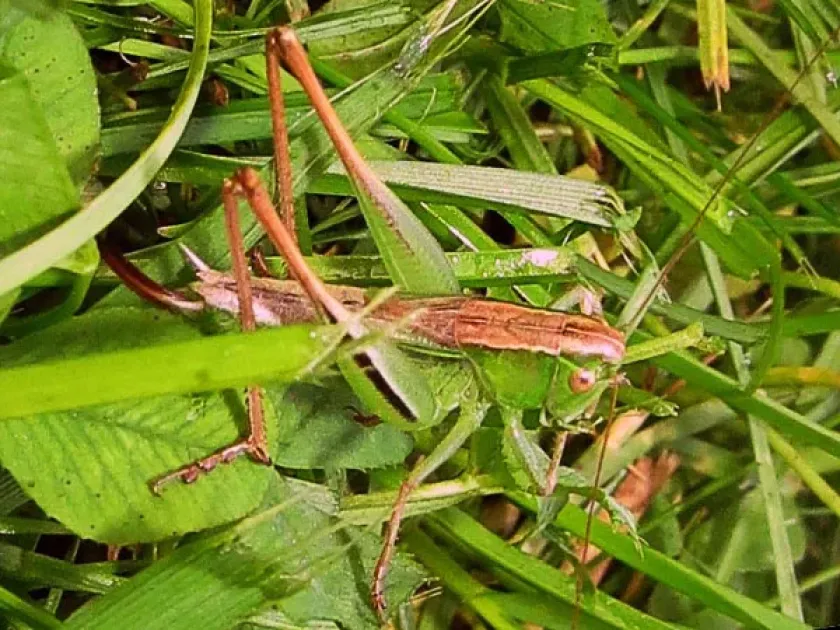
The bicoloured bush-cricket (Metrioptera bicolor) belongs to the order Orthoptera and the family Tettigoniidae. It is a medium-sized insect, typically brown or green, often featuring a dark stripe along the sides of the pronotum.
Both males and females possess short or moderately developed wings, which limits their migratory capabilities. A characteristic feature of this species is its ability to produce sound, which helps in locating the insects within field environments.
Nymphs resemble the adults but are smaller in size and lack a fully developed ovipositor in females. Their development involves incomplete metamorphosis, passing through several nymphal stages.
This species prefers open, sunny habitats such as meadows, forest edges, and the peripheries of agricultural fields. They are primarily diurnal, showing peak activity during warmer hours.
Winter is spent in the egg stage, which females deposit in the soil or within plant stems, providing protection against extreme cold and desiccation.
What it damages
This pest is polyphagous, meaning it can feed on a wide range of vegetation. Within agroecosystems, it often moves into crops located near their natural habitats.
Significant damage is observed on cereal crops, including wheat, barley, and rye. The bush-crickets feed on both vegetative parts and the developing grain within the ear.
In addition to cereals, vegetable crops and clover can also be targeted. Damage to leaves reduces the total photosynthetic capacity of the plant.
The most severe impact involves damage to the reproductive organs of plants, leading to direct yield loss and reduced grain quality. At high densities, the economic damage becomes considerable.
Nymphs in later stages and adult individuals pose the greatest threat due to their robust, chewing mouthparts.
When it appears
The life cycle begins with the hatching of nymphs in the spring, typically in May, once soil temperatures remain consistently positive.
Nymphal development takes several weeks, followed by the final molt into adults. The emergence of adults (imago) usually occurs in June and July.
The period of peak pest activity coincides with the grain-filling stage of cereal crops, which requires vigilant monitoring by agronomists.
By late summer and early autumn, females begin laying eggs in the soil or dry plant debris, completing the annual life cycle.
There is only one generation per year, thus limiting the high-impact period of this pest to the summer months.
Signs of infestation
The first sign of infestation is the presence of ragged edges on crop leaves, often appearing as large, irregular notches.
On the ear, one can observe damage to the glumes and the grains themselves. Insect frass is often present near the damaged plant parts.
The presence of a high number of crickets is easily identified by their characteristic chirping, which intensifies during sunny weather.
Both nymphs and adults are visible upon inspection of fields, especially along field margins bordering uncultivated vegetation.
Yield reduction in specific zones, often manifesting as sparse patches on the edges of the field, may indicate local clusters of these pests.
Control measures
The primary control method is the management of weeds along field borders, as these areas serve as reservoirs and breeding grounds for the species.
Tillage and deep soil cultivation in autumn or spring can destroy egg clusters in the soil, effectively reducing the population for the next season.
Chemical control involves the application of broad-spectrum insecticides if the pest population exceeds the economic injury level.
- Regular monitoring of population density during the nymphal stage.
- Implementation of crop rotation to limit available food sources.
- Application of barrier sprays along field perimeters to prevent migration into the crop.
Biological control strategies include preserving populations of natural predators, such as birds and insectivorous insects, which help keep bush-cricket numbers in check.
Taxonomy
- Latin name
- Metrioptera bicolor
- Order
- Orthoptera (locusts)
- Family
- Tettigoniidae
- EPPO code
- MTRPBI
Discussion
No discussions yet — be the first.