
Dark pollen beetle
Meligethes atratus
Description
How to identify
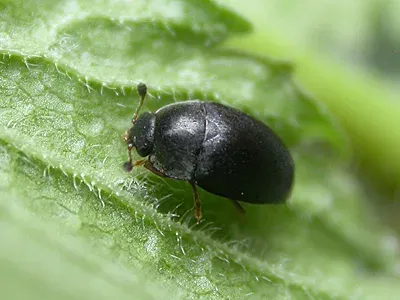
The dark pollen beetle (Meligethes atratus) is a small coleopteran belonging to the family Nitidulidae. Adult beetles typically reach 2–3 mm in length.
The body is dark brown or black in color, characterized by a metallic sheen. The surface of the elytra is covered in dense punctures and short, fine hairs.
The head is small and slightly retracted into the pronotum, while the antennae terminate in a three-segmented club, which serves as a key morphological identifier.
Larvae are elongated and highly mobile, specialized to feed within the protective environment of developing flower buds of various host plants.
The species overwinters in the adult stage within the topsoil, under leaf litter, or in protected woodland edges, emerging during early spring.
What it damages
The dark pollen beetle primarily affects crops within the Brassicaceae family, with oilseed rape being the most significant host in agricultural settings.
Both adult beetles and their larvae consume generative parts, specifically targeting pollen, anthers, and pistils within unopened flower buds.
Feeding activities lead to the destruction of buds, which subsequently drop from the plant, directly reducing the total number of pods and seed yield.
In high-pressure years, severe infestations can cause significant economic losses, impacting the uniformity and quality of the harvest.
The damage is often distributed unevenly across fields, but it can rapidly intensify under favorable weather conditions during the crop's budding stage.
When it appears
Adults emerge from hibernation when soil temperatures reach approximately 8–10 degrees Celsius, aligning with the start of the early vegetation period.
The most critical period for pest activity is during the budding phase of oilseed rape, which coincides with the maturation of their reproductive organs.
Females lay eggs inside the buds after piercing the outer layer; this ensures that larvae have immediate access to nutrients upon hatching.
The life cycle from egg to adult takes approximately one month, depending on ambient temperatures and the availability of suitable host plants.
Following the peak flowering period, the new generation of adults migrates to late-blooming cruciferous weeds to feed before entering winter diapause.
Signs of infestation
The primary symptom of infestation is the premature shedding of flower buds, leaving bare pedicels ("blind stalks") on the raceme.
A closer inspection of unopened buds reveals tiny puncture marks, indicating where beetles have chewed into the tissue to access internal parts.
Plants affected by the beetle exhibit stunted growth of the main raceme and a significantly extended, uneven flowering period across the field.
Adult beetles can be visually identified clustered deep within the yellow flowers during sunny, warm hours when they are most active.
Sparse pod formation and reduced seed set at harvest time often indicate a history of heavy pollen beetle pressure throughout the spring season.
Control measures
Integrated pest management (IPM) for the dark pollen beetle focuses on combining cultural practices with targeted insecticide applications when necessary.
- Implementation of wide crop rotations to break the beetle's life cycle in affected fields.
- Effective control of cruciferous weeds in field margins to remove alternative host reservoirs.
- Deep autumn plowing to disturb overwintering sites and reduce the survival rate of the following year's population.
Chemical intervention should be reserved for instances where the population exceeds the economic threshold, usually determined by plant inspection during budding.
When applying insecticides, it is essential to select bee-safe formulations and adhere to strict timing protocols to protect local pollinator populations.
Taxonomy
- Latin name
- Meligethes atratus
- Order
- Coleoptera (beetles)
- Family
- Nitidulidae
- EPPO code
- MELIAT
Discussion
No discussions yet — be the first.