
Eurasian badger
Meles meles
Description
How to identify
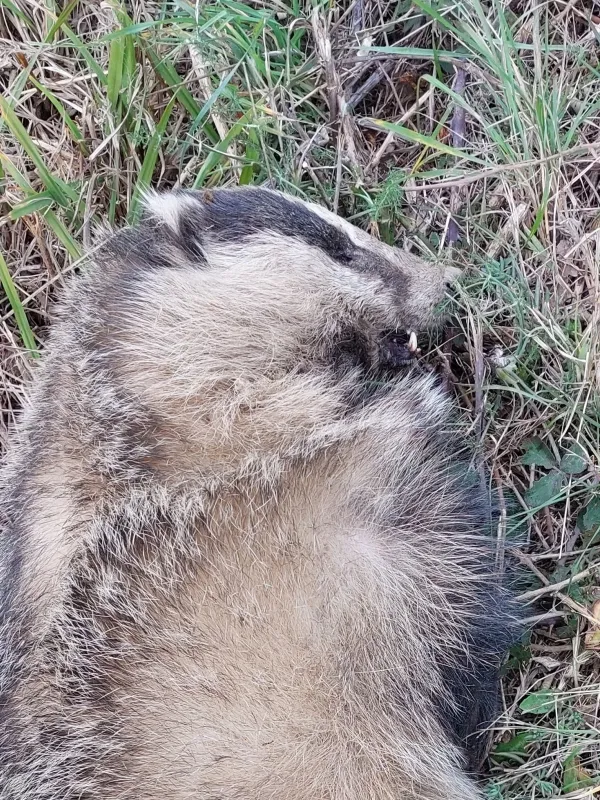
The Eurasian badger (Meles meles) is a large mammal belonging to the mustelid family, primarily nocturnal. It is easily recognized by its distinctive black and white striped face.
Adult badgers weigh between 10 and 24 kilograms and possess a robust, stocky body with short legs. Their strong, long claws are perfectly adapted for digging deep burrows and excavating the soil.
Badgers prefer soft soils for denning and often build their setts near agricultural areas. This proximity creates potential conflicts as they move into farms and gardens in search of food.
The badger is an intelligent, omnivorous animal with highly developed senses of smell and hearing. Due to their secretive nature, they are rarely seen by humans, and their presence is usually identified through traces of their activity.
Highly adaptable, badgers can thrive in various habitats, including the edges of agricultural land. Their social structure and site fidelity often mean they return to the same foraging grounds repeatedly.
What it damages
Badgers cause significant damage to crops such as corn, oats, wheat, and root vegetables like potatoes. They consume the crops directly and disturb the soil structure during their foraging trips.
In corn fields, badgers often snap stalks and create wide, matted paths as they move through the crop. Damaged plants are prone to decay and may ultimately fail to produce a harvestable yield.
Their digging behavior for earthworms and insect larvae leads to severe soil displacement. This can rupture the root systems of cultivated plants, causing wilting and death within a short period.
In orchards, badgers may dig near the base of young trees to reach subterranean food sources, undermining the roots. This destabilizes the tree and restricts water and nutrient uptake, leading to long-term decline.
Furthermore, the large piles of soil excavated during burrowing can interfere with farm machinery. These mounds create obstacles for irrigation systems and complicate the operation of seeding and harvesting equipment.
When it appears
Badger activity peaks during the summer and autumn months as they build up fat reserves for their winter dormancy. This is when their impact on agricultural yields is most pronounced.
In early spring, after emerging from their winter rest, badgers forage for high-energy food sources, which may include newly planted potatoes or early spring grains. This is a critical time for protecting young crops.
Throughout the summer, badgers maintain regular foraging patterns between their setts and nearby fields. The most significant damage often occurs in August and September as cereals reach maturity.
By late autumn, their activity levels drop as they prepare for winter. During the coldest months, badgers spend most of their time underground, posing no threat to agricultural productivity.
The frequency of visits depends on the distance between the burrow and the crop fields. When natural food sources are scarce in the forest, badgers are more likely to venture into cultivated land.
Signs of infestation
The primary sign of a badger's presence is the creation of deep pits and large mounds of excavated soil. Footprints showing five distinct toe pads and long claw marks are easily identifiable on damp ground.
In corn fields, trampling is a clear indicator, with paths leading from the field edge deep into the standing crop. Stalks broken at a height of 50-70 centimeters are typical for a large badger.
A distinct, musky odor often lingers around areas where badgers have been foraging. Their digging often leaves behind neatly rounded, small holes that differ from the irregular holes made by other animals.
Badger tracks are distinct and quite large, with the claw marks being a prominent feature. The arrangement of the pads in the print forms a recognizable semi-circular pattern.
- Damaged corn cobs showing evidence of chewing.
- Uprooted soil and disturbed vegetation in vegetable patches.
- Broken grain stalks along well-worn paths.
- Fresh soil mounds near tree roots.
- Visible tracks leading from hedgerows or forest edges.
Control measures
Installing a sturdy wire mesh fence is the most effective deterrent. The fence should be buried at least 30 centimeters deep to prevent the badger from digging underneath the barrier.
Ultrasonic deterrents and flashing light devices may offer temporary relief by disrupting the badger's foraging habits. However, these animals often become accustomed to such devices over time.
Applying scent-based repellents around the perimeter of the field can create a temporary barrier. These products must be reapplied frequently, especially after rainfall, to maintain their effectiveness.
Good field maintenance, including clearing long grass and debris along boundaries, reduces the cover badgers prefer. They are cautious animals and generally avoid crossing open, exposed terrain.
If damage is severe, contact local wildlife management agencies for advice on non-lethal deterrents or relocation options. Lethal control is strictly regulated and often prohibited by law.
Taxonomy
- Latin name
- Meles meles
- Family
- Mustelidae
- EPPO code
- MLESME
Discussion
No discussions yet — be the first.