
Megacephala euphratica
Megacephala euphratica
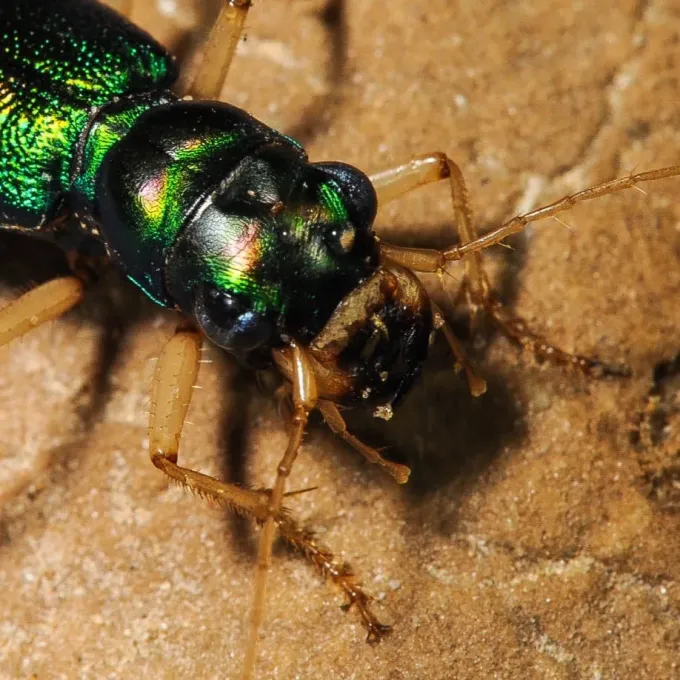
Description
How to identify
Megacephala euphratica belongs to the family Carabidae, subfamily Cicindelinae, commonly known as tiger beetles. These insects are easily identified by their elongated bodies, often featuring a metallic sheen and powerful, sickle-shaped mandibles.
Adults are highly mobile and fast-running, which is typical for the species within this subfamily. They possess large, prominent eyes that provide excellent vision for hunting in open habitats.
The coloration usually ranges from dark bronze to black, allowing them to blend in with moist or saline soil conditions. They are well-adapted to arid environments, often found in proximity to water bodies.
Larvae exhibit a specific morphological trait—a dorsal hook that allows them to anchor themselves in subterranean tunnels. They remain hidden, waiting for prey to pass, which makes them difficult to detect during standard scouting.
This species is highly specialized for habitats with high salinity, allowing it to colonize agricultural areas that might be unsuitable for other less resilient insects.
What it damages
While many tiger beetles act as beneficial predators, Megacephala euphratica can cause significant damage when natural prey populations are insufficient. Young seedlings are the most vulnerable targets.
Beetles damage the epidermis of stems and cotyledon leaves in search of moisture or nutrients, which can lead to stunted growth or total plant mortality.
Damage to the root collar is particularly destructive, as it compromises the plant's ability to uptake water and nutrients, often resulting in sudden wilting.
The severity of the damage increases during drought periods when the insects are forced to shift their diet towards irrigated crop tissues to meet their hydration needs.
Secondary infections often take hold in the damaged tissues, leading to complex disease profiles that further reduce overall crop yield and vigor.
When it appears
Adult activity is primarily concentrated in the spring and summer, coinciding with optimal temperatures for the beetle's metabolic functions.
They are predominantly nocturnal or crepuscular, avoiding direct sunlight during the hottest periods of the day to prevent desiccation.
Larval development spans several months, with peak population densities often aligning with the most critical growth stages of agricultural crops.
Pupation occurs in specialized soil chambers, ensuring that the developing beetles remain protected from external climatic fluctuations.
Overwintering is achieved in deeper soil layers, which provides a thermal refuge, allowing the population to emerge successfully every season.
Signs of infestation
The most reliable sign of an infestation is the presence of small, circular holes in the ground that serve as hunting burrows for the larvae.
Irregular, chewed-off sections on the stems or leaves of young plants indicate the presence and feeding activity of adult beetles.
Sudden wilting of seedlings in the absence of root rot or irrigation issues often points to mechanical injury caused by these insects.
During the night, a distinct reflective shine from the beetles' eyes, visible under artificial light, can confirm their presence in the field.
Increased beetle activity near irrigation channels or damp field edges is a clear indicator of a potential threat to nearby crop areas.
Control measures
Deep autumn plowing is a highly effective mechanical control method, as it destroys larval burrows and exposes them to predators.
Applying contact-stomach insecticides to seeds or seedlings can significantly reduce beetle populations during the sensitive emergence stage.
Proper crop rotation and the removal of edge weeds prevent the buildup of beetle populations by limiting their hiding and breeding grounds.
Managing soil moisture levels and eliminating excessive water logging in non-irrigated zones makes the environment less hospitable for the species.
- Utilizing light traps to monitor population density and suppress adult beetle numbers.
- Deploying insecticide-treated baits along field perimeters to mitigate crop damage.
Taxonomy
- Latin name
- Megacephala euphratica
- Order
- Coleoptera (beetles)
- Family
- Carabidae
- EPPO code
- MGCPEU
Discussion
No discussions yet — be the first.