
Megacephala beetle
Megacephala
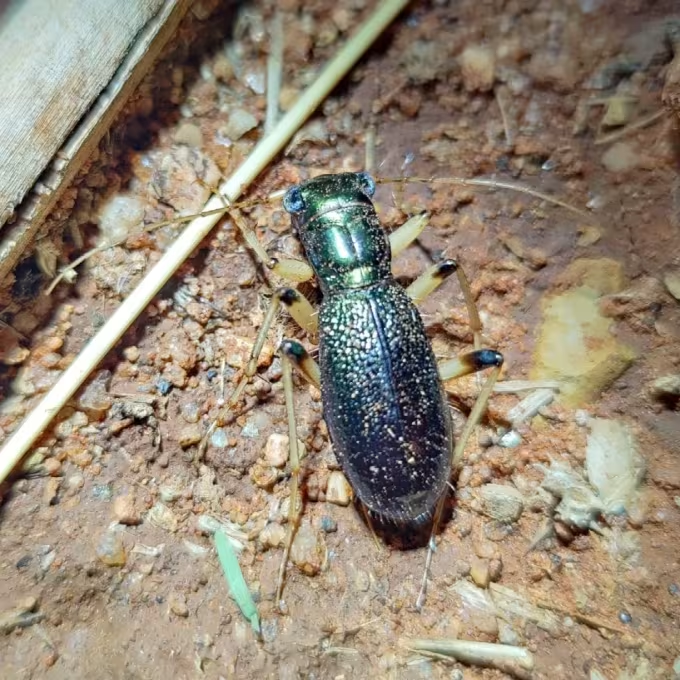
Description
How to identify
The genus Megacephala belongs to the Carabidae family, commonly known as ground beetles. These insects are characterized by their relatively large heads, formidable sickle-shaped mandibles, and often brilliant metallic coloration.
Adult beetles possess elongated bodies and long, cursorial legs, enabling them to run rapidly across the soil surface. They are primarily nocturnal and favor moist, open environments with loose soil structure.
The larvae exhibit a cylindrical body shape with a distinct hump equipped with powerful hooks. They live in vertical burrows within the soil, serving as ambush predators for small invertebrates passing by.
The life cycle follows complete metamorphosis: egg, three larval instars, pupa, and adult. Overwintering typically occurs in the adult stage, sheltered within the soil profile or under dense vegetation debris.
Accurate identification is based on subtle morphological characteristics, particularly the shape of the head and pronotum, distinguishing them from other predatory ground beetle species.
What it damages
While primarily predatory, Megacephala species can occasionally cause economic damage to agricultural crops when their natural prey population is insufficient or during periods of high pest density.
Damage is mostly observed in vegetable and cucurbit crops at the early seedling stage. Beetles and larvae may feed on the root collar of young plants, causing sudden wilting and mortality.
Larval activity in the soil often results in damage to root systems and underground stems, creating entry points for opportunistic plant pathogens and fungal infections.
Economic impact is more significant in fields with poor crop rotation practices or excessive accumulation of plant residues, which provide ideal refugia for the beetle population.
Prolonged high soil moisture levels in irrigated agricultural systems can lead to increased beetle activity, posing a recurring risk to seedling establishment.
Control measures
Integrated Pest Management (IPM) is essential for controlling Megacephala. Deep autumn plowing is a highly effective cultural practice, as it destroys larval burrows and exposes the larvae to natural predators.
Strategic crop rotation helps disrupt the life cycle of the beetles by changing the habitat conditions and food availability in the field.
Chemical control focuses on the application of soil-incorporated insecticides during the seeding process, providing a protective barrier around the root zone.
Seed treatments using systemic insecticides are recommended to protect germinating crops during the critical early stages when they are most susceptible to larval feeding.
Monitoring using soil pitfall traps is crucial for assessing population density, allowing growers to make data-driven decisions regarding the need for targeted interventions.
Taxonomy
- Latin name
- Megacephala
- Order
- Coleoptera (beetles)
- Family
- Carabidae
- EPPO code
- MGCPSP
Discussion
No discussions yet — be the first.