

Psyllid
Psyllidae
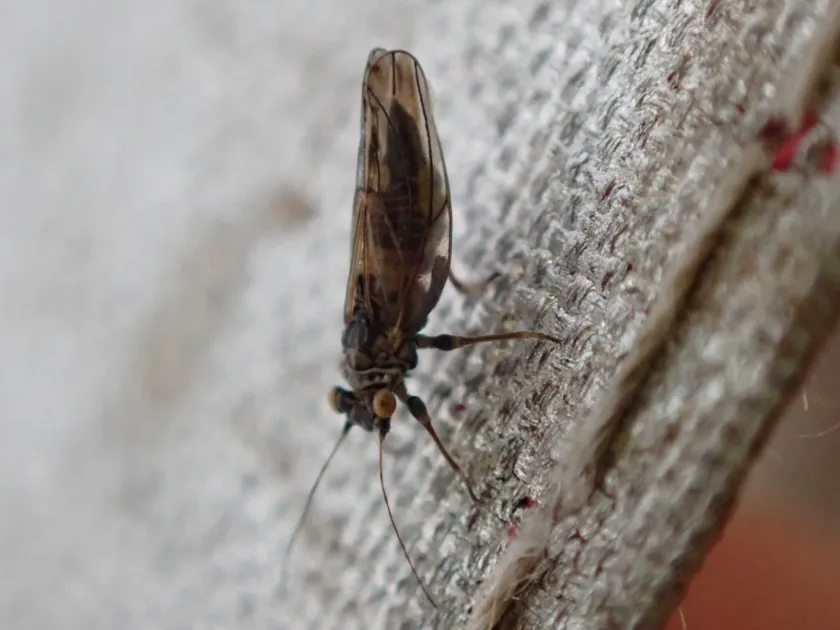
Description
How to identify
Psyllids, commonly known as jumping plant lice, belong to the family Psyllidae. These insects are small, typically ranging from 2 to 5 millimeters in length, and are easily recognized by their ability to jump using their enlarged hind legs when disturbed.
Adult psyllids resemble tiny cicadas and possess two pairs of membranous wings held roof-like over their bodies. Their life cycle includes the egg, five nymphal instars, and the adult stage, with nymphs often producing waxy secretions for protection.
What it damages
Psyllids are significant pests in agricultural systems, particularly affecting fruit trees such as pears, apples, and citrus. They feed by inserting their piercing-sucking mouthparts into the phloem of the host plant to extract vital nutrients.
Constant feeding causes stunted growth, leaf curling, and the premature shedding of blossoms. In severe cases, the damage to the plant's vascular system leads to a total failure of fruit development and can permanently stunt young saplings in nursery conditions.
When it appears
Overwintering adults become active as soon as the weather warms up in early spring, migrating to tree buds to feed and lay eggs. This initial generation is the most critical to control to prevent an exponential population increase throughout the season.
Depending on the climatic zone, psyllids can complete multiple generations per year. The population usually peaks during the late spring and early summer, coinciding with the rapid growth of succulent green shoots that provide the best nutritional source for nymphs.
Signs of infestation
A classic sign of psyllid infestation is the accumulation of honeydew on foliage, a sticky substance excreted by the nymphs. This honeydew creates a substrate for sooty mold growth, causing leaves to turn black and reducing the plant's ability to perform photosynthesis.
Additional symptoms include the yellowing and distortion of new growth. Gardeners may also observe visible clusters of nymphs or the waxy, thread-like coverings they produce while feeding on the undersides of leaves or near the base of buds.
Control measures
Integrated pest management strategies are essential, starting with the use of dormant oils in early spring to smother overwintering eggs. This mechanical approach is highly effective in reducing the initial pressure of the pest population.
During the growing season, systemic insecticides or horticultural soaps can be applied to target the nymphs. It is crucial to monitor populations regularly and ensure treatments are timed before the nymphs develop protective waxy coverings, which make them harder to kill.
Content graph
Connections · Psyllid
Most often together:
Marketplace
Products · 40


Dimavit
Три Дельта Компані Інтернешнл, Гонконг, Китай.
Insecticides
0
0
·
57
12 offers
4.31 €per 1 l
Buy


Super Bison
«Юнісіті Ентерпрайсіс Л.П.», Единбург, Великобританія
Insecticides
0
0
·
53
10 offers
5.98 €per 1 l
Buy
BIOINSECTICIDE «BIOSENZIB» SC
IMPERIAL GOLD TOBACCO, LLC
Insecticides
0
0
·
51
24 offers
2.18 €per 1 l
Buy


Super Bison
Ф.Меатон Лімітед, Лондон, Великобританія.
Insecticides
0
0
·
42
3 offers
6.45 €per 1 l
Buy

Insectoacaricide Preparation 30 D
Agroprymnika, LLC
Insecticides
0
0
·
35
12 offers
2.92 €per 1 l
Buy



Dime 58 c.e., in
Jiangsu SevenContinent Green Chemical Co., Ltd.
Insecticides
0
0
·
41
No offers
—
Details
Biology
Taxonomy
- Latin name
- Psyllidae
- Order
- Hemiptera (bugs, aphids, leafhoppers)
- Family
- Psyllidae
- EPPO code
- 1PSYLF
Community
Discussion
No discussions yet — be the first.