
Acacia psyllid
Acizzia uncatoides
Description
How to identify
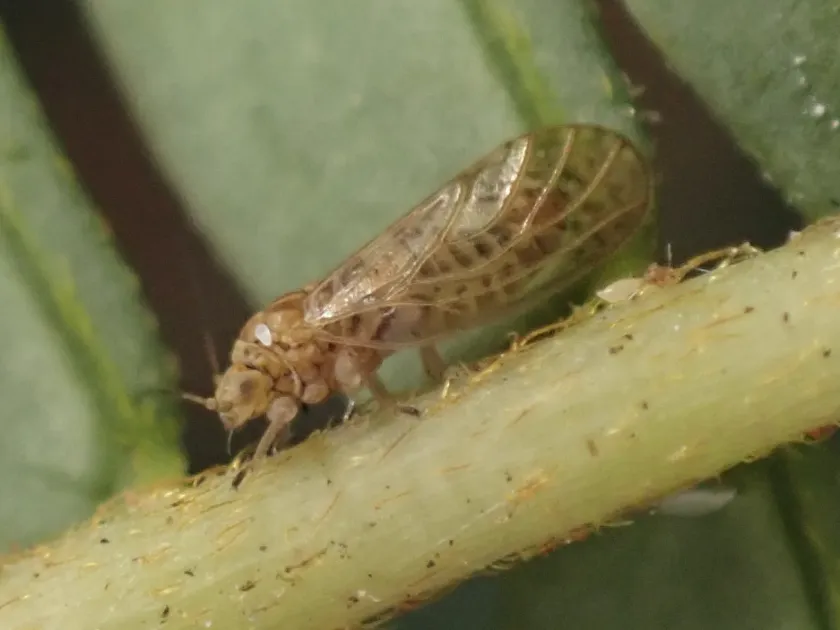
The Acacia psyllid (Acizzia uncatoides) belongs to the Psyllidae family. These tiny sap-sucking insects are approximately 2–3 mm long and are often overlooked until significant damage occurs.
Adult psyllids resemble miniature cicadas with transparent wings held in a tent-like fashion over their bodies. Their coloration ranges from yellowish-brown to green, blending perfectly with new foliage.
Nymphs are flattened and often covered in white, waxy, thread-like secretions, which act as a physical shield against environmental stress and predators.
Originally native to Australia, this species has become a significant invasive pest in many parts of the world where various species of Acacia and Albizia are grown.
Identification is best achieved by inspecting the underside of leaves and terminal shoots, where large colonies of nymphs and adults typically congregate.
What it damages
The primary hosts of Acizzia uncatoides are trees within the Acacia and Albizia genera. The insects target the most succulent and nutrient-rich growth, such as new shoots and buds.
Feeding causes severe physiological stress to the tree. Leaves often become curled, yellowed, and may drop prematurely, significantly affecting the aesthetic value of ornamental specimens.
As they feed, psyllids excrete honeydew, a sugary substance that coats the leaves. This creates an environment for sooty mold to thrive, which further inhibits the tree’s ability to photosynthesize.
Heavy infestations can lead to stunted growth, branch dieback, and in severe cases, the overall decline of the tree, especially in young or stressed individuals.
Furthermore, psyllids are known vectors for various plant pathogens, including phytoplasmas, which can cause long-term health issues for the host plant.
When it appears
The life cycle of the Acacia psyllid is highly dependent on climate. Populations typically peak during the warm spring and summer months when new growth is most abundant.
In temperate climates or greenhouses, the pest can undergo multiple overlapping generations throughout the year, making it a persistent problem for landscape management.
Insects overwinter primarily as eggs laid near the buds or as adults sheltered in bark crevices, becoming active as soon as temperatures rise in the spring.
Migration to new trees usually occurs when adult psyllids take flight, particularly during mild, windless days, allowing them to spread rapidly throughout a garden or nursery.
Strategic timing of monitoring efforts during the early flushing stage of the host tree is crucial to prevent the establishment of large colonies.
Signs of infestation
Visual symptoms start with the curling and twisting of new leaves. Affected shoots often fail to elongate properly and may appear bunched or distorted.
The presence of a sticky, glistening residue on the foliage is a primary sign of infestation. This honeydew often attracts ants, which can sometimes be seen tending the psyllids.
Sooty mold, appearing as a dark, powdery substance on leaves and branches, is a secondary effect of the psyllid’s presence and indicates a long-standing infestation.
Inspecting the plant often reveals small, white waxy clumps on leaf undersides, which are the protective covers for developing nymphs.
- Curling and distortion of young leaves.
- Stunted shoot development.
- Presence of sticky honeydew.
- Development of black sooty mold.
- Adults jumping away when branches are disturbed.
Control measures
Cultural control involves regular inspection and the pruning of heavily infested shoots to reduce the population density of the pest.
Systemic insecticides are generally the most effective method for chemical control, as they are translocated within the plant to reach the protected nymphs.
For a more environmentally friendly approach, insecticidal soaps or neem oil can be applied, though they require thorough coverage and repeat applications to be effective.
Biological control, utilizing natural predators like lady beetles, lacewings, and parasitic wasps, plays a vital role in maintaining the psyllid population below the economic threshold.
Maintaining tree vigor through proper irrigation and balanced fertilization helps the plant withstand psyllid attacks and recover more quickly from potential damage.
Taxonomy
- Latin name
- Acizzia uncatoides
- Order
- Hemiptera (bugs, aphids, leafhoppers)
- Family
- Psyllidae
- EPPO code
- PSYLUN
Discussion
No discussions yet — be the first.