
Menzbier's marmot
Marmota menzbieri
Description
How to identify
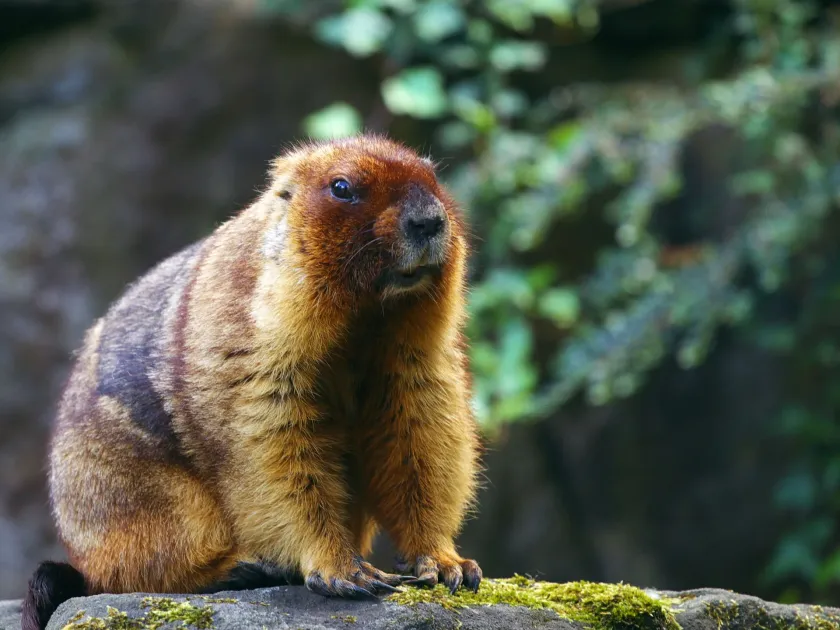
Menzbier's marmot is the smallest member of the marmot genus, native to the high-altitude regions of the Western Tian Shan mountains. Adults reach a body length of about 45–50 cm and weigh between 2 and 3 kg.
Taxonomically, it belongs to the order Rodentia and the family Sciuridae. The species is characterized by a dense, sturdy body and short, powerful limbs designed for extensive burrowing.
Their fur color typically ranges from dark brown to near black, providing camouflage against rocky mountain terrain. They are colonial animals that live in dense, well-organized social groups.
Menzbier's marmots are highly adapted to alpine conditions, spending the majority of the year in hibernation due to the harsh climate of their habitat.
These rodents are endemics, meaning their range is very restricted, making their interactions with agricultural lands particularly critical in local high-mountain valleys.
What it damages
The primary impact of Menzbier's marmot on agriculture is the severe degradation of alpine and subalpine pastures through overgrazing and foraging on nutritious grasses.
In areas adjacent to mountain croplands, these rodents frequently damage roots and seedlings, leading to the stunted growth or complete death of forage crops.
Their extensive burrowing activity disrupts soil structure and promotes erosion on steep mountain slopes, which can destroy the long-term utility of the grazing land.
Excavated soil (mounds) deposited by marmots covers existing vegetation, effectively creating barren patches where no forage or crops can thrive.
High population densities in specific colonies can lead to the near-total elimination of native grasses, leaving the soil vulnerable to invasive weeds that livestock avoid.
When it appears
Activity for Menzbier's marmot commences in early spring as soon as the snow cover retreats. During this time, they aggressively forage for the first green shoots.
Summer months represent the period of highest activity, as marmots must consume vast quantities of vegetation to build fat stores for the upcoming winter hibernation.
By autumn, as temperatures drop and frost becomes common, the marmots reduce their foraging time and prepare their deep burrows for the cold season.
Winter is characterized by total hibernation, lasting from late autumn through early spring, meaning no active damage occurs during these months.
Agricultural managers should focus monitoring and preventative efforts on the period from late May through August when the marmots are most active and visible.
Signs of infestation
The most prominent sign of a marmot colony is the presence of large soil mounds, known as mounds, which are easily identified across mountain meadows.
Well-trodden pathways between burrow entrances and preferred feeding spots indicate an active and established colony in the area.
Patches of bare ground, where vegetation has been completely cleared by constant foraging and trampling, are clear indicators of high rodent density.
The frequent, piercing whistle sounds emitted by members of the colony serve as a warning system and are a reliable indicator of their presence.
Root destruction and the presence of gnawed plant stems near the burrow entrances confirm that the marmots are actively feeding on local crops or grasses.
Control measures
Management of Menzbier's marmot requires a balanced approach, as they are a protected species in many parts of their natural range.
The use of ultrasonic deterrents is often effective in encouraging colonies to relocate to wild, non-agricultural areas without causing direct harm to the animals.
Agrotechnical strategies, such as the strategic plowing of non-critical buffer zones, can help break up burrow systems and discourage colonization of crop fields.
Maintaining taller pasture grass during peak seasons is a natural deterrent, as it limits the marmot's visibility, making them feel vulnerable to predators.
In cases of severe agricultural damage, farmers should coordinate with local conservation authorities for the humane trapping and translocation of problematic marmot populations.
Taxonomy
- Latin name
- Marmota menzbieri
- Order
- Rodents
- Family
- Sciuridae
- EPPO code
- MAROME
Discussion
No discussions yet — be the first.