
Himalayan marmot
Marmota himalayana
Description
How to identify
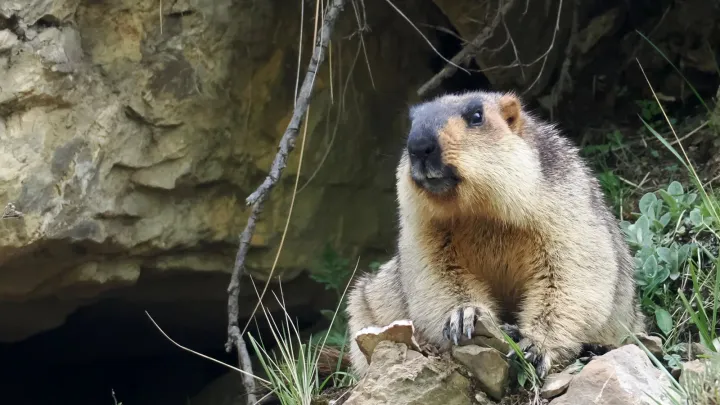
The Himalayan marmot (Marmota himalayana) is a large rodent belonging to the Sciuridae family. It is physically robust, adapted to high-altitude environments, with thick, coarse fur and strong claws for digging.
Adult individuals can grow up to 60 cm in length and weigh nearly 9 kg. They live in social colonies, constructing deep, interconnected burrow systems that provide shelter and winter hibernation sites.
These marmots exhibit highly developed social behaviors, including the use of high-pitched whistles to warn other colony members about potential threats from predators.
Reproduction is slow, with litters occurring only once a year, yet the animals are highly resilient to extreme cold, allowing them to thrive in mountain ecosystems.
Their primary biological goal is to build up body fat reserves during the short summer months to survive the long, harsh winter dormancy period.
What it damages
The primary agricultural impact of the Himalayan marmot is the consumption of significant amounts of pasture vegetation, which reduces the availability of forage for livestock.
Their extensive burrowing activity causes mechanical destruction of soil structure and promotes erosion, particularly on steep mountain slopes used for grazing.
Marmot colonies compete directly with domestic animals for grazing resources, which can lead to reduced livestock productivity in affected highland areas.
The mounds of soil displaced by marmots can interfere with irrigation channels, agricultural machinery movement, and overall pasture management practices.
Furthermore, these rodents can serve as carriers for various diseases, posing a potential veterinary risk to livestock health and, in some cases, human safety.
When it appears
The active season for the Himalayan marmot typically begins in April or May, once the snow begins to melt and vegetation starts to emerge on the mountainsides.
During the summer months, they are highly active, foraging intensively to accumulate fat and maintaining their complex burrow systems for the coming winter.
As temperatures drop in autumn, usually around September or October, marmots retreat into their burrows to begin a long period of hibernation.
Their daily activity is diurnal; they are most active during the cooler hours of the morning and evening, retreating to shelter to avoid midday heat.
Management monitoring should be focused between late spring and late summer when the marmots are most visible and actively impacting the pasture environment.
Signs of infestation
The most visible indicator of a marmot colony is the presence of large soil mounds (burrow tailings) near the entrance holes, which stand out in grassy areas.
Well-worn paths or tracks in the vegetation, leading from burrow entrances toward foraging sites, are common signs of frequent movement by the colony.
Visual observation of marmots sunning themselves on rocky outcrops or mounds is a definitive sign of an established colony in the vicinity.
Audible signals, such as their characteristic loud, piercing whistle, serve as a clear warning that an active colony is nearby.
- Fresh soil mounds near burrow entrances.
- Overgrazed patches or bare spots in pastures.
- Visible trails in grass leading to burrows.
- High-pitched whistling calls.
Control measures
Managing Himalayan marmots requires a focus on non-lethal deterrence, as they are often integral components of alpine ecosystems and sometimes protected species.
The use of well-trained livestock guardian dogs is a highly effective, natural method for keeping marmot colonies away from farm perimeters.
Implementing proper pasture rotation and avoiding overgrazing can make the environment less attractive to marmots, as they prefer areas with clear sightlines.
Physical barriers, such as specialized fencing, can be used for small, high-value agricultural plots, although this is impractical for large, remote pasture areas.
In scenarios of extreme population density, consultation with local wildlife authorities or veterinary services is necessary to ensure any population management aligns with regional regulations.
Taxonomy
- Latin name
- Marmota himalayana
- Order
- Rodents
- Family
- Sciuridae
- EPPO code
- MAROHI
Discussion
No discussions yet — be the first.