
Steppe marmot
Marmota bobak
Description
How to identify
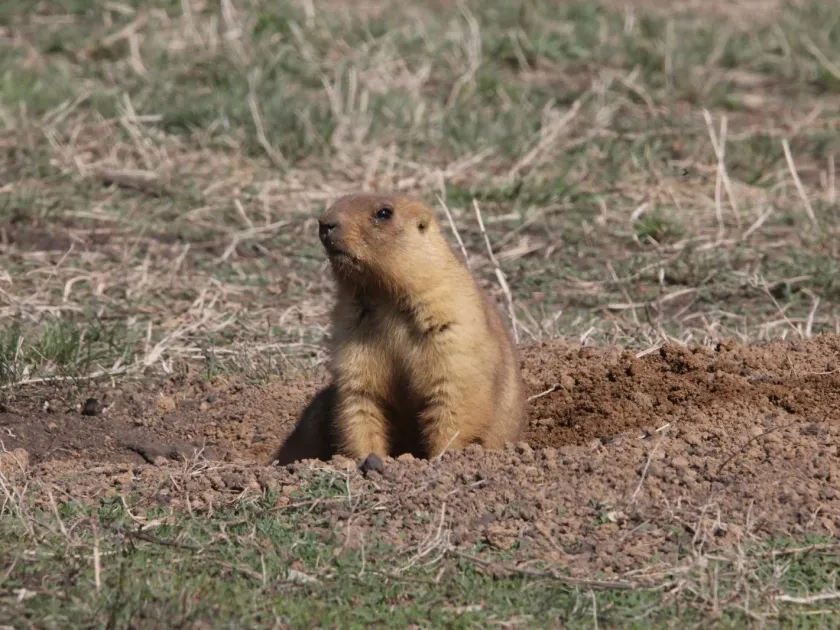
The steppe marmot (Marmota bobak), commonly known as the bobak, is a large rodent species belonging to the squirrel family (Sciuridae).
Adult marmots have a sturdy build, short, powerful limbs with long claws adapted for digging complex tunnel systems in the soil.
Their fur is typically a golden-brown color, providing effective camouflage against the dry grass and steppe vegetation of their native habitat.
They are highly social animals that live in colonies, communicating with each other through distinct, high-pitched whistles that can be heard from a distance.
The presence of large mounds of earth, known as burrows or 'marmot lodges', is the most reliable indicator of their activity in a specific area.
What it damages
Steppe marmots cause significant economic loss by grazing on young cereal crops, legumes, and perennial grasses planted near their colonies.
They selectively feed on tender shoots, which results in patchiness of the crop and reduced density, ultimately leading to lower harvest yields.
Trampling and burrowing activity destroy large sections of agricultural land, leaving bare soil patches around burrow entrances where crops cannot grow.
Their underground networks pose a serious risk to heavy machinery, as tractors and harvesters can suffer mechanical damage if they fall into concealed holes.
Additionally, the soil mounds pushed to the surface bury nearby crops and disrupt the uniformity of the field, complicating post-harvest soil management.
When it appears
The life cycle of the steppe marmot is dominated by a prolonged hibernation period, which typically spans from late summer until early spring.
Marmots enter their deep winter burrows by August or September and emerge in March or April, depending on regional weather and soil thaw conditions.
The period of maximum agricultural impact occurs from May through July, when the animals are highly active and feeding extensively to gain body fat.
During spring and early summer, the nursing of young marmots increases the colony's nutritional needs, leading to heavier grazing on nearby crop fields.
As vegetation matures and dries out, the marmots' interest in field crops decreases, and their focus shifts back to traditional steppe grasses before hibernation.
Control measures
Managing steppe marmot damage requires an integrated approach that balances agricultural productivity with environmental conservation regulations.
Agricultural land development, such as deep plowing and cultivation of nearby uncultivated lands, is the most effective deterrent to force relocation.
Installing physical perimeter fencing around high-value crops can prevent marmots from accessing fields during their peak feeding months.
Constant monitoring of colony boundaries and population density allows farmers to predict potential damage zones and intervene with preventative measures.
In cases of severe infestation, farmers should consult with local wildlife authorities to employ legal and approved methods of population management or scare tactics.
Taxonomy
- Latin name
- Marmota bobak
- Order
- Rodents
- Family
- Sciuridae
- EPPO code
- MAROBO
Discussion
No discussions yet — be the first.