
Apple capsid bug
Lygocoris rugicollis
Description
How to identify
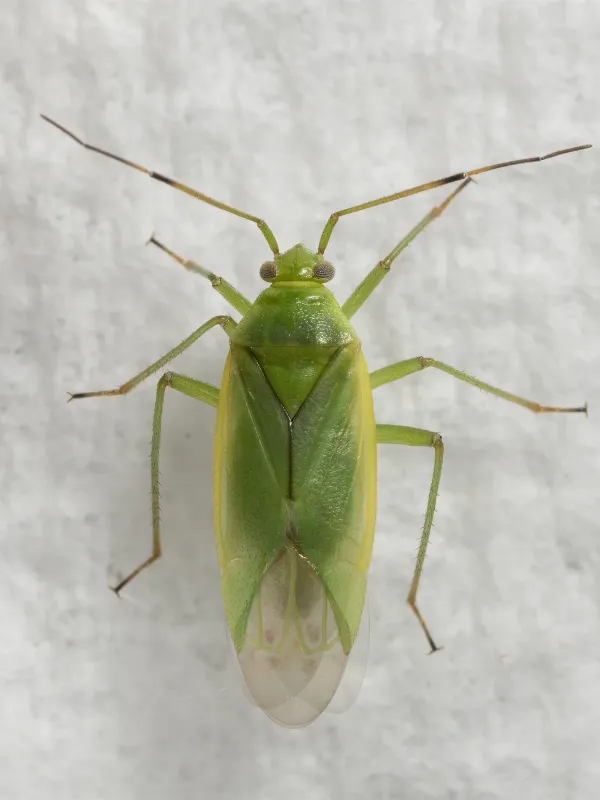
The apple capsid bug (Lygocoris rugicollis) is a species of mirid bug belonging to the Hemiptera order. Adult insects typically measure between 5 and 7 mm in length and possess a characteristic oval, greenish-yellow body shape.
The species is identified by specific fine wrinkles on the pronotum, which justifies the Latin scientific name. They are equipped with piercing-sucking mouthparts, enabling them to feed on plant vascular tissues.
Nymphs develop through five distinct instars, gradually increasing in size while retaining a bright green color that provides excellent camouflage against apple foliage.
This species overwinters primarily in the egg stage. Eggs are inserted into the bark of young shoots or woody tissues, where they remain dormant during the colder winter months.
Hatching usually occurs in early spring, coinciding with the bud burst phase, which allows the newly emerged nymphs immediate access to high-nutrient food sources.
What it damages
The primary hosts of the apple capsid bug include apples and pears, though it may also infest various shrubs within the Rosaceae family. Its feeding activity is most destructive in commercial orchards.
The pest targets young, developing tissues. When feeding, it injects enzymes into the plant tissue, which causes localized cell death and disrupts normal growth and development.
Leaves affected by the bug often show mottled yellow spots, which later develop into small holes as the leaves expand, leading to significant foliage distortion.
Damage to young fruit is particularly severe, as the feeding punctures result in corky tissue formation, leading to deformed, stunted, and asymmetrical fruits at harvest time.
In nursery environments, infestation causes severe twisting of new shoots and the death of apical buds, which stunts the growth of saplings and reduces their market value.
When it appears
The life cycle of Lygocoris rugicollis is strictly synchronized with the phenology of fruit trees. Emergence of the nymphs occurs during the spring, typically starting in April or May.
Nymphs are most active during the blossom and fruit set stages. They cluster on tender buds and succulent leaves, causing maximum damage to future fruit clusters before they are fully established.
Adults emerge by early summer, usually June. During this phase, they are highly mobile and disperse across the orchard canopy, engaging in mating and continuing to feed on foliage.
The reproductive phase involves egg-laying within the bark of twigs. This process continues through late summer and early autumn as the population prepares for the winter season.
There is typically one generation per year, but their high survival rate means that even small numbers can cause significant economic losses if not monitored correctly.
Signs of infestation
Early symptoms of infestation include subtle pin-prick marks on leaves. These marks are often accompanied by slight yellowing of the leaf tissue around the feeding site.
Deformed flower buds are a clear indicator of infestation. Frequently, these buds fail to open properly or drop prematurely, directly impacting the final yield of the orchard.
Fruit symptoms are perhaps the most recognizable: small, bumpy scars on the skin of young apples that grow into larger, corky patches as the fruit matures.
- Twisted and curled young leaves.
- Small, translucent holes in leaves.
- Premature dropping of young fruit sets.
- Deformed, asymmetrical fruit development.
- Visible nymphs hiding on the underside of foliage.
Close inspection of the branch tips in spring will often reveal the presence of nymphs, which move quickly when disturbed to seek shelter in crevices.
Control measures
Effective management begins with regular monitoring during the early spring. Growers should use tapping methods to check for the presence of nymphs on blossoms.
Chemical control is most effective when applied early, specifically at the green cluster or pink bud stage, to minimize the impact before the fruit begins to set.
Cultural control involves pruning and disposing of infested shoots during winter, as this can reduce the population density by removing the overwintering eggs.
Conservation of natural predators, such as ladybirds, lacewings, and predatory bugs, is essential for long-term ecological balance within the orchard system.
Integrated Pest Management (IPM) strategies, including the use of selective insecticides, should be employed to protect the tree while preserving beneficial insect populations.
Taxonomy
- Latin name
- Lygocoris rugicollis
- Order
- Hemiptera (bugs, aphids, leafhoppers)
- Family
- Miridae
- EPPO code
- PLESRU
Discussion
No discussions yet — be the first.