
Common green bottle fly
Lucilia sericata
Description
How to identify
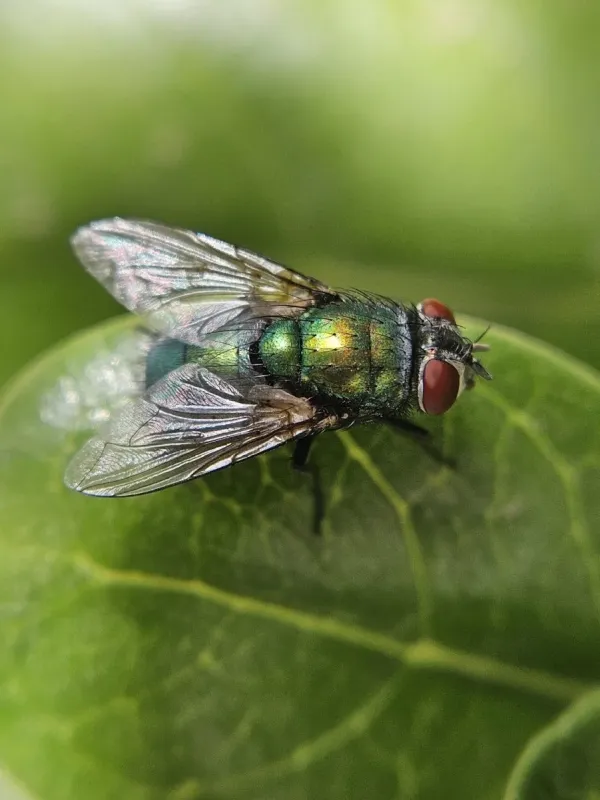
The common green bottle fly (Lucilia sericata) is a member of the Calliphoridae family, order Diptera, easily recognized by its metallic, vivid green, or bronze-colored body.
Adult flies typically range from 5 to 10 millimeters in length and possess large, complex eyes that provide excellent vision for locating food and breeding sites.
The larvae are typically creamy-white, headless, and legless, with a tapering body shape adapted for burrowing into organic matter during development.
Development involves distinct stages: egg, three larval instars, pupa, and finally the adult fly, with the speed of metamorphosis highly dependent on temperature.
They are strong fliers and are highly sensitive to odors, allowing them to detect potential breeding sites from significant distances.
What it damages
While they are not primary plant pests, they cause significant indirect damage by contaminating agricultural products, livestock feed, and processing facilities.
They act as vectors for various bacteria and pathogens, which can lead to secondary infections in crops if the flies congregate near wounded plant tissues.
In greenhouses, their activity in organic soil amendments can create breeding hubs that disrupt the sanitary quality of the growing environment.
The larvae contribute to rapid decay processes in stockpiled organic materials, leading to economic losses due to product degradation and hygiene violations.
High populations can negatively impact farm operations, causing stress to animals and requiring costly sanitation measures to maintain food safety standards.
When it appears
Lucilia sericata emerges from overwintering in early spring, once temperatures remain consistently above the threshold required for adult fly activity.
Population peaks typically occur during the height of the summer season, when high temperatures accelerate their reproductive and development cycles.
Multiple generations can occur throughout the growing season, with the total number of cycles depending on the local climate and availability of food.
As temperatures begin to drop in the autumn, the flies transition into a dormant state, seeking sheltered locations for the winter period.
They often hibernate as pupae in the soil or as adults in wall cavities, sheds, or other protected structures, ready to emerge the following spring.
Signs of infestation
The primary sign of an infestation is the visual presence of metallic green flies hovering in high concentrations around organic waste or animal areas.
A distinct, unpleasant odor near storage sites of manure or organic compost is a strong indicator of larval development occurring in the substrate.
Discovering clusters of small, white, active larvae within organic debris or feed containers confirms the presence of an established population.
The presence of fly speckling on surfaces, such as walls or containers in storage rooms, indicates high levels of adult fly activity in the area.
Unusual rapid decomposition of organic materials or moist plant remains can often be traced back to the feeding activity of green bottle fly larvae.
Control measures
Sanitation is the most effective management tool: remove all organic waste, manure, and rotting materials frequently to eliminate potential breeding sites.
Implement physical barriers such as fine-mesh screens on ventilation systems and doors to prevent adult flies from entering warehouses or stables.
Utilize insecticide-treated baits or surface sprays in designated areas to reduce the adult population before they can lay eggs.
Regularly monitor population levels using sticky traps or pheromone-based lures to trigger timely management interventions.
- Proper management and burial of organic waste.
- Frequent cleaning of livestock housing and feeding zones.
- Strategic placement of biological control measures to target larval stages.
Taxonomy
- Latin name
- Lucilia sericata
- Order
- Diptera (flies)
- Family
- Calliphoridae
- EPPO code
- LUCISE
Discussion
No discussions yet — be the first.