
Scaly-breasted munia
Lonchura topela
Description
How to identify
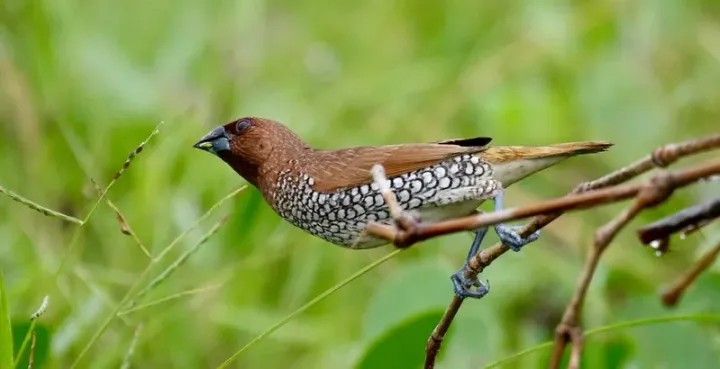
The scaly-breasted munia (Lonchura punctulata) belongs to the order Passeriformes and the family Estrildidae. This small bird, measuring about 10–12 centimeters, is characterized by a dark brown upper body and a pale belly marked with dark, scale-like patterns that resemble dots.
Juvenile birds exhibit a more uniform grayish-brown plumage, which makes them harder to distinguish in the early stages. These birds possess a short, conical, and powerful beak, perfectly adapted for crushing the hard seeds and grain husks.
In their natural habitat, they prefer open spaces, including agricultural fields, scrublands, and forest edges. They often nest in colonies, which significantly increases their destructive impact on agricultural ecosystems.
Munia are highly social and maintain constant communication within the flock. They forage in large groups, sometimes numbering hundreds of individuals, making their presence in fields highly visible.
Visually, they are distinct due to the specific pattern on their breasts and flanks. Their flight is rapid and undulating, and they demonstrate remarkable agility while perching on thin stems to feed on ripening crops.
What it damages
The primary food source for this species is the seeds of various crops, with rice plantations suffering the most severe economic damage. The birds feed on grains during the milk and dough stages when they are most nutritious.
In addition to rice, these pests may consume the seeds of millet, sorghum, and other grasses growing near cultivated fields. While searching for food, the birds collectively attack agricultural lands during the maturation phase of the crop.
The main damage results from the direct consumption of a significant portion of the grain harvest. A single flock can drastically reduce the total yield on a specific plot of land in a very short amount of time.
Secondary damage involves the breaking of stalks and panicles during foraging. The birds often bend or snap the cereal stems, which leads to lodging and complicates mechanized harvesting processes.
In regions where rice is the staple food, the scaly-breasted munia is classified as a major agricultural pest that requires systematic population control measures to prevent severe losses.
When it appears
The activity of these birds is directly correlated with the phenological phases of cereal development. The most dangerous period occurs during the grain filling and ripening stages, when carbohydrate levels in the seeds are at their peak.
In tropical and subtropical climates where seasonal changes are minimal, breeding and foraging can occur throughout the year. This allows the birds to synchronize their activity with the planting and harvesting schedules of different rice varieties.
Migratory movements of the flocks often coincide with the ripening periods of the harvest across large geographical areas. Munias are capable of traveling long distances to find productive feeding sites, constantly moving between fields.
Bird activity peaks during the early morning and late evening hours. It is during these times that they feed most intensely on the crops, exerting the greatest pressure on the agro-ecosystem.
Outside the cereal ripening season, the birds transition to a diet of wild grass seeds and insects, which allows them to maintain high population numbers throughout the entire calendar year.
Signs of infestation
The first sign of the pest's presence is the appearance of large, noisy flocks over rice fields. The sounds produced by the birds are quite distinctive and can be heard from a significant distance.
On the crops, noticeable gaps or localized patches of damage appear, where panicles look gnawed or completely empty. Damaged stalks are often bent downwards or broken at the base.
On the ground beneath the stems, one can find significant amounts of husks and grain debris, indicating intensive feeding. Heavy fecal deposits on plant leaves also serve as an indicator of areas where the flock has concentrated for extended periods.
While the birds are naturally timid, their high flock density allows them to return quickly to the feeding site after being startled. Their presence often displaces other small bird species due to intense food competition.
An indirect sign of their presence is the restless behavior of local birds and other small animals that react to the arrival of large flocks of munia.
Control measures
To protect crops, a combination of mechanical and acoustic deterrents is used. The use of reflective tapes, spinners, and mechanical clappers can help minimize the time flocks spend in the fields.
Bioacoustic systems that broadcast specific alarm calls are highly effective. These signals create a perceived danger, forcing the birds to leave the protected area in search of safer locations.
The use of protective netting is recommended for small experimental plots or breeding nurseries. It is the most reliable method for ensuring 100% crop protection against seed-eating birds.
Agrotechnical methods include adjusting planting schedules to synchronize with periods of lower bird activity. Additionally, timely weed control around field edges is crucial, as these areas serve as temporary shelters for the pests.
- Regular patrolling of crops during the grain-filling stage.
- Combining multiple deterrent methods to prevent habituation.
- Preserving natural predators that hunt birds around the agro-ecosystems.
Taxonomy
- Latin name
- Lonchura topela
- Family
- Estrildidae
- EPPO code
- LONCTO
Discussion
No discussions yet — be the first.